The agency also said one person has died and over 80 homes have burned.
The wildfire surpassed the previous burned area record of 2,545 acres (1,030 hectares) set in 1992 in Kushiro, FDMA said. That makes this fire the largest wildfire since the nation’s Heisei era, which lasted from 1989 through 2019.
FDMA said 17 fire brigades made up of 2,569 people were fighting the fire as of Friday afternoon. The brigades include a command support team from the Tokyo Fire Department and helicopters from Fukushima Prefecture Disaster Prevention.
Japan Prime Minister Shigeru Ishiba dedicated “maximum effort” towards firefighting activities to prevent the fire from further spreading into residential areas, a statement from Ishiba’s office said. He also advised crews to work closely with local governments to provide evacuation assistance and the recovery of affected residents.
Any fire that burns more than 25 acres (10 hectares) is considered a “large” wildfire, according to Tohoku University combustion researcher Samuel Manzello.
The frequent high winds that Japan experiences can cause massive conflagrations, but despite that, the nation has only taken minimal concrete steps toward preparing for future fires, according to Manzello.
“Japan is not prepared for the (Wildland-Urban Interface) fire threat, as there have been no major efforts to address it here,” Manzello told Wildfire Today. “At the same time, in Japan, fire researchers believe a wrong impression that WUI fires are a problem that only bothers famous people. In general, WUI fires are often reported in the Japanese news media from the perspective of famous Hollywood people losing their homes.”
It’s been over a month since President Donald Trump began his nationwide federal hiring freeze and job-cut effort. Since then, the impact on the nation’s wildland firefighting force remains unclear.
A USDA spokesperson told Wildfire Today that the agency had laid off 2,000 probationary employees from the Forest Service, but claimed the layoffs were non-firefighters.
“To be clear, none of these individuals were operational firefighters,” the USDA statement said. “Released employees were probationary in status, many of whom were compensated by temporary IRA funding.”
Reporting from various news outlets, however, gives first-hand accounts of employees with wildland firefighter roles having their jobs cut, many of which had jobs at the USFS.
Wildfire Today has a dedicated reader base of wildland firefighters, hotshots, and fire managers. We want to hear how these cuts have affected you, your colleagues, and your area’s firefighting force. In addition, many of the reports have been of cuts to related workers and programs, such as in land and forest management, public information activities, and new equipment purchases. These impact upon firefighting too.
Share your own experience with Wildfire Today in a comment below. Keep it short and succinct. Tell us what you are seeing so we can all get a better, wider view of what is going on.
Update – thanks for all the comments coming in. Your insights and honesty is much needed and welcomed. But just note that I am deleting any personal abuse, long articles cut-and-pasted into the comment, and comments just too obscure for anyone to understand. Keep it nice, keep it factual. We will follow up on some of the comments as best we can. David Bruce, editor, Wildfire Today.
Thousands of Los Angeles residents fled their communities in January as the Palisades and Eaton fires neared their homes. While they escaped the dangers of the flames, another danger was spewed into the air, affecting countless other people.
Airborne lead levels in the city were 110 times higher than usual during the wildfires, according to a new report from the Centers for Disease Control and Prevention (CDC). Los Angeles’ “Atmospheric Science and Chemistry mEasurment NeTwork (ASCENT)” (sic) site measured the increase from Jan. 8 to 11, with lead amounts spiking on Jan. 9.
The CDC attributed the increased lead levels to the homes that burned, many of which were built before 1978 when use of leaded paint was still common.
“The presence of heavy metals such as lead is not unusual in urban fire emissions, particularly in California, where legacy pollutants from older infrastructure, industrial sources, and soils can be remobilized during fires,” the CDC’s report said. “For example, during the 2018 Camp fire, monitors recorded ambient PM2.5 lead concentrations that averaged 0.13 μg/m3 during a period of 17 hours.”
The health effects from the lead-heavy emissions won’t be specifically known for some time, but center officials said ASCENT’s real-time measurements of airborne lead and other chemical constituents from the wildfires will be combined with health data of smoke-exposed individuals to gain a better understanding.
Generally, increased lead levels affect nearly every human organ, accumulate in teeth and bones, and pose significant health risks, especially for children who are more vulnerable to the element’s neurodevelopmental effects, the CDC said.
“Measures including removing lead from gasoline and leaded pipes and the banning or limiting of lead in consumer products, such as residential paint, have led to a 97% decrease in airborne lead concentrations in the United States since 1980,” the report said. “However, unlike chronic lead exposure, which has been widely studied, the health effects of brief, elevated lead exposures, such as those described in this report, are not well understood. Additional health research is needed, because airborne lead levels alone do not necessarily indicate exposure.”
We have all come to wildfire with a different story. Here is an unprompted contribution from a reader, with a rich history in fire and life. As part of an occasional Wildfire Today series, and when we could do with a change of pace or a weekend read, here is the story of Ron Guy Jr, currently a wildland fire training coordinator at Tall Timbers.
The first time I fought fire, the world felt alive in a way I’d never experienced before—crackling flames, smoke curling against the spring sky, and the raw smell of scorched earth. Colorado, 21 years old, fresh-faced and wide-eyed, I’d just joined a volunteer fire department, still trying to make sense of the tools in my hands and the heavy bunker gear on my back. The call had come in about an agricultural burn gone sideways—out-of-control flames racing through dry grass and brush, threatening to jump fences into neighboring fields.
When they handed me the pulaski, it didn’t feel awkward or oversized—it felt like destiny. The weight of it in my hands hummed with purpose, as if it had been forged for this very moment. It wasn’t just a tool; it was an extension of me, a weapon against chaos, the hammer of Thor in a rookie’s grip.
Our crew moved quickly, scattered across a smoldering landscape littered with blackened cow patties. My job? Mop up. The seasoned guys smirked as they pointed me toward the smoking remnants of manure, a rookie’s rite of passage, but I didn’t flinch. Every swing of the pulaski, every shove of the shovel, felt like I was answering some ancient call—taming the fire, reclaiming the land.
The work was gritty, humbling, and unrelenting. Every step kicked up ash and dust, the heat biting at my face despite the cool spring air. But somewhere in that chaos, I found clarity. The fire had a rhythm, and so did we, moving in sync as we cut lines, doused embers, and worked to bring order back to the land.
That first fire wasn’t heroic or glamorous—it was dirty, exhausting, and full of cow patties—but it sparked something in me. I didn’t know it then, but those long hours in the smoke were the start of a journey, one that would carve into my soul a lifelong addiction to the wild, unpredictable beauty of fire and the camaraderie forged in its wake. And that was just the beginning.
Discovering the mountains
I was born and raised in Ohio, where the forests were my playground and the seasons marked the rhythm of life. Growing up in the ’90s, my brothers and I spent every free moment outside, running wild through the woods behind our house. We climbed trees like squirrels, built forts out of fallen branches, and turned creeks into battlegrounds for stick-sword wars. When the leaves fell and the air turned crisp, we swapped games for hunting—following in the footsteps of our father, uncles, and grandfather.
Those woods were where I learned to shoot a gun, track a whitetail, and sit still long enough to let the forest come alive around me. We’d tromp through the underbrush in borrowed camo, carrying shotguns that felt too big for us, chasing deer in the fall and ducks in the winter. It wasn’t just about the hunt; it was about being part of something older than ourselves—a tradition, a rite of passage, a bond forged in cold mornings and quiet moments in tree stands.
I never wanted to be indoors. The hum of fluorescent lights and the artificial glow of TV screens couldn’t compete with the smell of wet leaves, the crack of a twig underfoot, or the thrill of spotting a set of antlers moving through the brush. The woods were my classroom, the wild my teacher, and every scrape and bruise a badge of honor. Those early days shaped me, carving into my soul a deep-rooted need for adventure and the outdoors—a spark that’s never gone out.
By my teenage years, the woods of Ohio started to feel small. My body had grown, but so had my hunger for something bigger. I started trekking into the Appalachians, flipping through the pages of a storybook written in stone and sky. Rock climbing became my new drug of choice—the exhilaration of dangling hundreds of feet off a cliff edge with nothing but calloused fingers and a thin rope to keep me alive. Backpacking was my therapy, days and nights spent wandering the Appalachian Trail, lost in my thoughts and the rhythmic crunch of boots on dirt. One winter, I climbed Mount Washington in a full-on whiteout, a white hell of wind and snow so fierce it could strip the sanity from your soul. And I loved every second of it.
But the Appalachians, wild as they were, couldn’t hold me forever. At 21, I left Ohio in search of something grander. The Rocky Mountains called to me, their jagged peaks slicing into the clouds like the spine of some ancient beast. Colorado became my new playground. I climbed 14ers, those mythical mountains towering over 14,000 feet. I shredded powder on snowboards and skis at resorts like Vail, where the snow was champagne-soft, and the air was as thin as a razor’s edge. Mountain biking through wildflower-laden trails and scaling vertical rock faces became my daily rituals. Life was raw, thrilling, and utterly intoxicating.
Fighting fire
I started out as a volunteer firefighter with a small-town Volunteer Fire Department, the kind of place where the firehouse doors were always open, and every call was answered by someone you knew. The pager on my hip became an extension of me, its shrill tone snapping me to attention at all hours. At first, it was a blur of training courses—swift water rescue, technical rope rescue, EMT-B. I learned to tie knots that could hold the weight of a truck and how to keep calm when someone’s life depended on it. We rappelled off bridges, waded chest-deep in icy rivers, and even practiced crevasse rescue, though I figured those skills were more suited to the Rockies than the Midwest. Every class felt like a new key unlocking a door to a world I’d barely begun to understand.
But for all the adrenaline and camaraderie, something was missing. Most of our calls were medical runs or the occasional car fire—not the roaring infernos I’d imagined when I first pulled on my turnout gear. One day, between drills, I sat down with my captain, a grizzled veteran who’d seen more fire than I could fathom. He’d spent years as a hotshot in California, battling blazes in places where the sky turned orange and the air itself felt combustible.
I asked him what it was like, and his eyes lit up as he described the rush of digging line, the roar of a crown fire racing uphill, and the unbreakable bonds forged on the fireline. “If you really want to fight fire,” he told me, “not just run medical calls, you’ve got to go west. You’ve got to be a wildland firefighter.”
Those words stuck with me. Fighting fire wasn’t just a job—it was a calling, a test of grit and endurance against something primal and unforgiving. I didn’t know it then, but that conversation was the spark. The next step was clear. If I wanted to trade medical bags for a pulaski and sirens for the roar of wildfire, I’d have to chase the flames to where they burned hottest.
When I decided to go west, I didn’t stop at the Pacific Coast—I went as far as I could go, all the way to Alaska. The land of endless summer daylight and fire seasons that stretched across millions of acres. I joined the Northstar Fire Crew, a feeder crew for the Midnight Suns and Chena Hotshots, the two elite Interagency Hotshot Crews in the state. The Northstars wasn’t just a fire crew—it was bootcamp and Survivor rolled into one. They weren’t just training firefighters; they were breeding hotshots, testing us in ways I never imagined, weeding out the weak and hardening the strong.
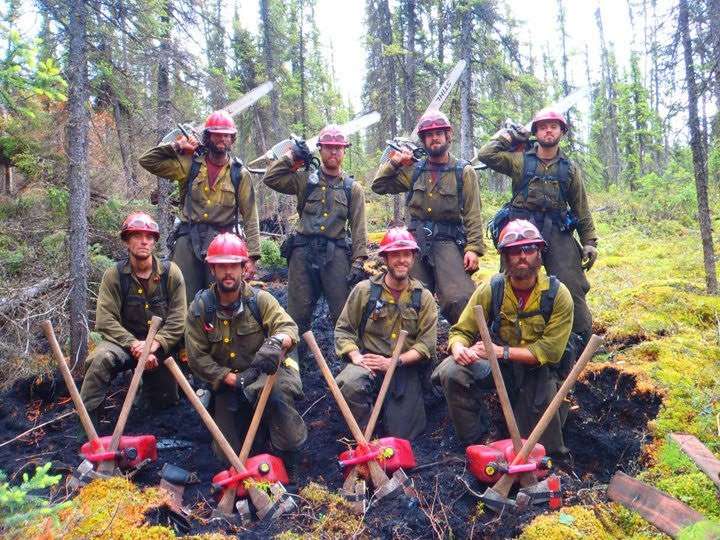
Ron Guy Jr, Tall Timbers, bottom right, with saw team Midnight Suns Interagency Hotshot Crew in 2011.
Every day was a grind. We worked long hours cutting line, hauling gear, and hiking through some of the most unforgiving terrain I’d ever seen. Alaska doesn’t care about your comfort—it’s a place that demands respect, where the fire is relentless, the mosquitoes are legendary, and the wilderness stretches farther than the eye can see. If the grueling pace wasn’t enough, we had weekly reviews out on the fireline. The leadership would call us together, go through each person’s performance, and then someone would be sent packing—flown out by helicopter from the middle of nowhere. It didn’t matter how remote we were or how hard they’d worked. If you didn’t meet hotshot standards, you were gone.
Those reviews kept us sharp. Every swing of the tool, every cut, every step—it all mattered. I pushed myself harder than I ever had, not just to stay, but to prove I belonged. By the end of that first wildfire season, I’d made it through. I wasn’t just surviving anymore; I was thriving. That fall, I earned my spot on the Midnight Suns, stepping into the ranks of some of the toughest firefighters in the nation.
That’s where I learned what it truly meant to be a hotshot, fighting fire in the most unforgiving conditions imaginable. Long hikes through tundra, carrying 50-pound packs across bogs that threatened to swallow you whole, and cutting line for hours under the midnight sun. Alaska wasn’t just a proving ground—it was a crucible, and it forged me into something stronger than I ever thought I could be.
I stayed on hand crews my entire career—ground pounder for life. After my time on the Midnight Suns, I shifted to a Wildland Fire Module, where we specialized in fire use and backcountry operations. It was a different pace, but the work still demanded grit and precision, lighting prescribed burns in remote areas or monitoring fires that were too rugged or dangerous for traditional suppression crews. From there, I moved to a prescribed fire crew, trading the chaos of wildfire for the controlled intensity of setting fires to restore landscapes. Every burn felt like a chess game against nature, balancing fire behavior, weather, and the land’s needs.
Eventually, I found myself on a Type 2 IA crew—back to the grind of initial attack, where you live and die by your speed, teamwork, and ability to adapt. Helicopter bucket drops or sawyers ahead of us, boots on the ground, digging line and holding fire in some of the toughest conditions imaginable. I loved it. Whether it was holding the torch, swinging a pulaski, or scouting the next line, I was exactly where I was meant to be—on the ground, in the thick of it, shoulder to shoulder with my crew. A frontline leader. A squad boss. That was the heartbeat of my career, and I wouldn’t have traded it for anything. For 15 years, I chased flames across the country, from the deserts of Arizona to the tundra of Alaska. The life on a handcrew is not for the faint of heart—long days, short nights, and the kind of bone-deep exhaustion that most people never experience. We slept under the stars more often than not, the ground our bed and the sky our blanket. But there’s something pure about that kind of life, something that strips away all the noise and leaves you with nothing but the essentials: grit, sweat, and a fierce love for the land you’re fighting to protect.
With a crew in California in 2015.
Eventually, I found my way to Tall Timbers Research Station in Florida, where I now serve as a training coordinator, sharing everything I’ve learned about fire with the next generation of practitioners. My focus has shifted from fighting fire to teaching about it—leading courses, mentoring future firefighters, and instructing practitioners on the art and science of prescribed burning.
Fire is a tool. When used with intention, it shapes ecosystems, restores balance, and breathes life into landscapes that depend on its renewal. It’s a delicate craft—a kind of alchemy that transforms destruction into growth—and it’s one I’ve come to respect deeply. Now, my role isn’t just to ignite the land but to ignite the minds of those who will carry this work forward, equipping them with the knowledge and skills to wield fire as a force for good.
Instructing in Alaska in 2019.
Finding balance
When I stand in front of a class of future fire practitioners, I tell them that there are so many ways into fire—it doesn’t have to be the federal route, and it doesn’t have to mean boots on the ground. If they do choose the federal path, I remind them that they don’t need to chase the hotshot dream if it’s not what drives them. Yes, hotshots see the most intense fire activity, and yes, they do things most people can’t even imagine, but that life isn’t for everyone. Hotshots are built different. Hand crew personnel are built different. Wildland firefighters, as a whole, are built different than structure firefighters. The key is to find what fuels your fire—whether it’s running saws on a crew, lighting drip torches, flying drones, or coordinating behind the scenes.
Students tell me it’s hard to find work-life balance, and I’m honest with them—it is. On a crew, fire becomes your life. You eat, sleep, and breathe it for months on end. That’s the reality of this work, and it’s not for everyone. If you want a life outside of fire, you need to pick a role that allows for balance. There are so many ways to fight fire while carving out a career that won’t burn you out. The future of fire doesn’t just need people who can dig line and carry heavy packs—it needs thinkers, planners, and leaders who can sustain the mission for decades.
Stepping away from being a primary firefighter wasn’t an easy decision, but it was the right one. My daughters mean more to me than chasing spot fires outside the line ever could. Fire season is relentless—long days, weeks away, missing birthdays and milestones. I didn’t want to miss any more. Being present for my family became my priority, and I knew I had to find a way to balance what I love with who I love.
Now, as a training coordinator, I can still contribute to the fire community that shaped me. I can pass on the knowledge and experience I’ve gained to those stepping into the field, helping them navigate their own journeys. I still feel the pulse of fire in my veins, but I’ve found a way to honor it while keeping my family at the center of my life. I’ve traded the frontlines for a role that lets me guide, teach, and support—and I wouldn’t have it any other way.It’s been a journey of grit, growth, and purpose, marked by moments of intensity, camaraderie, and transformation. Fire has taught me patience, resilience, and humility—qualities I now pass on to those stepping into this world for the first time.
As I look back, I see the threads that tie it all together: the lessons learned in the woods with my brothers, the early calls with the VFD, the relentless grind of hotshot life, and the quieter, deliberate craft of prescribed fire. Each step prepared me for this role, where my job isn’t just to teach but to inspire, to show students the many paths they can take and help them find the one that fits their fire.
The future of fire lies in their hands now, and I see the spark in their eyes. They are eager, determined, and ready to carry the weight of this responsibility. I tell them that fire is more than a job—it’s a calling, a lifelong commitment to something bigger than yourself. And while the work is hard and often unforgiving, it’s also deeply rewarding. If they can find their place in it, whether on the ground or in the air, behind the wheel or behind a desk, they’ll discover what I did: fire doesn’t just consume—it transforms.
This isn’t the end of my story—it’s just a new chapter. And as I step back to guide others, I know that the flame will burn brighter and stronger in their hands, carrying forward the work that began long before me and will continue long after I’m gone.
Urban fires have plagued Japan for generations, the most notorious of which killed nearly 45,000 people.
A strong earthquake and tsunami claimed thousands of lives around Tokyo and Yokohama in 1923, but then came the fire. The region’s wooden homes, cookstoves, and ruptured gas lines ignited fires that extreme winds worsened, soon setting the entire city ablaze. Most people were immolated by a 300-foot-tall funnel of fire known as a “dragon twist,” according to Smithsonian Magazine.
Japan’s tragedies drove the nation to become a leader in urban fire and combustion research, an expertise it still fosters today. It’s now sharing that knowledge with researchers from South Africa and Botswana.
The “dragon twist” representation above may be one of the oldest artistic representations of the firebrand showers. The phenomenon happens when large amounts of embers from a fire get blown airborne, igniting possible fires elsewhere.
The 1923 tragedy and others like it pushed Japan to study the phenomenon, leading to the nation building the world’s first large-scale wind tunnel for fire testing, nicknamed the “Dragon”. The research replicates building and vegetation ignitions during firebrand showers, according to Samuel Manzello, a combustion researcher at Tohoku University’s Institute of Fluid Science.
“Our firebrand research using the Dragon had become very well-known across the world,” Manzello told Wildfire Today. “In Japan, you could conduct experiments on actual, real-scale building components. In the USA, there were no such facilities to do this type of research.”
Tohoku University‘s firebrand research would go on to catch the attention of researchers in Southern Africa, who have dealt with numerous firebrand shower disasters. The joint interest led to the Japan Science and Technology Agency launching the AfriWUIFire project in 2023 to bring together experts from both regions to help mitigate firebrands’ global threat.
The joint research would also help establish international testing methods and common testing methodology, Manzello said. The vast difference in vegetation types in both regions benefit researchers in determining the propensity of each vegetation type to produce firebrands, which can then be used in numerous countries.
“Through years of research in Japan, we have developed experimental methodologies to better understand and quantify the dangers of firebrands, so exchange of information is important,” Manzello said. “At the same time, there is a need to develop globally accepted international standard test methods for firebrand quantification from vegetative and structural fuel combustion. The project affords the ability to independently compare test methods across multiple countries for disparate vegetation types, to develop such international test methods.”
AfriWUIFire researchers from Japan, including Manzello, traveled to South Africa in April to evaluate local fire hazards and then attended an Africa-Japan Collaborative Research workshop in Botswana. Soon, AfriWUIFire researchers from Africa will visit Japan, in part to conduct full-scale vegetation combustion experiments and quantify firebrands using the Dragon.
The Pedrógão Grande mega fire of June 2017 shaped a region by tragedy, causing profound human consequences that have left people battling their own memories, questioning their safety and working through trauma.
Lily Mayers writes on how the lives of those touched by Portugal’s worst mega fire have changed since the smoke cleared.
The fire storm’s intensity melted skin off hands and feet, liquified glass windows and reduced standing signs to puddles of metal. The ferocious wind whipped heat up from the burning forests, thrusting flames forward before crashing them down on the small towns dotted across Portugal’s central region, suffocating the area in thick black smoke.
On the afternoon of Saturday, June 17, 2017, a complex of at least five wildfires ignited, spread and merged across 11 small towns surrounding the municipality of Pedrógão Grande in Central Portugal creating an unstoppable and catastrophic fire event. Sixty-four people died and 250 were injured. Over five days more than 46,000 hectares of land were destroyed. The fire struck territory carpeted by highly flammable, abandoned pine and eucalyptus plantations at a time of prolonged drought and enduring heat waves. The major triggers were found to be contact between vegetation and a 25 kV electrical line as well as lightning strikes.
Aerial view of a forest area between the villages of Pobrais and Nodeirinho, in the municipality of Pedrógão Grande, in the central region of Portugal.
Volunteer firefighter Rui Rosinha, 46, was called in as reinforcement. He was driving to one of the emerging spot fires when his team’s truck collided with a car on the N-236 highway near Pobrais, southeast of Coimbra. The crash stranded them on the side of the road and trapped the three unconscious passengers of the car. As the firefighters struggled unsuccessfully to free the passengers from the wreckage, the wind, radiation and heat from the approaching fire became unbearable. They were forced to save themselves and leave the passengers behind. Huddled together on a small island junction of raised concrete in the middle of the highway, Rui and his four colleagues then endured an hour of exposure to flames, heat, cyclonic winds and the thrashing of airborne debris.
“We experienced temperatures that seemed impossible,” Rui said “The radiation came in waves. I felt it as if it were extreme waves of heat, I remember not just once, but many times the impact and pain, as it hit my body.”
Though severely burned, the group was able to successfully shelter three adults and a child on the same junction. When help finally arrived Rui and the others were driven to medical centers before being airlifted to hospital and that’s the last thing he remembers.
“If ever there was a hell on earth, for me it was there.”
The fire moved at unbelievable ferocity, with more than 4400 hectares burned in a single hour, violently accelerated by intense wind gusts, emitting enough energy to propel itself and exceed the capacity to be extinguished within four hours of igniting. The severe speed of the fire, which by nightfall was advancing at 15 kilometers an hour, outpaced evacuation orders and knocked out communication networks, trapping hundreds and killing dozens in their cars as they fled on the N-236 highway.
It was the worst mega fire in Portugal’s history. As a result of the disaster, family members of those who died and others who were seriously injured were compensated from a 2.5-million-euro support fund. A complete reform of land management legislation was also prompted including the introduction of a new 10-meter clearing rule between roads and vegetation, the banning of new eucalyptus plantings and a shift away from purely reactive firefighting to prevention investment. The reach of the Pedrógão Grande mega fire has left physical, psychological and generational scars, altering the social fabric of the small communities forever.
How have the lives of those touched by Portugal’s worst mega fire changed since the smoke cleared?
RUI
Almost three months after the fire, Rui awoke from a coma to a new reality. He had suffered debilitating burns to his hands, back and feet, respiratory problems as well as partial paralysis to his left side due to injuries in a nerve plexus making him wheelchair dependent.
“Those first nights, when I began to realize what had happened and when I began to understand my body and what was happening to me, those first nights were horrible.” He pleaded for psychological help as he grappled with suicidal thoughts, “I saw that I didn’t have the capacity to deal with it [alone].”
Thrust into this new reality beside him was his family.
Rui’s distraught but resilient wife, Marina, 45, had anguished through the months he was in a coma with daily drives to the hospital two hours away and when he woke she became his full-time caregiver. His two young sons, Antonio and Francisco, 12 and nine at the time, were confronted by a jarring role reversal in prematurely being the able men and joint caregivers of the house. Among these harrowing realizations for Rui was that his close childhood friend and colleague with him in the fire, Gonçalo Conceição, hadn’t survived. Rui says the guilt of surviving when his friend didn’t and not being able to save the passengers of the car, are two of the most complex psychological hurdles he is working on overcoming.
“I’m managing to approach and exorcize some ghosts and it is an almost permanent mourning to face traumas and talk about certain subjects that were taboo for me or at least I couldn’t face it.” Over the years, Rui has been able to reconcile and overcome parts of the trauma in a process that he says will never end, just forever evolve.
“These are the steps I am taking, that I am achieving to feel more at peace with myself and be at peace with others too.”
Rui comes from a family of firefighters. With reduced mobility however he has been transferred away from active duties after 28 years of service and now the Castanheira de Pêra fire brigade, once a second home to his family, is a place he feels uncomfortable and alien within. Despite everything his family has been through, both his sons dream of pursuing the family tradition. For now, it’s a dream Rui and his wife are conflicted in supporting.
ANA
Some see daily reminders of the fire written on their bodies, while others face stubborn mental barriers in evolving past June 17. Ana Luisa Bernardo, 51, lost both her mother and father, Maria, 71, and Manuel, 80 in the fire. Their car crashed on the shoulder of a road as they fled the town of Sarzedas de São Pedro.
“The descriptions from people were that the sky suddenly turned dark and they couldn’t see anything. So, I believe he didn’t realize that the turn was right there on a steep slope,” said Ana. Having worked as a diagnostic and therapeutic technician in hospitals for 25 years, she says not being able to save her parents brings immense pain, “Every day I still think about the subject. I can’t dissociate.”
For two years Ana was so paralyzed by the pain of losing her parents she was unable to enter their family home. She would visit it every weekend and clean the lower patio but not cross the threshold. Even now, Ana is still gradually sorting her parent’s belongings, a journey her daughter Sátia, 16, is helping her through. “What I’m trying to do is triage only what brings back good memories, what’s bad is not worth keeping. It’s very delicate.”
From what was already a network of small towns where most people are known to one another, now exists a new subcommunity forged by their shared grief and loss after the fire. This web of survivors refer to each other as a family who speak the same language of experience. “We share the same pain, some in one way, others in another,” Ana said of one of the tragic event’s rare silver linings.
But from the community the fire created, it also took away. Many of the towns affected haven’t been able to return to the bustling places they once were. Ana says in Sarzedas de São Pedro, the change is palpable.
DEOLINDA AND ANTONIO
Deolinda Henriques Simões and Antonio Dias Gonçalves work on their property in Nodeirnho. The manual labor involves pulling weeds, clearing gutters and cutting back the forest’s understory, to reduce the chances of another fire. Photo: Paulo Nunes dos Santos for Sonda Internacional.
Retired couple Deolinda Henriques Simões, 55, and Antonio Dias Gonçalves, 80, spend their weekends in the tiny town of Nodeirnho. The day before the fire struck, the renovations of their weekend home were finished. They escaped just in time but “in the blink of an eye” their new home was destroyed before they could enjoy it.
Once it was safe to return to the smoldering town, they drove back and found the remains of their home and all their life savings destroyed beyond repair. “All the windows and doors were wooden in the old-fashioned way. I remember getting there, I only saw the walls and that’s what happened. So much so that the beams that I had placed in aluminum were all crammed together like snails,” said Deolinda.
It is estimated more than 1,000 buildings were damaged or destroyed in the fire resulting in damages of up to 200 million euros. The Portuguese government committed to providing 30 million euros for the reconstruction of first homes. But for Deolinda and Antonio their old home had been registered as dilapidated by the previous owner, unbeknown to them, so it wasn’t eligible for insurance cover or government aid. The couple were left with nothing and had to wait three years before investing again. They have now bought around the corner from their old destroyed home but their new view frames their past struggles.
“Unfortunately, we can see the skeleton of the old house, which is just the torn walls, there’s nothing left.” Antonio says their new home has the best insurance they could get.
The couple, now acutely aware of what fuels a mega fire, use their weekends to clear the land around their new home. The manual labor involves pulling weeds, clearing gutters and cutting back the forest’s understory. It’s back-breaking work for the couple who are noticing the difficulty their age brings to the task but are limited by the cost of outsourcing it.
CÉU
Their town of Nodeirnho was once described as a lively place filled with young families and weekenders. But when the June 17 fire came through it killed 11 of the town’s 50 residents. Those who remain still live among burned houses, hauntingly permanent reminders of the night their neighbors died.
Maria do Céu Silva, 52, is one of them. Céu (as she’s known) survived the fire by sheltering in the water tank beside her home with a dozen others. She is lucky to have lived, but it was at a cost. She and the others with her had to endure the sounds of their neighbors dying within earshot. “We heard screams and cars crashing, and then we realized there were a lot of people in the village who were already dead. We never thought there would be so many. It was horrible but we couldn’t do anything. We didn’t have the means to help.”
The fire and the evidence of its destruction across the town mean residents like Céu are trapped in a time capsule, unable to move forward. “I used to actually be a very fun person, and I think that since that happened, I’m not. Because we leave the house, I speak for myself and go to my work and pass by several places where victims died. It marks us every day no matter how much we go through and forget, we remember every day.”
Among the town’s victims were two children aged three and four, and several people in their 30s. Céu says much like in Sarzedas de São Pedro, they had filled the town with activity and dynamism. Now the chemistry of the tiny village has changed dramatically. Deathly quiet and still ash-stained, it feels ghostly with virtually no passing foot or car traffic. Céu says many of the remaining population are elderly and mostly stay inside their homes. In summer, when the wind picks up Céu fears fire will return to the town.
GONÇALO
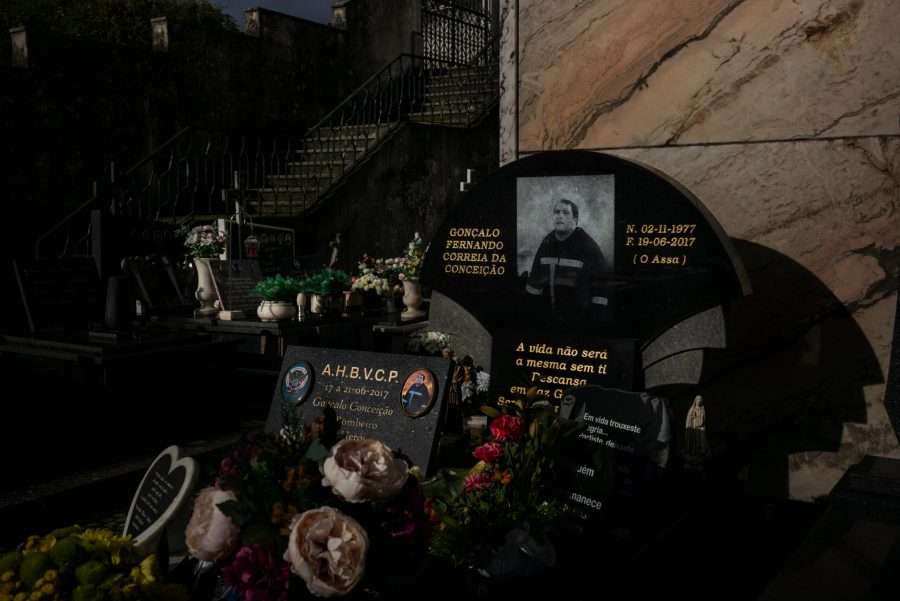
Monuments dedicated to the victims of the Pedrógão Grande fire are scattered across the region. Written on all of them is the name of the only firefighter who died, Gonçalo Fernando Correia Conceição. The charismatic and well-loved firefighter was known as “Assa” or “Dr. Assa” (from the Portuguese assar, meaning to grill) due to his renowned barbequing skills and restaurant of the same name.
The 39-year-old is missed by many within the community he was so involved in, but none feel the loss more than his family. Years on from the fire, his parents strain to speak through the grief. They, and Assa’s 17-year-old son David, live with the consequences of his selfless decision to routinely run into danger to help others, “It’s the life he chose, that’s it. It was his way to help others.” said his father, Joaquim Domingos da Conceição, 69.
Maria da Conceição, 63, grips a portrait of her son, Gonçalo Fernando Correia da Conceição, the only firefighter to die during Portugal’s Pedrógão Grande mega fire of 2017. Gonçalo was severely injured after he and his team became trapped in the flames during the extinction operation. Six years after the fire, Maria remains grief stricken by the loss of her son who was well-loved by the Castanheira de Pêra community. Photo: Paulo Nunes dos Santos for Sonda Internacional.
The 39-year-old is missed by many within the community he was so involved in, but none feel the loss more than his family. Years on from the fire, his parents strain to speak through the grief. They, and Assa’s 17-year-old son David, live with the consequences of his selfless decision to routinely run into danger to help others, “It’s the life he chose, that’s it. It was his way to help others.” said his father, Joaquim Domingos da Conceição, 69.
Hotelier Joaquim and his wife, Maria da Conceição, 63, have kept their son’s house in pristine condition in the hopes their grandson, who had to move away after Assa’s death, will someday return to the town and take over his father’s restaurant. Like many families, they experienced a double desolation when the death of a loved one prompted other family members to move away.
Inside Joaquim and Maria’s lakeside hotel in Castanheira de Pêra a huge quote has been painted on the wall of the dining hall, it reads, ‘May my presence never be forgotten in my absence! Thank you friends. – Dr. Assa.’ His parents say they have no fear their son will ever be forgotten.
THE PEDROGAO GRANDE MEGA FIRE
The Pedrógão Grande mega fire shaped a region by tragedy, causing profound human consequences that have left scores of people battling their own memories, questioning their safety and working through trauma. For those, the fire is unfathomable to forget. But in the wider community others are eager to leave it in the past and focus on the future.
While these communities oscillate between the two outlooks, the vegetation surrounding them has been quietly regrowing. Now the build-up has reached levels higher than before the fire and many fear history could repeat when the region almost inevitably faces future weather extremes.
Government forestry workers are attentively cutting back trees close to roads and houses while homeowners like Deolinda and Antonio race tirelessly against the growth of the pines closing in around them. Looking at the dense forests threaded throughout his town Joaquim Conceição says the work doesn’t go far enough, “Another similar tragedy could happen tomorrow,” he said. Meanwhile, the graves of Ana Bernardo’s parents lay claustrophobically encircled by the same thick vegetation that accelerated the fire that caused their deaths.
Lily Mayers is a freelance journalist from Sydney, Australia, based in Madrid, Spain. Mayers’ career began in television and radio news for Australia’s national broadcaster, the ABC. Since moving to Spain in 2020, Mayers’ work has focused on the long-form coverage of world news and current affairs.
This report was developed with the support of Journalism fund Europe.
Two U.S. senators are pushing to consolidate the nation’s wildland firefighting force into a single agency.
Republican Senator Tim Sheehy of Montana and Democratic Senator Alex Padilla of California recently introduced a Senate bill that would create the “National Wildland Fire Service.” The bill directs the Secretary of Agriculture and the Secretary of the Interior to reorganize federal wildland fire response nationwide, create a Director of the National Wildland Firefighting Service position, and develop a description for the new agency.
“The Secretary of Agriculture and the Secretary of the Interior (referred to in this Act as the ‘Secretaries’) shall jointly develop a plan to consolidate the authorities of the Secretaries relating to Federal wildland fire preparedness, suppression, and recovery efforts under an agency of the Department of the Interior, to be known as the ‘National Wildland Firefighting Service’,” the bill’s text reads.
Sheehy and Padilla also recently introduced legislation to create a “National Wildfire Intelligence Center” modeled after the National Weather Service to coordinate fire response across federal and state institutions. The Senators called the current system “unnecessarily burdensome,” and said this bill would close gaps in federal response, as multiple agencies currently have their own fire management goals, firefighters, and jurisdictions.
“There is established in the Department of Agriculture, the Department of Commerce, and the Department of the Interior a joint office, to be known as the ‘Wildfire Intelligence Center’…serving as the development and operational center for the comprehensive assessment and prediction of fires that occur in the wildland and fires that move into the built environment to provide decision support services to inform land and fuels management, community outreach and risk reduction, post-wildfire recovery and rehabilitation, and fire management,” the bill’s text read.
Sheehy, before becoming a senator, founded Bridger Aerospace, which operates the largest private Super Scooper fleet in the US, according to its website. He said the acts would streamline resources for wildland fire events.
“We can all agree that the federal government must do a better job protecting our people, property, public lands, and communities from wildfires, and this bill will go a long way in streamlining our wildland firefighting efforts and best leveraging all available resources to accomplish our shared mission,” Sheehy said. “As the only aerial firefighter in the Senate, I’m proud to be working with folks on both sides of the aisle to deliver commonsense solutions to more effectively fight the devastating threat of wildfires and protect the American people.”
“This new agency would consolidate all wildland fire management responsibilities from the five separate federal land management agencies (US Forest Service, Bureau of Land Management, National Park Service, US Fish and Wildlife Service, and Bureau of Indian Affairs) into a single, cohesive agency,” the advocacy group said. “The new agency should be a comprehensive wildland fire management agency directly under the Department of Homeland Security (DHS) and should be run by experienced wildland fire practitioners and managers. We are optimistic about the discussion this new legislation will generate, but there are few specifics on how it will be implemented.”
The group said the agency’s creation would streamline response to wildfire events, prioritize the safety of wildland firefighters, and efficiently provide cost-savings to American taxpayers.
The “National Wildland Fire Service” bill was referred to the Senate Committee on Agriculture, Nutrition, and Forestry on Feb. 6. The “Wildfire Intelligence Center” bill was referred to the Committee on Agriculture, Nutrition, and Forestry also on Feb. 6.
The author, Rick McRae, argues that the impacts of climate change must be better included in wildfire management strategies. McRae is an adjunct professor with the Bushfire Research Group at UNSW Canberra.
After a career as an ecologist, senior emergency manager, and bushfire scientist I have a particular view of where climate change is taking us; it is fundamentally based on Australian conditions, but I have an international perspective that is both operational and scientific. A lot of people say a lot about this problem, but too many are saying different things. Who does one listen to, especially if you enjoy your comfort zone? You may disagree with my views, but rather than dismiss them, start a conversation with your colleagues and think about how what I am saying might affect both them and your collective goals. My career and my research has all been aimed at reducing wildfire risks. Here I simplify some topics, and omit a lot of necessary technical detail, but I completely support the outline that I present.
The global collective of fire management wisdom is clearly focused on a fuel-oriented path forward in the face of climate change. The Landscape Fire Governance Framework that arose from the 8th International Wildland Fire Conference in Oporto in May 2023 is the latest element of a global framework. The framework states that fires are getting worse due to a combination of too much wildfire suppression, a lack of investment in fire management, and changes to how communities handle fire on the landscape. A common theme in discussions is the need for more fuel management, either through more fuel reduction burning or a switch to Indigenous practices.
To this end, planning typically includes a focus on risk reduction through hazard reduction via fuel management. Training, equipment, and systems are focused on this system, matched by budget allocations. Satellites show that certain countries produce a lot of smoke from this risk-reduction effort. For normal wildfires, fire services and their communities do a very good job mitigating the risk. (Can this ever be enough?) Climate change is increasing fire danger as the world warms up, and fire services and land managers are correctly adapting to the heightened risks.
At the same time, the world is being severely affected by what are called extreme wildfires, which dangerously couple with the atmosphere above.
It is critical to correctly use the terms normal and extreme: normal fires spread by quasi steady state fire behaviour – if you know the fuel and the terrain, then you largely know what the fire will do; extreme wildfires have one or more blow-up fire events (BUFEs), where the fire couples with the atmosphere and exhibits dynamic fire behaviour, which often involves feedback loops and so the details are largely unpredictable. Figure 1 shows their relationship.
For BUFEs, there is no explicit role for fuel load (beyond the need for a prior fire), indicating that fuel management – central to the framework – is unlikely to be an effective preventative action. We do, however, need to explore how fuel management can be targeted to prevent future dynamic fire escalation. Extreme wildfires do not occur in flashy fuels such as most grasslands: they are mainly a problem in forests and woodlands and they have, in recent years, occurred in new ecosystems (discussed below). (See figure 2.)
When an extreme wildfire couples with the atmosphere after being triggered by dynamic fire behaviour, a BUFE occurs, lasting up to three hours, and typically burning 50 to 100 square kilometres (20 to 40 square miles). With little opportunity for fire suppression the only real incident objective is to save lives. Saving structures may put fire crews at risk for little return. This minority of fires cause the majority of damage.
Figure 1. The relationship between the fire drivers for normal wildfires with quasi-steady state behaviour and the fire drivers for extreme wildfires with dynamic behaviour. The left is quasi-deterministic while the right involves unpredictable feedback loops.
The incident action plan for affected sectors and divisions during a BUFE looks very different to that for a normal fire. Locally appropriate strategies and tactics need to be formulated to help save lives.
There is an archive of decades of high-quality satellite data that is informing many aspects of the challenges associated with extreme fires; it will become increasingly important that we get the full leverage off the datasets involved. The complexity of the changes already underway can be overwhelming. It will be important for end users to make clear what their needs are, and for them to accept the answers produced.
While many authors have used forward-looking climate models to anticipate how climate change will impact fire risks, observations are now showing a far more alarming picture overall.
Fire thunderstorms, called pyroCbs, are the most obvious manifestation of extreme wildfires. A recent study found that there has been no recent global trend in the frequency of pyroCbs. Global pyroCb activity has always been dominated by fires in and around Boreal forests. However, areas such as Australia, South Africa, South America, and the Mediterranean have only recently started having problems with extreme wildfire. Canada, in 2023, experienced the most protracted ever season for extreme wildfires, globally. Australia’s Black Summer was just as prominent with record breaking intensities.
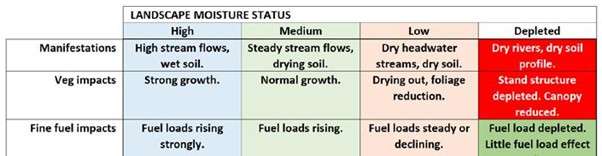
Figure 2. The drivers of fire risk. The “depleted” column is where dynamic fires usually occur.
An important step must follow on from recognition of the wildfire-type dichotomy: operational doctrine must be revisited. As an example, in Australia, the national doctrine for operations in the urban interface lacks any dynamic fire behaviour elements. This document is founded on decades or experience during fire fighting and is state of the art – for normal fires only. What is different? When a BUFE arrives at the urban interface, it is characterised by: (1) a lack of a headfire, with a switch to dense spotting, and a high chance of loss of overall situational awareness; (2) an ember storm (a sea of flowing pea-sized embers flowing over the ground), which is very different to typical ember attack (which is more like a mortar attack); (3) strong turbulence; (4) a darkened sky; and (5) much deeper penetration of the urban edge. Air ops are likely to be impeded.
Also, standard doctrine is often founded on past damaging fires, but key lessons from previous events may need revisiting if, as is often the case, those fires were driven by processes subsequently discovered, such as the key elements of dynamic fire behaviour.
Several past landmark fires have featured descriptions of the fire spreading sideways on the lee face of a ridge. We have seen this in news footage, with chief officers waving their hands sideways during media briefings, or even in official post incident reports. After being identified in 2003 in the Canberra fires, a scientifically validated concept called Vorticity-driven Lateral Spread (VLS) is now known to be the cause. VLS is by far the main cause of forest fire damage in rugged landscapes, globally. Fire service operations based on key lessons learned need to adapt to this. A lookout at a fire where VLS might occur has to be trained to look to the rear at certain landform elements, as opposed to the prior practice of focusing on the headfire. To avoid VLS-driven BUFEs, it may sometimes be an option to burn-out VLS prone areas ahead of the main fire when fuels are too damp to support spotting. Another key instance of the need to rethink is that dynamic fire behaviour is often associated with large air tanker accidents. Climate change is leading to large aircraft flying out of aviation weather into fire weather while climate change is turbo-charging weather close to the ground.
It used to be that different countries had different types of fire, and therefore different operational approaches. Climate change is reducing these differences. I identified a fire near Canberra in 2004 as being foehn-wind driven. Some time after that my collaborators and I wrote a paper on this, introducing Australian firefighters to an idea that has long been a mainstay of training in North America and the Mediterranean Basin. Over the following decade we found only a few good cases of local foehn-wind driven fires. Then during Black Summer, with hundreds of BUFEs, perhaps 50 per cent of those were of this type. That is a massive escalation.
These changes clearly suggest that the world needs a multi-pronged adaptation strategy to climate change’s impacts on wildfire risk. The strategy for normal fire is well understood and must be implemented and continually improved upon. The strategy works better than is acknowledged, because the metrics for success were developed using data from both types of fire. The inclusion of dynamic events with bad outcomes biases the outlook.
In passing, a serious issue arising from lumping all fires together is the mis-training of artificial intelligence and machine learning systems being developed to help mitigate bushfire risks. Just because a fire was attributed as something in a database 25 years ago does not mean that that is correct in today’s thinking. Climate change will not be forgiving to field crews using poor intelligence.
A new strategy is required for rapid adaptation to extreme wildfires. The ongoing escalation suggests a need for the multi-pronged approach to be created as quickly as possible. I have developed a framework for predicting dynamic fire events in the forests of south-east Australia, which aims to show the potential for new thinking (Figure 3). The framework seeks to predict BUFE events using hydrology, remote sensing, and fire ground data in a multi-scaled way.
For the adaptation strategy to work it is necessary to define the following: ownership (by a global body); working membership; protocols; data and accounting needs; professional development protocols; and dissemination channels.
The mandate for climate change adaptation for wildfires might include:
Focussing on extreme wildfires (to complement on-going collaboration on normal wildfires);
Defining, owning, and disseminating research goals;
Providing a hub for research outcomes;
Providing a forum for international exchange of relevant operational lessons;
Maintaining a global overview of wildfire problems and tracking the overview’s evolution;
Rapidly disseminating new information or certified lessons from major fire events.
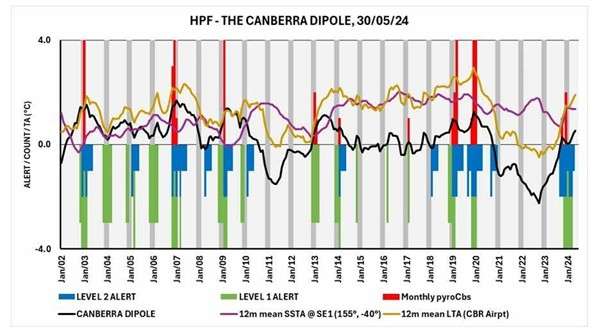
Figure 3. Two decades of predictive analysis on the potential for pyroCbs in the forests of southeast Australia. PyroCbs (red bars) occur when alerts are generated by the system, either due to temperature anomolies (green bars) or landscape hydrology (blue bars). The orange line clearly shows the impacts of climate change on air temperatures in Canberra, while the purple line shows a more worrying trend for offshore sea-surface temperatures. The difference between the two sets of 12-month average anomalies – the Canberra Dipole (black line) – is critical for BUFE potential. At the peak of Black Summer, Canberra had an extraordinary 12-month average temperature anomaly of 3C. Similar frameworks could work elsewhere.
Students of the evolution of wildfire can look at the references cited in many new wildfire papers and see – from the references alone – where the paper was written and what technical specialty it is from (for both the authors and the journal). However, this Fire Tower of Babel situation is not good enough. In a similar vein, if we are to collaborate on these problems, we must standardise the terminology. The use of alternative terms, and the widespread misuse of others does nothing to aid adaptation –foundation terms such as pyroCb or megafire are key examples – and surely reinforces the previously mentioned issue with the training of machine learning systems.
The wildland fire sector needs to stop being overly distracted by fuel loads, otherwise we will all be affected by extreme wildfires and their impacts on ecosystems, communities, soils, hydrology, biodiversity, traditional practices, and the upper atmosphere – including the ozone layer.
Rick McRae served as a headquarters technical specialist in what evolved to become the ACT Emergency Services Agency in Canberra from 1989 until his recent retirement. He worked in business planning, arson investigation, multi-hazard risk assessment, as planning officer for major incidents, weather specialist, and as a research scientist focusing on extreme wildfires, and especially pyroCbs. McRae has conducted case studies, described new phenomena, and developed predictive tools. He maintains a website that aims to present operationally useful material on extreme wildfires: https://www.highfirerisk.com.au/.
McRae is an adjunct professor with the Bushfire Research Group at University of New South Wales Canberra.
Los Angeles’ historic Palisades and Eaton fires are fully contained after nearly a month of burning, according to CalFire officials. The cause of the fires is still under investigation.
“The conditions, that night, were unbearable,” Los Angeles County Fire Chief Anthony Marrone said during an interview with 60 Minutes. “It was a devil wind that came out, you know, that extreme Santa Ana wind condition.”
In the wake of the devastation Governor Gavin Newsome signed a $2.5 billion aid package to help the city rebuild, while numerous fundraisers opened with a range of objectives. The massive FireAid concert and the fundraiser linked to the Grammy Awards are hoping to raise over $100 million and $24 million respectively, according to the Associated Press and Variety.
Palisades Fire via Cal Fire
Numerous other relief efforts are underway, including:
More than 13,000 residential and 250 commercial structures in the Los Angeles area were affected by the Palisades Fire and Eaton Fire, according to the Environmental Protection Agency (EPA). Officials are now kicking off the largest cleanup of hazardous material from a wildfire in agency history.
The agency announced on Monday that it has deployed 1,050 response personnel into the area, up from the 478 personnel in the field last week. The EPA also announced it has begun assembling 60 teams to clear hazardous materials from the remaining properties, all at no cost to residents.
“We’re not going to wait days or weeks or months to ramp up,” EPA Administrator Lee Zeldin said in a press release. “We have over a thousand personnel on the ground to aid Californians, and our local, state, and federal partners, in Los Angeles’s recovery. The Trump administration is tackling this head-on in a way that EPA couldn’t possibly be prouder to be a part of.”
EPA said its first priority is removing lithium-ion batteries in the area affected by the wildfire and properly disposing of them. Many homes in the burned areas had energy storage systems and/or electric hybrid vehicles, and the agency has reportedly removed 80 of them burned or destroyed in the fire.
“Residents returning home are encouraged to exercise extreme caution and can call our hotline at 1-833-798-7372 if they encounter a lithium-ion battery while re-entering their property and/or are unsure if a lithium-ion battery was damaged,” the EPA said.
The agency, in the cleanup’s second phase, will remove debris in the fires’ burn footprints so the material isn’t released into the environment. Phase 2 will primarily be conducted by FEMA and the U.S. Army Corps of Engineers. The material that will be removed includes:
Paints
Cleaning supplies
Automotive oils
Garden products such as herbicides and pesticides
Batteries
Propane tanks and other pressurized gas containers