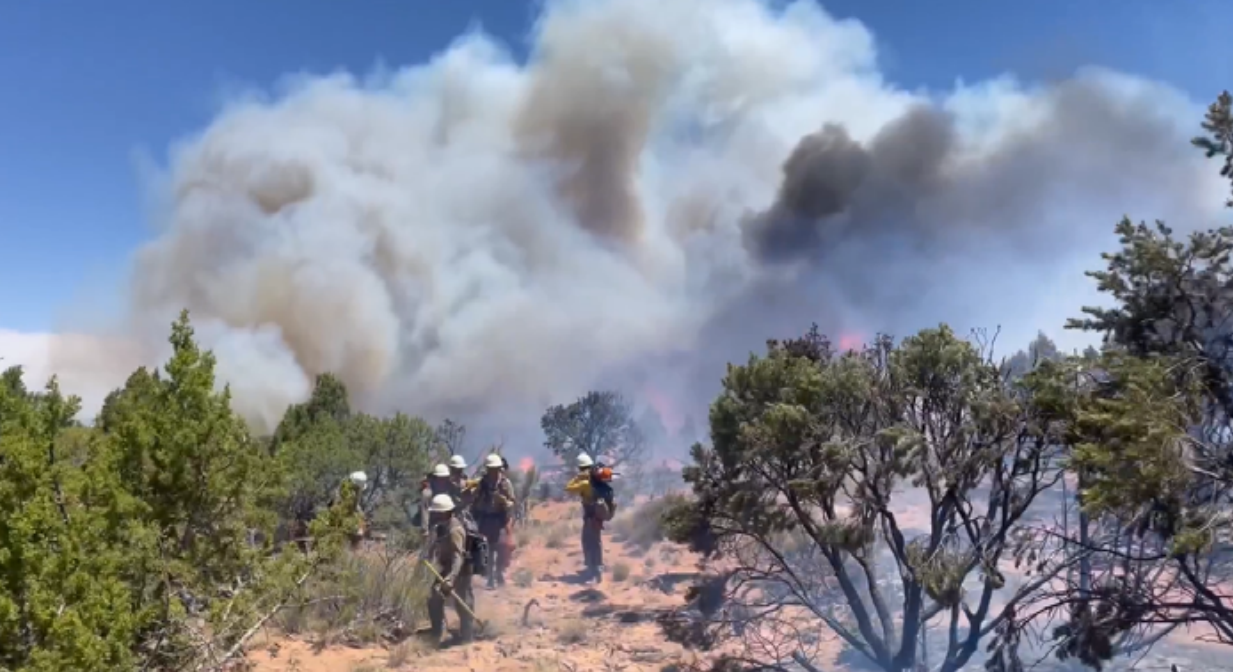
Yesterday we provided live coverage of the National Transportation Safety Board’s all-day meeting about the 2008 crash of the Sikorsky S-61N helicopter on the Iron Complex fire near Weaverville, California in which nine firefighters died. The pilot-in-command, a U.S. Forest Service check pilot, and seven firefighters were fatally injured; the copilot and three firefighters were seriously injured. The helicopter was operated by Carson Helicopters, Inc. of Grants Pass, Oregon.
According to the NTSB, there was “intentional wrong-doing” by Carson Helicopters that under-stated the weight of the helicopter and over-stated the performance of the helicopter in the documents they provided to the USFS when bidding on their firefighting contract. The NTSB estimated that the actual empty weight of the helicopter was 13,845 pounds, while Carson Helicopters stated in their contract proposal that the weight was 12,013 pounds. For the purpose of load calculations on the day of the crash, the pilot assumed the weight to be 12,408 pounds, which was 1,437 pounds less than the actual weight estimated by the NTSB. According to the NTSB, for the mission of flying the firefighters off the helispot, the helicopter was already over the allowable weight even without the firefighters on board.
In addition, here is an excerpt from the NTSB report:
The altered takeoff (5-minute) power available chart that was provided by Carson Helicopters eliminated a safety margin of 1,200 pounds of emergency reserve power that had been provided for in the load calculations.
The pilot-in-command followed a Carson Helicopters procedure, which was not approved by the helicopter’s manufacturer or the U.S. Forest Service, and used above-minimum specification torque in the load calculations, which exacerbated the error already introduced by the incorrect empty weight and the altered takeoff power available chart, resulting in a further reduction of 800 pounds to the safety margin intended to be included in the load calculations.
The incorrect information—the empty weight and the power available chart—provided by Carson Helicopters and the company procedure of using above-minimum specification torque misled the pilots to believe that the helicopter had the performance capability to hover out of ground effect with the manifested payload when, in fact, it did not.
The NTSB has notified the Department of Transportation’s Inspector General that Carson’s actions may merit a criminal investigation.
The NTSB and the FAA seem to have a rocky relationship. Some of the recommendations that the NTSB makes to the FAA following accident investigations are ignored, which frustrates the NTSB. This was evident a couple of times in the meeting yesterday. The AP reports on an example of this tension that affected the NTSB’s ability to investigate the Iron 44 fire fatal accident:
Two months after the accident, the FAA office in charge of overseeing Carson received letters from two pilots with knowledge of Carson’s operations who expressed concern that the company was miscalculating helicopter weights, investigators said.
Investigators said that if FAA had provided NTSB with that information at the time, it would have helped them figure out sooner that the weight calculations were faulty. FAA was a party to the accident investigation and its inspectors were aware of the investigation, they said.
However, FAA dismissed the allegations and didn’t provide the letters to NTSB until about a year later after the investigators made a general request for documents related to the agency’s oversight of Carson after the crash, investigators said.
Carson surrenders FAA certificate, but may still be operating in Afghanistan
It was reported by the FAA after the NTSB meeting on Tuesday that Carson Helicopters has surrendered their FAA Certificate, which is equivalent to an operating license. However, they may still be flying for the military as a subcontractor. The Mail Tribune in Medford, Oregon reported in January, 2009 that Carson Helicopters signed a contract with a subsidiary of Blackwater Worldwide (which recently changed their name to “Xe”) to use seven of their Sikorsky S-61 helicopters in Afghanistan. The contract, worth $605 million through 2013, is for the helicopters to transport supplies; they will not be involved in combat.
Fuel Control Unit missing
Conspiracy theory enthusiasts will enjoy speculating about the fuel control unit that went missing after it was gathered as evidence. The NTSB says the part played no role in the accident and that both engines were operating at full power during the accident. However, Carson is saying the crash was caused when one engine experienced a loss of power caused by the part that later disappeared. If Carson can successfully deflect blame to the company that manufactured the part, or at least establish some doubt about the accident’s cause, it may reduce their financial liability.
Who regulates wildfire aviation?
The answer is: nobody. The FAA claims they have no authority to regulate the aviation activities of other federal agencies or state and local governments. This authority has to be granted by Congress, which has shown no interest in becoming involved in the aviation safety of firefighters. And the federal agencies, or at least the U.S. Forest Service as proven in this accident, generally do not have the aviation expertise to inspect and regulate their own agency-owned or contracted aircraft. Good luck in trying to not think about this the next time you’re climbing into a helicopter at a fire. (Let’s see – got hard hat, gloves, line gear, tool, life insurance.)
NTSB report
We have a copy of the NTSB’s Conclusions, Probable Causes, and Recommendations, released yesterday, on our Documents page. Some of the highlights are below.
Probable Cause
1. Carson’s intentional understatement of the helicopter’s empty weight;
2. The alteration by Carson of the power available chart to exaggerate the helicopter’s lift capability;
3. Carson’s practice of using unapproved above-minimum specification torque in performance calculations that, collectively, resulted in the pilots’ relying on performance calculations that significantly overestimated the helicopter’s load-carrying capacity and did not provide an adequate performance margin for a successful takeoff; and insufficient oversight by the U.S. Forest Service and the Federal Aviation Administration.
Contributing to the accident was the failure of the flight crewmembers to address the fact that the helicopter had approached its maximum performance capability on their two prior departures from the accident site because they were accustomed to operating at the limit of the helicopter’s performance.
Recommendations for the U.S. Forest Service
- Develop mission-specific operating standards for firefighter transport operations that include procedures for completing load calculations and verifying that actual aircraft performance matches predicted performance, require adherence to aircraft operating limitations, and detail the specific Part 135 regulations that are to be complied with by its contractors.
- Create an oversight program that can reliably monitor and ensure that contractors comply with the mission-specific operating standards [as detailed in the first recommendation].
- Provide specific training to inspector pilots on performance calculations and operating procedures for the types of aircraft in which they give evaluations.
- Require that a hover-out-of-ground-effect power check is performed before every takeoff carrying passengers from helispots in confined areas, pinnacles and ridgelines.
- Review and revise policies regarding the type and use of gloves by firefighting personnel during transport operations, including, but not limited to, compatibility with passenger restraints and opening emergency exits.
- Review and revise your contract requirements for passenger transport by aircraft so that the requirement to install shoulder harnesses on passenger seats provides improved occupant crashworthiness protection consistent with the seat design.
- Require that helispots have basic weather instrumentation that has the capability to measure wind speed and direction, temperature, and pressure and provide training to helitack personnel in the proper use of this instrumentation.
- Modify your standard manifest form to provide a place to record basic weather information and require that this information be recorded for each flight.
- Require all contracted transport-category helicopters to be equipped with a cockpit voice recorder and a flight data recorder or a cockpit image recorder with the capability of recording cockpit audio, crew communications, and aircraft parametric data.
=======
UPDATE, November 28, 2011:
We obtained a copy of the response from the FAA in regard to the NTSB’s recommendations for the FAA which were specified in the report. It is HERE, and is a 1.5 MB pdf file.