


 Fortress equipment at the retardant base at the Missoula airport, June, 2021. Fortress photo.
A company formed to develop a new long term fire retardant will be conducting a real-world test of their product this year in Montana. When fully approved, it will be the first newly formulated long-term retardant product to make it onto the Forest Service’s Qualified Products List in over two decades.
Since Dennis Hulbert retired from the US Forest Service as the Aviation Officer for Region 5, California, he has been working on developing a new long term retardant that can be used by helicopters and fixed wing aircraft to help firefighters suppress wildfires.
FORTRESS was founded in 2016 by a team of industry experts, including Mr. Hulbert and former Federal and State firefighters with experience in natural resource protection, wildfire suppression, aviation management, and environmental engineering. Now Mr. Hulbert is the Director for Base Operations and Construction for the company. The website for FORTRESS North America went live today.
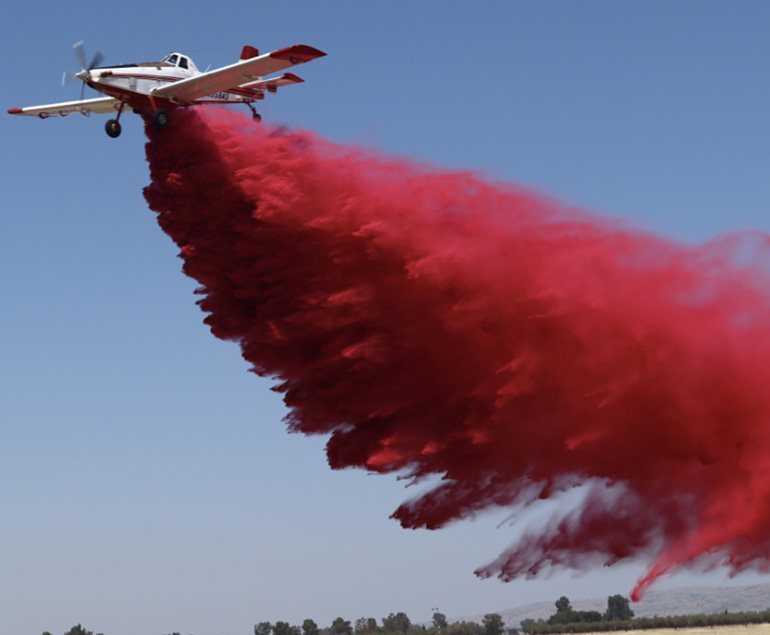 Fortress FR-100 long term fire retardant being dropped by an AirSpray air tanker. Fortress photo.
Their first aerial fire retardant product, FR-100, began its final field evaluation by the U.S. Forest Service yesterday at the Missoula Air Tanker Base in Montana. In order to be considered for a federal contract, they will need to load 200,000 gallons of FR-100 onto air tankers as they depart to wildfires. The ease and effectiveness of mixing, loading onto air tankers, and slowing the spread of wildfires will be assessed as each of those gallons make their way through the logistics and tactical stages of use.
FR-100 is a magnesium chloride-based, gum-thickened dry powder concentrate with a high-visibility red fugitive color. The retardant has successfully completed all US Forest Service laboratory tests for fire retardancy, toxicity, corrosion, and viscosity. The company says the magnesium chloride is more friendly to the environment than conventional retardants based on ammonium phosphates.
Like other retardants, FR-100 can be applied in advance of a spreading wildfire to protect firefighters, infrastructure, watersheds, and critical emergency evacuation routes.
Due to its low critical relative humidity, magnesium chloride in the retardant pulls moisture from the air — self-rehydrating when the relative humidity is greater than 32 percent. Some dust suppressants used on on non-paved roads are based on magnesium chloride due to this hydrating principle.
FORTRESS products can be stored and applied using existing equipment and infrastructure.
“Our long-range vision, through the expansion and advancement of our portfolio of fire retardants, is to reduce the environmental impact of this essential public safety service on our communities, watersheds, and broader ecosystems,” said Robert Burnham, FORTRESS CEO.
Mr. Hulbert explained that the environmental assessment they are working under during the evaluation limits the use of the new retardant to within 200 miles of Missoula. When a national environmental assessment is complete for the entire country in August they hope to be able to drop it wherever retardant is being used today.
 Fortress equipment at the retardant base at the Missoula airport, June, 2021. Fortress photo.




3 Comments
I’m not in favor of putting Mag Chloride into the watershed, I’ve seen what it does to vehicles when used on winter roads, they said it was environmentally safe there also
I hope Fortress treats it’s employees better than Perimeter and doesn’t cut huge corners on their equipment. Even if their retardant is less effective than LC95 I’d prefer them for those reasons alone.
It is not approved for helicopters with fixed-tanks, only for helicopters with buckets.
Comments are closed for this article!