


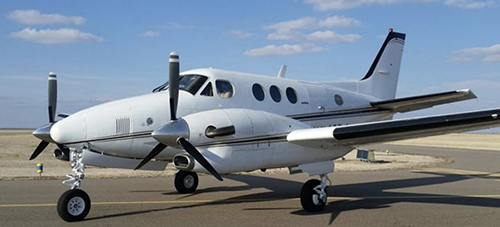
 File photo, example of a King Air C90. This is not the aircraft that crashed.
During the investigation of the crash of the Beechcraft King Air C90 on July 10 in which two aerial firefighters were killed in Arizona, one of the facts that the investigators will consider is that the C90 was one of the models mentioned in a recent FAA Airworthiness Directive (AD). Beginning January 11, 2021, AD #85 FR 78699 required inspection of certain Beechcraft King Air and Queen Air models due to a danger of wing separation.
The directive was came about after Textron Aviation, who now holds the type certificates, received reports of fatigue cracks in the lower forward wing fitting on two airplanes. An investigation revealed that installing washer P/N 90-380058-1 on the wing bolt will cause a premature torque indication. The fix is to inspect the washer and replace it, if applicable, with washer P/N 90-380019-1.
It will be many months before the final report is released by the National Transportation Safety Board and the true cause is made public. But we can’t ignore the facts that the Arizona Republic interviewed a woman who saw the aircraft from her home coming down at a “steep angle” and then “slam into the ground.” An hour later she and her husband drove to an area near the crash. They said Bureau of Land Management employees told them they they witnessed a wing fall off the plane in the air before it crashed.
At the time of the crash Pilot Matthew Miller, 48, and Air Tactical Group Supervisor (ATGS) Jeff Piechura, 62, were on board conducting visual reconnaissance and aviation command and control over the fire.
Today we talked with an ATGS who told us that many of the aircraft they work out of are quite old, and if maintenance isn’t kept to a rigorous standard the risks go up.
Another ATGS gave us an open-ended question: “What is the role of the U.S. Forest Service in the oversight and monitoring of contract air attack aircraft?”
The age of an aircraft is not proof that it is airworthy or not, but the plane that crashed July 10 was N3688P, manufactured 41 years ago.
Hopefully the cause of the crash, whatever it was, can lead to changes and lessons learned that will provide a safer working environment for our aerial firefighters.




26 Comments
The FS and BLM have a duty to provide their Aerial Supervisors with aircraft that are maintained to the utmost airworthiness standards! If it turns out there was negligence on behalf of either Falcon or an agency than people need to go to jail!!!!
There is a lot in aerial firefighting that we cannot control (bird strikes, drone strikes, CAT, GA intrusions) but there is no excuse for lacking proper and thorough maintenance, none whatsoever. We owe it to our aviators to ensure they are in impeccably maintained and equipped aircraft with no compromises.
I am a current ATGS and I’ve been in planes that are haggard and clearly lacking maintenance. I’ve refused to get in aircraft in my career. All too often an IMT orders a CWN aircraft for their fire, ostensibly the only thing available, and then you show up and it’s a clapped out Skyhawk or Shrike or single engine with a plug in for a handheld radio. Nope. Not doing it.
Rockwell AC680’s and AC690’s are the status quo, and are robust aircraft, but they were originally designed in the late 40’s and are notoriously expensive and difficult to maintain. KA’s make great leads and ASM’s (250gt’s) but they suck for ATGS work unless you want to stare at an engine cowling the whole time and make the pilot fly a threading pattern so you can see the ground.
It’s high time to quit cutting corners. Firefighting airspace is far more complex with higher speeds and tempos than at any other time. We need good equipment since there are no small mistakes up there, they all have immediate and fatal consequences.
One thing we can control is to stop using manned aircraft for firefighting. There is absolutely no excuse for risking the lives of dedicated crews for this task, when, with appropriate rotorcraft designs and established remote control and feedback technology, it is possible to insert large turboshaft coaxial drone tankers immediately above the fire zones. Check out RC cubed, Remotely Controlled Coaxial Cranes, LLC for information regarding this technology.
Unfortunately, the AD has a compliance time of 200 hrs or 12 months, whichever occurs later, so if it’s determined to be the root cause of the accident, it is unlikely that the maintainers will be charged for any ill intent. The FS and BLM inspectors that perform pre-use inspections on contract aircraft are conducting basically a “spot” inspection of the aircraft for general condition. The main purpose of the pre-use inspection is for contract compliance, granted, condition of the aircraft is one of the factors assessed. Airworthiness of the aircraft is in the hands of the maintainer that is signing it off.
Never trust an aircraft that is older than you.
With that thought
We might as well put all the LATs and VLATs to parking on the ramp, eh?
Risky business. As a F.A.A. licensed mechanic, maybe look at a “hard landing” that occurred (who know when) which might have set up a chain of events. The Southwest area of the U.S. (Arizona and Nevada) have some of the countries craziest and roughest air.
There’s always one of these if KAs suck: https://media.txtav.com/193441-first-cessna-skycourier-twin-utility-turboprop-takes-flight
King Air’s don’t suck. There are a lot of them out there, all over the world, doing a lot of things, and they have an outstanding safety record. The King Air line, as well as other beech products, have had several requirements for spar inspections. I performed some years ago when I observed pulled in the wing. Both the piston and turboprop aircraft have been subject to increased scrutiny.
Presently, there are wild calls and accusations, and only second and third hand accounts of what might have happened. It may be worthwhile to let the investigation play out.
Dropping the air attack platform in favor of unmanned assets, or going to all unmanned assets over the fire isn’t likely to happen any time in the near, or distant future, nor is there a reason to do so. Air attack operations are most valuable because of the eyes and ears in the sky, and positioning an experienced firefighter where he or she can see what those on the ground cannot. There’s no substitute for a live pair of eyes. I can tell you from combat experience alongside unmanned assets, eye’s on targets have a BIG advantage over unmanned assets. I can tell you from decades of flying fires that there is no substitute for judgement and experience when it comes to making a drop, calling a drop, or overseeing the fire.
Unmanned assets are more expensive, miss more, and present hazards in the fire environment that are mitigated my having a live person in the cockpit.
This event, like every mishap and loss of life, is unfortunate and tragic, and nothing should diminish that…not even voices with emotional calls to action before anything is even known about what occurred. Get the facts in hand, then make sound decisions based on the facts. As for using this event as a political springboard to overhaul the aerial fire system based on speculation and emotion: no. Inappropriate. Don’t do that.
Wait for the facts to emerge. We may find the obvious, or we may learn something. In the meantime, take time to mourn for the loss and give those who need to grieve, time to grieve.
Doug
I was replying to current ATGS
I KNOW King Airs dont suck. Been in the aviation biz as long as a few here not necessarily the wildland fire world…but the Army has em and I have hung a few engines and right seated them a few times…
Might such for the ATGS world …but they’ve been a mainstay turbo props well as the AC series including the old 500 series for freight….yeah no…King Airs don’t suck
I was not saying King Airs suck in general, they just suck as an ATGS platform where you’re at the top of the stack and need to look down. I agree, they’re tried and true work horses but the low wing design doesn’t lend itself well to that particular mission. As for ASM platforms, they’re great but the flight profile is altogether different and the demands on both the crew and aircraft are much more rigorous in the low level environment than they are at 2500agl in a low speed, 3-5deg bank, orbit.
As for the alleged wing separation scenario, yes I agree, the NTSB will determine the mechanism and resultant failure. However, even if this was suspected, C90’s should have been immediately grounded by the agencies (not the FAA) as there were exigent circumstances. Those planes, crewed with a pilot and right seater, flew all the rest of that day and part of the next until the decision was made for a precautionary stand down. This is unacceptable and certainly cuts at the confidence and mindset of aerial supervisors that are already doing a high tempo and stressful job. We don’t have time to wait months for the NTSB final. It would be a long walk across a short ramp with those uncertainties and doubts in your mind before you’re even chocks out.
Perhaps a more salient question would be; why were air assets headed to a remote desert fire where it was confirmed that there were no values at risk ??? The midair SEAT double fatality last year by Rainbow Canyon? Absolutely NO values at risk there. The Smokejumper that lost his life last month jumping a desert fire in south New Mex? No values at risk identified there either. We need to get smarter about how we utilize air resources. We all need to come home and not keep putting aviators at risk (and killing then) over cheat grass that’s just going to burn again the next year.
I value and respect all of your thoughts and opinions and recognize these are merely mine. Lets work together to stop the insanity and drastically reduce the accident rate which, at this point, is higher than GA…and that is terrifying.
I would be careful about making broad, sweeping, definitive statements about three fires, “there were no values at risk”, unless you have specific on the ground knowledge.
Mr Gabbert,
As for the Cedar fire, the BLM itself noted that there were no values at risk. Concerning the Bishop fire by Rainbow Canyon outside of Caliente, NV I have definitive ground confirmation from the incident itself that there were, indeed, no values at risk. Additionally, as a decade+ R4 hotshot, I had been on no less than 10 fires in that Canyon and can state that unequivocally. Concerning the Eicks fire in S. New Mex, again, I have definitive confirmation from ground resources that there were no values at risk. So much so that they even refused to engage the fire upon initial response due to no values being threatened. I also understand that a “value” can be extremely subjective. I wouldn’t dare make statements like those without confirmation. We’ve all been on “those” fires where we stop and ask ourselves, in the immortal words of retired Black Mountain IHC Supt. Matt Hoggard “What are we saving out here”?
I agree w Current ATGS and his assessment of values at risk ….once one is airborne …enroute or circling…can see what values are at risk….yep some of the SEAT missions in cheatgrass alley …one has to wonder…unless there is some “scientific study areas,” 1800s cabins that haven’t been IDd as historical until last week ..yada yada. Yeah values at risk…ill go with what one can see in the air. Being in NW NV and NE CA …theres a few areas of federal land that could stand a burn or responsible logging that could prevent some of these arguments….the last 50 yrs of “forest management” have shown what Agencies ideas of values at risk are…. What happened to the 10 AM rule? What’s this new fangled “managed fire” BS? How does that correlate w values at risk? LOLOLOLOL
Mr Gabbert
Then those folks with ground knowledge had best ID them on a map and with all that GIS technology ought provide aircrews that knowledge if we are to know those values at risk on Fed land. We already know the values at risk when it comes to WUI, peoples wanting to build cabins, etc….we already get that. Technology, i thought, advanced the forestry world. If that is true, values at risk, urban vs wildland, vegetation vs timber etc ought to be a no brainer…but like ATGS states we are still chasing fire on well established desert and cheatgrass farms
The more we fly aircraft that were designed for cargo and passenger flight profiles outside of their designed flight profiles, the less that hours and cycles can adequately predict and track accumulated airframe stress and structural fatigue. To base inspection and maintenance requirements for these aircraft on hours and cycles is a mistake. The FAR’s primarily utilize hours and cycles and airframe design safety factors based on assumed flight profiles. Flying different flight profiles introduces the possibility of “eating into” structural design safety factors.
Ageing fire aviation aircraft that are converted passenger and cargo aircraft require a different monitoring, inspection, and maintenance program to fly safely. Note that the FAA’s AD in this case has a flight hour restriction.
Until fire aviation utilizes something besides flight hours and cycles on which to base maintenance cycles, inspection cycles, and aircraft retirement dates, older aircraft flown on fire aviation missions will continue to experience airframe structural failures.
The military utilizes a different stress strain monitoring philosophy and bases many maintenance and inspection actions on strain monitoring because their aircraft tend to be flown with less predictable flight profiles just like fire aviation aircraft.
Here’s some “light reading” for those who are interested. https://courses.washington.edu/mengr541/ramulu/541/notes/agingaircraftreview.pdf
Ding..ding…ding we have a winner !!!!
Bean,
For the LAT group, we are forced to come up with Aerial Dispersion fatigue mission profiles based on actual recorded data from that fire fighting mission, then re-evaluate the structure to determine new intervals (yes, based in hours and cycles — depending on which aspect is critical). This is a very sound and technical approach. We also have to monitor the airplanes in real time after we complete the evaluation (with installed onboard strain gages and accelerometers) to ensure that our analytical mission profiles are accurate. Every two years there is a technical report written with the evaluation of that 24 month data that is collected on each LAT and adjustments to the inspection program are made if the existing program turns out to be unconservative.
We are NOT permitted to utilize the existing commercial inspection intervals (or even their inspection methods necessarily). Since the usage is different, the inspection protocols must be re-evaluated. The entire airframe is checked for its fatigue and crack growth life based on the revised mission and a new inspection protocols are determined based on that mission of low altitude, lots of nasty gusts, new fuel loading, etc. All of that is considered on the Large Air Tanker evaluation programs. They are very expensive programs, but are worth every penny.
For smaller SEATs and Lead Aircraft, I assume the government agencies (States and USFS) require the same level of effort be expended. If not…..there’s your problem.
DPM,
Correct me if I’m wrong but it was my understanding that the OLM instrumentation used to develop representative flight profiles is not installed on every aircraft but only representative aircraft for each particular type. This provides a better maintenance management and inspection program because it better reflects operational flight profiles, but absent instrumenting and monitoring every aircraft, it is not possible to catch the outliers that can cause structural damage between inspection and maintenance cycles.
Instrumenting every aircraft, crack growth monitoring, in addition to keeping track of cycles and hours was the military’s solution to tracking airframe fatigue in aircraft that are flown in unpredictable environments. While there are type/model/series generalities, aircraft flown in unpredictable environments are treated individually.
Having flown some fairly old tactical military aircraft in my career, my observation is that the older the aircraft, the more time we spent tracking individual component fatigue and replacing individual aircraft airframe structures based on G Nz counts not hours and cycles. The aircraft were treated less like representatives of a type/ model/series tracked by hours and cycles and more as individuals with individual component fatigue histories determined by onboard stress strain intstrumentation data.
I submit that fire aviation aircraft, because they are flown in an unpredictable environment, could benefit from a maintenance philosopy that instruments and monitors each individual aircraft to track structural fatigue.
Bean,
For the LATs, each individual aircraft is tracked and fatigue damage measured in terms of recorded data.
Let me explain:
There are “heavy” OLM systems that measure the strains on critical parts of the airframe as well as accelerometers which measure G forces seen. Usually one aircraft in the fleet for an operator has this system installed. Then there are “light” systems that measure accelerations only. Those are on each and every large air tanker.
The strains measured on the single airplane in one’s fleet make certain that the engineer understands the conversion of “G force” to strain and therefore stress. The accelerometers and strain gages permit the engineer to understand that conversion function because each aircraft will have a different design and thus, the conversion of G’s seen while flying (could come from gusts, manuevers, landing impact, etc etc) to strain will have a different conversion factor for each piece of structure on each airplane design.
Once that factor is understood for that airframe, re-confirming that factor from year to year is quite trivial and unnecessary. It doesn’t change as the airframe ages or is utilized. So the rest of the fleet gets the accelerometers, which tells the engineer how that particular airframe was utilized as we can see every bump and jolt seen with just that data. Thus on the other airframes, you know accelerations and thus, because you already know the conversion factor, you know strain and stress on every airplane in your fleet.
So in reality after the first conversion of G to strain, all that one needs to see how each airframe is flown and what fatigue damage it has seen is the accelerometers. It tells you even the dynamic effects, say at the end of the wing tip versus the root (if you’ve placed them appropriately around the airframe).
These acclerations are combined into a convenient amount of flight time (hours and cycles) via what’s called an “exceedance curve” that shows each and every G event for each and every airplane. So when you say you should or should not count cycles/flights versus G events, it’s really the same thing. If you have created an event-by-event exceedance curve, you are really tracking each and every G event so counting those or counting flights/hours is really the same thing. An exceedance curve puts those G events into a flight and into flight hours standard so you can really still track flights and hours and you are capturing each G event anyway. It’s much easier for a mechanic to count flights and let the engineers determine how many G events were in that flight via his/her exceedance curve. Either way, the result is the same.
Certainly agree completely with you that as an airframe ages, the chances of more and more parts starting and growing fatigue cracks increases. If there is a safe amount of time to catch those cracks through structural inspections without compromising the aircraft’s ability to react limit level loads, structural inspections alone can be used to keep the airframe safe. However, if there is not enough time to utilize inspections to catch flaws before they reach critical length, than life limits are typically utilized to “remove and replace” that structure once a certain number of flights/hours/G events have been seen. Large damage capable aircraft usually will use an inspection program and small flaw critical structure (such as steel structure utilized on landing gear) will use life limits. Most aircraft have some of both types (inspections/replacement) of methods utilized on their maintenance programs depending on the structure involved and its tolerance to this type of damage.
The point I was making at the outset was that for smaller (non Large Airtanker Aircraft), the requirements for this Operational Loads Monitoring system may be different than the LATs. There really is no safer means of establishing a maintenance program for the LATs, the engineers need to evaluate the ENTIRE airframe (even if that piece of structure is not critical for the fire fighting mission). Each inspection protocol is proven by analysis and then backed by flight testing and 2 year intervals of recorded data. There is very little that could be added to increase the safety for the LATs, certainly not economically as even this system is not cheap and it causes, at times, an entire re-do of the established maintenance program if the aircraft are operated away from the initial evaluation done by the engineers. That typically takes hundreds of thousands of dollars.
For the SEATS and Lead aircraft, are the requirements the same? I do not think so. Just because the aircraft doesn’t drop retardant, doesn’t mean the mission it’s carrying out isn’t more critical than one that was established by the OEM (you know, the mission that does not spill martini’s in the laps of business folks going from meeting to meeting). So while we don’t know until the NTSB and/or the FAA comes out with findings from accidents as to cause, and we should certainly not jump to conclusions without that investigation being complete, we do know that studying and application of current damage tolerance requirements laid out in FAR 25.571 does work to keep airframe’s and operators safe. Shortcuts or use of OEM maintenance programs that do not account for usage changes can get one into trouble and often does.
Unlike the large air tankers, the SEATs are doing exactly what they were designed to do.
You say these are the problem?
Do tell.
Hi Doug,
I can tell you from some experience dealing with fatigue problems on aircraft like the Thrush or Air Tractors, these aircraft’s certification basis are quite old and many have not had current fatigue/damage tolerance principles applied to the development of their maintenance programs.
In fact, some aircraft were so old and the cert basis was so old that they were legally allowed to be overloaded 30% from what the original engineers used to design the airframe. Overloads are an every day occurrence for some of these airplanes. This is despite the high G nature of their originally intended mission profile. Fatigue and damage tolerance regulations were not in place until the late 80s in Part 25 aircraft and even more recent in Part 23 aircraft like the SEATs and lead airplanes. So although some of these aircraft’s missions aren’t greatly different than what the OEM designed for, the full up evaluation for damage tolerance and crack growth still may not have been conducted as would be required today of Part 25/26 aircraft.
In general, it takes just 2-5% of weight overload to completely mess up a maintenance program and make it very hard to catch fatigue damage in time. Approx 15% of weight overload can cut fatigue lives IN HALF on typical aluminum structure.
So although the technology and current Part 25 cert requirements could be used to develop maintenance programs for some of these airplanes, I seriously doubt that all of them have these types of program applied to their repetitive maintenance. Some probably do, but some certainly do not. Their cert basis is not Part 25, but an antiquated version of Part 23 and some go all the way back to CAM 8. Look up CAM 8 sometime if you are bored, it’s pretty scary what it allows one to do in terms of loading and overloading.
My original post to Bean was more about King Air type airplanes (lead airplanes and such), but I’m quite certain that the LAT rules for compliance to aging aircraft in the government contracts are not nearly as rigorous for all of the smaller aircraft, like SEATs. Some of that is for good reason, but some of it ignores that fatigue damage really doesn’t care how small your aircraft is in weight or payload and in my opinion, all should be evaluated with the “state of the art” criteria.
DPM,
I’m very familiar with CAM 8, and with all the current, and former SEAT aircraft, from both a pilot and mechanic perspective.
It’s not about size, you’re correct, but it’s also about mission performance, design, and the program under which these aircraft are operated.
I certainly share the concern for fatigue; I flew both the aircraft that broke up in 2002, and they’re two of five aircraft I’ve flown in my career that ended up with cracked wings, from light twins to the 747. It’s far from an academic issue to me.
Presently this discussion is taking place based on the allegations regarding an air attack C90, which may, nor may not have experienced a structural failure. A discussion of this, therefore this, isn’t yet appropriate given that we don’t take evasive action for traffic we can’t see, and can’t solve a problem which is as yet undefined. We don’t know what happened. Let’s know before we slay the dragon that may not exist.
In the 802, one inspection involves removal of wing attach bolts, inspection, and retorquing of the bolts. In each inspection of which I’ve been a part, the bolts have always been replaced, along with inspection of the surrounding structure. Every inspection has been thorough.
I’ve operated the Dromader with radials, garrets, and pratts, the S2R’s, 502, and 802 on state and federal fires, and have sprayed with them. The 802, which has become the global standard for single engine tankers, and is the most common tanker worldwide in terms of numbers, was designed with firefighting, and agricultural applications in mind; this differs substantially from transport category airplanes which were not designed with that purpose in mind. Before we fiat a conversation about an inflight C90 structural failure which is as yet unknown in scope and nature, into an accusatory discourse about air attack and SEAT aircraft being the problem for lack of strain gauges and instrumentation, let’s back off a bit and sort the apples and oranges into their respective bushel baskets. I’d much prefer that those who need time to grieve, be given that time, before the mud slinging starts.
The 802, incidentally, is operated at 16,000 lbs as an air tanker, which is provided as part of its type certification. As a tanker, the gross weight is higher than when operating as a spray aircraft. The value is cited on the Type Certificate Data Sheet (the certification basis of which is 14 CFR 23).
The C90, and variants, including military, operate at a number of different weights, including above 12,500. I’ve maintained them, operated them, taught in them, ran a full motion simulator for them, and was even a director of maintenance for a King Air operation running the C90, BE20, and others.
So far as LAT requirements vs. those for all other aircraft over the fire, while apples and oranges, it’s worth noting that inflight breakups over fires have been largely relegated to LATs, from the C-119 to the C-130. I do not disagree with the testing and scrutiny, and life limitations applied; to date there is no evidence, smoking gun, history, or cause to push that same direction onto the SEAT world, or necessarily to impose it on the air attack aircraft. It does seem that certain comments within this thread have implied, or outright stated that those who do not, or are not engaged in the same or comparable level of scrutiny to the LAT program, are “the problem.” This is a non-sequitur, straw-man attempt at correlating an existing well-substantiated program with unknown data and unrelated aircraft and operations.
Your comment that operations in excess of a given weight may impose conditions outside of a particular maintenance program, is well taken. Regarding SEAT aircraft currently in use, it’s also misplaced, given that the maximum operating weight of carded aircraft is in keeping within the limitations of the TCDS; the aircraft are not operated overweight.
Which air attack aircraft are being operated over gross, or in excess of their weight limitations? None that I have operated have ever been operated over gross, our outside their legal limits. Which ones are?
Yes, and some operators (the smart ones) have engaged in understanding the stresses their fleets are enduring on the fire line. Even more of a novel concept, they’ve worked with the aircraft engineering departments of the OEMs to get their support and acceptance of their modifications. This should be mandatory – both at the FAA and Forest Service contract levels. As long as the FAA treats tankers as nothing more than a flying tank car, some questionable modifications and operations will slip through the cracks.
The same claims about aging aircraft and aircraft not designed for low altitude payload delivery were made about the PB4Y-2 and the C-130…aircraft designed to deliver large, heavy loads at low altitudes.
As for “no values at risk,” that’s subjective.
I’ve been on a LOT of fires which started out miles from anything, as a single tree or a run in cheat grass. They turned into values at risk, and those values have been anything from structures to power lines or other infrastructure, to the firefighters themselves.
It’s absolutely absurd to suggest that an air attack or SEAT not be called to a fire because one thinks there are no “values at risk.” Fires evolve. An air attack is a valuable resource over a fire regardless of the presence of structures, infrastructures, people, resources, etc . Air attacks provide crucial communications, big picture information, weather updates, and direction that ranges from tactics to ground hazards, escapes, ingress, egress, size-up, airspace management, resource requests, etc.
That segues into the matter of opportunity cost. Is the real cost of not putting equipment on that fire now, quickly, going to be much greater later when the fire expands? It’s generally far less expensive , far less risk and danger, and far less effort and resources tied up, if the fire is fought sooner than later; a box of retardant around a lightning strike may be a lot less expensive and a lot safer than having to call every tanker in the region in a few hours or the next day. To suggest that the fire doesn’t merit resources simply because it isn’t threatening anything NOW is shortsighted.
I once contacted a maintenance controller, in flight, due to an engine temperature issue. I was told that he couldn’t do anything, as the engine hadn’t actually exceeded any limits or experienced any damage yet. He could only provide input once the damage was done. Very short sighted. Far better to look at the parameters, and the potential, and handle it before the damage is done. I’ve been on enough fires involving fatalities over the years, as well as lost structures, equipment, infrastructure, resources, and acreage, that might well have gone very differently had different choices been made earlier in the process. When that burnover occurs isn’t the time to be calling for resources. Calling for them long before it gets to that point means one may never need to worry about the burnover; I’ve seen a lot of fires that started as a single tree and turned into something very different, and many of them were seemingly nothing when I first arrived at the fire. Anyone who has been in firefighting for very long as seen this time and time again.
I was the first drop at Yarnell. When I showed up, I had to orbit for a time just to find the smoke. A few whisps amid a rocky slope in a few blades of grass. We all know how that turned out. It may be little and seemingly inconsequential now. That doesn’t mean we should fail to throw resources at it. The cost of not using that resource, be it an air attack or tanker or helicopter, may be far greater than calling it out early.
Err on the side of caution. Send the resource.
Doug….you summed it up perfectly.
A couple of points I would add….tactical air resources are going to be effective when the fire is small…in the incipient stage. Chasing a running fire at peak burn time is often a fools errand.
Yet it seems to be standard practice more often than not. Affectionately known as “fire art” amongst a certain generation of aerial firefighters…
My other point is to question why we are not utilizing air resources much,much earlier in the morning while the fire is layed down and the air is much better for flying..
As an atgs, I often had a very specific area in mind where I would like to get mud on early in the 2nd shift. Practically took an act of congress to get that to happen, though.
Every once and a while I could get a tanker pre-ordered to come on an hour earlier and use it
As far as values at risk….some of the posters apparently have never seen the impact on a small ranching family that has lost their grazing rights for a 2 year period. It’s a gut punch and puts a few of them under financially.
Doug,
Not saying I particularly know of any aircraft fighting fires as SEATS or any other role that are using what I call “loopholes” in CAM 8 to overload the aircraft. My experience is that if the TCDS is old enough, one can legally do it and in the commercial world, there are many owners who, if the FAA allows them, do it without hesitation. Even with flying the airplane perfectly per the OEM design parameters and TCDS, if the TCDS is older, there was no requirement for the OEM to create the maintenance program based on fatigue and damage tolerance analysis or anything nearly as rigorous as what the LATs need to do now. Some older aircraft utilize “failsafe” design philosophies to base the maintenance program on. Depends on the age of the TCDS as to what regulation was in place when it started it’s life.
Sounds like you have lots experience on these aircraft, which is fantastic. Thank you for your service in this incredibly important role.
My point was and is this:
We all know about the dangers of fatigue damage in airframes.
Regardless of role, regardless of TCDS requirements or how old the aircraft is, regardless of size, we should all use the “state of the art” engineering techniques to create a maintenance program that has been tried and tested and works quite well to ensure the safety of the fleet. The older Type Certificates typically do not require this type of evaluation.
The LATs, in the last 15 or so years since the Blue Ribbon Panel gave their recommendations and the USFS mandated it contractually, have that system in place. It works and is very rigorous. The maintenance programs on those aircraft have safely located dozens, if not hundreds, of fatigue cracks that could have been catastrophic if left undetected (as was the case on the C130A model — which was not on this rigorous program –its what caused the transition to this program). It would be awesome if all aircraft associated with this incredibly important role be held to those same rigors. I’m not 100% certain that’s the case currently, but if so, then the maintenance programs are about as good as they can be. Then it’s up to the inspectors to find the damage and keep the airplanes operating within their structural capability.
Thanks for the feedback and input Doug. Good talking with you on this.
Comments are closed for this article!