


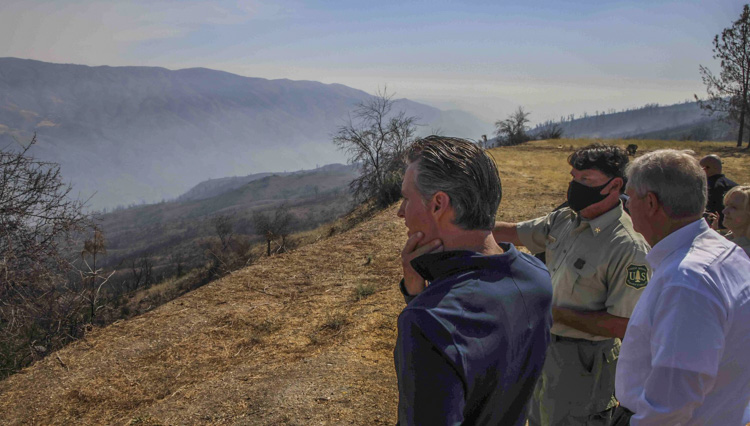
On August 4 Governor Gavin Newsom, U.S. Agriculture Secretary Tom Vilsack, and new U.S. Forest Service Chief Randy Moore met at the burn scar of the 2020 August Complex of fires in Northern California to discuss state and federal collaboration on wildfire response and fuels management across the West.
During a press availability, Secretary Vilsack uttered words we don’t hear from Chiefs of the Forest Service, or certainly from Secretaries of Agriculture:
We are prepared to do a better job [of forest management] if we have the resources to be able to do this… Candidly, I think it’s fair to say over the generations and decades, we have tried to do this job on the cheap. We have tried to get by, a little here, a little there, with a little forest management here, a little fire suppression over here, but the reality is this has caught up to us.
We have to significantly beef up our capacity. We have to have more boots on the ground… And we have to make sure our firefighters are better compensated. Governor, that will happen.
We need to do a better job, and more, forest management to reduce the risk of catastrophic fire.
Governor Newsom said he has been exploring way to obtain more fire aviation resources, lamented that there are “only a few contracted DC-10s nationwide”, and said he was looking at how “to get the 747 back in our hands, and that’s been a challenge, that thing has been sold, so we’re still working to get some more aerial equipment.” (This statement is queued up in the video below.)
Secretary Vilsack said the Governor’s request for additional aviation resources, “… Came to my desk. One of the challenges we’re working on right now is making sure we get the Defense Department personnel necessary to fly the planes. So sometimes it’s not even the planes, it’s the pilots, the people who know how to fly these planes…I was given instructions to… make sure we have the people in the planes to fly them.”
The Secretary was most likely referring to the military Modular Airborne FireFighting Systems, MAFFS, which can be loaded into C-130 aircraft to temporarily serve as air tankers. They are the only military air tankers used on wildfires in the U.S. Each requires a seven-person crew, additional support personnel, and often a third conventional C-130 for every two MAFFS that are activated.
The Secretary’s comment could be the explanation for why only five of the eight MAFFS have been activated this year. On July 27, wondering if there was a specific reason why the remaining three were still parked, I asked US Forest Service spokesperson Stanton Florea if the three were available if needed. He replied on July 28, “There are 3 additional MAFFS-equipped C-130s that can be brought into service, if needed.”
As of today, August 6, there are still only five MAFFS working.





55 Comments
Ask Hon. Tom McClintock and Bob McAndrew (Evergreen past pro) what they think. USFS needs to be looked into big time.
BTW, my first job out of Naval Air (CVS) ASW was Boeing SST & 747, so near and dear . . .
GET THE 747 BACK IN BUSINESS.
What ever the cost , people all loosing their live hoods.
Unless you’ve been homeless you won’t understand .
And if they are homeless, they may not understand that the 747 wouldn’t have changed the outcome, here.
Tom McClintock–Jul 27–
Addresses the Tamarack Fire & “Let Burn” USFS Policy on FOX40–Jul 30–
Sorry, USFS – Fire is NOT our Friend: >>
“It’s dangerous nonsense to “monitor” incipient fires in today’s forest tinderbox, even if they seem to pose no immediate danger. In our national forests, only the USFS can prevent small blazes from becoming forest fires. It’s time they did.” (CalFire was chased away from the ‘burning bush” . . . USFS said “Get out. . . . it’s our fire”)
Chased away from the burning brush by the USFS?
How about this from about 30 years ago? The fire, while on the CNF, was well within our first in, we did not get the call until 12 hours after it started. USFS sent one engine about six hours after the fire started.
30 years ago would put it in 1991…Maybe it was Bill Gabbert’s engine that got there six hours later? lol
What district was it on? Palomar or Descanso?
This article is the first time someone in government has seen the NEED for Ultra Large Frame Aircraft!!!
I’m glad they pointed out one more benefit of the bigger birds in the firefighting A/C fleet – the need for less pilots!!!
The conflagrations of the last three years have proved the Fire Service is failing miserably in growing more efficient using new technology!
The article mentions one major cause — the unwillingness to spend the money required!
There are less than ten aircraft that can fight fires from the air that can carry over 10,000 gallons of water/agent.
The higher the capacity of the aircraft; the safer of the operation, for numerous reasons.
In the article the C-130 was mentioned — it only holds 3,000 gallons.
With current technology, a 747 holds 15K gallons and the DC-10 can hold 12K and in the past, they have only used Phos-Chek in actual wildland conflagrations.
I propose that with a year or two of research and with out of the box thinking, a fleet of 747 planes can be developed that can safely and efficiently drop loads of 20K gallons of water on these fires which have been burning for months at a time.
With a fleet of 50 or 75, 747-400s, making drops around the clock 24/7, this country would never again suffer as it has in the last 5 years or so.
We need planes updated with technology to fly these missions all night long!
But developing planes that can fly the mission requires an attitude which is willing to admit the current tactics and strategies are failing!
The Fire Service in America is too damn proud to admit that it currently is FAILING!
Boots on the ground, or even countless Strike-Teams can’t win the battles they are faced with today!
Today in 2021, the Fire Service needs to say what do we actually have to develop to stop fires from burning for longer than one week?
What is being done presently is costing too much money, too much of nature, too many towns, and too many lives!!!
Wake Up Folks, what you have been doing would be laughable; except for the fact humans, businesses, trees, animals are dying while people are standing around with their hands in their pockets blaming climate change and NOT DOING A DAMN THING TO PUT THESE FIRES OUT ANY FASTER OR MORE EFFICIENTLY!!!
My god, Brian, you keep posting this ignorant drivel, and you manage to be wrong about every single comment you make. Not just one or two items, but you’re consistently wrong about everything, and it’s been pointed out repeatedly.
I get it. You saw big airplanes on the ramp, and somehow think this makes you an expert in flying, large airplanes, firefighting, yada, yada, yada. It doesn’t.
The 747 has been introduced on the fireline three times now, each time failed to garner enough support, or pay for itself. 50 of them? Good luck with that. Good luck finding them, equipping them, finding the financial support, or pilots to fly them. The technology you’re talking about doesn’t exist. There aren’t enough lead aircraft. Your magical world of extinguishing fires from the air doesn’t exist, but you’ve never fought fire from the air, or from the ground, and wouldn’t understand that. You’re missionary for a cause you know nothing about.
Spouting ridiculous notions based on fallacy and misinformation won’t bring anyone any closer to a solution. Enough, already.
I think Brian has a BBC fetish…
The 747 never failed!
The model the fire service uses to fight wildland conflagrations in the USA is what is BROKEN, Not the 747 or DC/10s. CalFire has put several DC-9s and other planes that hold 3,000 gals into service — but it’s simple arthritic;
A 747 = 6 planes that hold 3,000 gallons. PowerPlants in NorCalif are being shut down because lakes are dry — letting fires burn for months on end can not last forever!
The ONLY REASON PEOPLE LIKE YOU CONDEM THE USE OF ULTRA LARGE FRAME AIRCRAFT IS BECAUSE HAVING A GOVERNMENT FUNDED FLEET OF 50-75 of the ULTRA LARGE FRAME IS IT WILL PROVE HOW INEPT TODAY’S SYSTEM IS.
Of course it didn’t fail. (one operator went bankrupt, the last operator’s own investors wouldn’t fund it, let alone any client agency, anywhere in the world)
That’s why it’s actively in demand today. (it’s gone)
There’s nothing to “bring back.”
“That’s right,” said Mr. Price. “Never say die. All fun, ain’t it?”
― Charles Dickens, Pickwick Papers 1837
The issues with the 747 were fixed before it was sold. You need this plane and many more like it!
Spot on . . . ! And thank Evergreen’s Bob McAndrew & Del Smith for the STC!
(do the Wiki)
We need more DC-10s not 747s. The 747s would be great out in the flat planes and sagebrush step but it has no place in the mountains or dropping anywhere near a line with personnel on it (noted for casualty on the Ranch fire) https://www.google.com/amp/s/amp.sacbee.com/news/california/article234971662.html I think the 747 belongs in Australia and it would be a damn good tool against a fast moving grass fire but not in big timber.
Explain why the DC-10 works in heavy fuels, but the 747 does not.
Having flown both, I’d love to hear this.
When fires are spotting 1-2 miles in front of the main main fire, aircraft are not going to stop it, regardless of the aircraft. In just the past week I don’t know how many times I’ve heard air attack state they are unable to work tankers under the column due to visibility or turbulence. Air craft are not the end all be all solution. They are a tool in the tool box that has a time and place.
The media has created this sense to the general public that air craft are here to save the day, plus they make great photos and video clips of a dramatic attack on the fire. Hand crews grubbing line and mopping aren’t sexy to the media.
The River Fire in Colfax was located in the right terrain to use multiple large aircraft with a quick turnaround. The fire was in a canyon with good ridge lines on both sides and the smoke column moving canyon allowing air attack to effectively work the tankers. Long open ridge lines are great for VLATs, while trying to turn the shoulder in tight terrain the S-2 may be the tool. The idea is not to rely on a single arrow but to have a quiver full of options. Cal Fire is attempting to expand the quiver with the C-130 but bureaucracy has gotten in the way.
Well said, more large aircraft are not the answer! Boots on the ground put out fires. Fixed wing aircraft can not fly in the worst conditions quit wasting taxpayer money on it!
While I dont ever see 50 747’s flying at night trying to “rain” a fire out, I do think that there needs to be a rethink regarding aerial firefighting. Not long ago a 100,000 acre fire was huge. Now they are common and 400K fires are becoming the new size. It won’t be many years before we see a million acre fire. It wasn’t that long ago that a hundred homes burned was massive, now multi-thousands burn every year. It wont be long before we see a 10,000 structure burned fire.
I do think that significant numbers of VLATs configured for water dropping, carrying 25% more payload (at a fraction of the cost) might be an idea whose time has come. I have dropped miles of water from a Crane flying DIRECT, and think they VLATS with water could also be used for that if Sat-lock or other tracking system were used to accurately connect drops. Perhaps multiple VLATs pre-treating well ahead of a fire would be effective to reduce spotting , increase humidity and at least slow down the spread. Aerial large tanker firefighting is still acting like 600 gallon drops with retardant. Perhaps it is time to have two separate fleets with different mission profiles, one to pre-reat and one to extinguish. Otherwise it is time to put 50% more Cranes and Chinnoks helicopters in the air to fight the fires direct when they are small. My 2 cents.
Sounds like a good idea, but from an air and ground perspective, “raise the humidity” doesn’t really work, especially if you don’t have folks on the ground backing it up.
Well, the Global Supertanker ad link is still on the sidebar of this page, click it and give them a call, tell them to get in gear!
Brian Curwick, you’re missing the point. The point is not a fleet of 747’s but an efficient “Tool Box”. Starting with better management of the forest, adequate number and well equipped ground fire fighters. The initial phase of a fire is critical. That’s when fires need to be fought hard with a combination and coordination of “tools”. VLATS are part of the tool Box for sure but you’re not sending a VLAT on a 5, 10 acres fire. The initial phase is crucial. More focus on that…
Thanks Jerome
We have a DoD and one CINC. Any ideas about a ‘DoFD’ and ‘CINFC’ in this annual, perennial ‘Fire War.’ . . ! The previous administration spoke on ‘Wildfire Today’ (companion to FIRE AVIATION) saying >> “We’re a forest nation.” (President Trump) . . . “You don’t have to have any forest fires” (Bill Gabbert 9 July 2019)
He should just damn do it…CA has enough $$ and needs to make it priority!!
the gst 747 cannot make as solid and precise drops as the dc10’s or the c130’s or aircraft of those sizes we see used by coulson and erickson. we need more c130’s for sure and the dc10s but not more 747’s. that is just a pipe dream to scam our tax dollars. do the research on “retardant drop precision”. the 747 is nowhere in the target zone it must be in to match the c130’s
Of course a 747 can drop with the same accuracy as a DC-10. The notion that some how the 747 as a platform is less accurate, is baseless, and ridiculous.
The point of a VLAT isn’t precise, pin-point drops, however. It’s about paining long lines, high coverage levels, and carrying more retardant quickly to a fire.
The advantages of a large airframe are counterbalanced against disadvantages, like any platform; adequate tanker bases with sufficient facilities, including the ability to handle the wingspan, a ramp and runway with qualifying load bearing capacity, etc, are components of the decision to use, as is cost. Not only hourly cost, but cost per gallon delivered, daily cost, etc. There’s a cost to not using the aircraft, and that’s always a consideration: it’s expensive even when not in use. In fact most expensive, when not used.
As others note, tools in the toolbox. It’s not about sheer volume, nor about sheer size, nor about sheer speed; there are advantages and counterpoints to every facet of every platform. The totality of the fleet is what lends flexibility and allows tactics and choice. Not every nail needs hit with a sledge hammer.
Roger that. Your analytics also answer any and all naysayers focused on the 747 issue, vs the overall trial and error protocol to use all resources available in concert to SOLVE THE PROBLEM at the ‘Gitgo’ . . . ! BZ . . . !
It would take a long discussion to describe how and when retardant is effective. It doesn’t matter if it comes out of a SEAT or a VLAT. Fuel type and continuity, coverage levels, terrain, winds, etc. all have a play in how effective it is. Bigger is not better and the 747 has proven that it won’t work as an air tanker. The key is a mix of aircraft for different conditions and situations. Most ground firefighters don’t understand how to use ac because they aren’t taught how to. They learn bad habits from their predecessors. Learn how to use what you have available, listen to the air attacks, and make decisions based on all of the inputs. Yes, we could use more of everything when it’s busy (including dozers!:), just don’t think that more of ONE resource is the answer.
At Fire Aviation we try hard to provide a venue for truth, but obviously, that is not a priority for everyone who leaves comments. There could be a variety of reasons why someone would say one model of aircraft makes a great air tanker, and another one does not or has proven it won’t work as an air tanker. They may have a financial interest in which aircraft receive contracts, they work for a company that flies them, or any number of reasons. If anyone makes such blanket statements either way, without backing it up with data and specifically where to find it, it’s best to ignore it and move on. Also in that category are folks who say we need “X” number of a model of aircraft that has never seriously been considered by experts as a candidate to fly low and slow in turbulent air over mountainous terrain that is on fire.
And don’t get me started on those who say drones can drop retardant because they have GPS.
The Doctor has spoken!! I will cool it. Drones can drop retardant? Thanks Bill for this great web site. Johnny Coldwater Yount, It’s the best. cheers
I will clarify my understanding of why the 747 doesn’t work as an air tanker, from a previous article, “The Interagency Air Tanker Subcommittee does not support any further interim approvals without correcting some issues originally identified in the 2009 test of the system that included failure to meet coverage level 3 & 6, retention of retardant in the system after drop, aeration of the retardant causing trail off, and inconsistent flight profiles affecting retardant coverage.” Not approved is more accurate.
Of course drones can drop retardant. It all depends on the size of the drone.
Those pesky-nosey-annoying-small drones that drop in to your back yard for a look in your sliding glass door can carry about, oh, I don’t know, a quart to a gallon? And those military grade drones? Control them from Creech AFB. Maybe two to four five gallon Home Depot Homer buckets instead of an expensive tanking system. Two/four buckets is just as good as two/four doors on any tanker. What’s yer pleasure? 20 gallons on a salvo or trail drop? Fer sure, fer sure! Fire doesn’t stand a chance now. (Insert incredulous grin here).
Hello from Australia and thank you for this great site and the work you do to keep it going Bill. Although a fan of GSTS and, having worked with some of the previous staff in the hope to get it here for a trial – I really think we all need to stop and consider the science. We suffered with our previous Govt in all things scientific. It’s a long road back to rebuild and fund but I think we will make it. Never mind the brand or type, just trust the science!
Brian thanks for your think-out of-the-box perspectives. Like the guy in 1980 who wrote a paper on using jumbo jets (wide body) to drop on fires threatening the WUI. What a stupid idea. I hope you will focus on some of your thoughts and let us know a plan, MBO got to start somewhere. For all the 747 haters talk with the ASM, ATGS, IC or Ops Chief that used the 747. Look at U.T 747 dropping. How many N3N, TBMs, PBYs, F7F, PB4Ys C119s B26s, B17s can we resurrect for aerial fire fighting. Must have worked, size and duration of fires were, well, not like today. Brian, scale your aircraft responding down. Most ATGS and ASM can only handle about five tankers arriving within the outer circle at a time.
I’ll take 5 D8’s with good operators over 5 LATS any day of the week. We really need to knock it off with all the “we need need more metal in the air” talk. Instead of aluminum in the air we need QRF’s of iron on the ground.
20×20 hind-sight observers abound (Monday AM Qrtrbks). All fires start “small” (unless C4 is involved). We have a “Fire Season” (Whut?). Also there seem to be ‘at-odds-entities’ vying for drama, control & visibility . . . on the ground, in the air and at sea. Rep. Tom McClintock is in the heart of the fire range and knows the drill . . . & the USFS. “Aim small, miss small”. Early . . . and BIG! (Saturation Fire).
Plan ahead. With drone tech and satellite monitors, early detection (DoD protocols) headsup works before visibility is reduced to ‘scramble’. Perhaps a large tanker ‘saturation’ of the hot spot zone would build confidence. We’re all involved.
And our astronauts are on ‘the front lines’. Look to wildfiretoday’s smoke-and-air-quality-maps-august-7-2021
California has contracted LATs and VLATs for extended periods of time on a CWN basis for years. If the Governor of California really wanted more VLATs available to his state, he would push for Exclusive Use state contracts. All the other talk is just politics.
The 747 would be a great tanker…..if its tank could only do the job required.
For many years this particular tank has failed to pass its drop tests, and has been operating on “interim” approvals.
We wouldn’t keep approving a smaller tanker if it kept failing its tests…. so why should we waste huge amounts of money on something like this failure.
The company has had several years to fix this tank design but hasn’t done so.
If you want 747s, get a new tank that does the job required.
Product development is a heady ‘Cut to Size, Beat to Fit, Paint to Match’ protocol, especially in aero converting from passenger to tanker or . . . (bin thar, dunnit). Gotta keep on ‘keepin’ on’ with what we have to work with. Evergreen’s 947 (979) and later development was challenging and challenged, just like the Ten-Tanker’. We have a new ‘infrastructure bill’ that should address this, along with mitigation measures (focused & A-Political). Keep up your ‘encouraging words’ troops!
We need an Imperial Star Destroyer capable of dropping 55 bagillion gallons of LC95. We won’t even need boots on the ground, the ISD would knock it down, mop it up AND put it out. 🙄
Better get 55 bagillion dollars together for that Imperial Death Star Destroyer and while you are at it can you firm up a date with the IATB for the cup test?
If a dip craft only uses water directly on a spot fire, why not use a 747 with a tank design flaw from carrying retardant drop only water to save towns, property and lives? It might not be 100% effective singularly but carpet bombing fires might be what’s missing in the equation. Isn’t the 747 that’s not available actually capable to carry a larger load?
Is there a correlation to “fire acre size” to fleet size number of very large craft? As a lay person searching information about this subject, there’s a chart that shows a high of 44 VL to a current number of 18. I also understand that “water” in any form be it humidity, rainfall and cooler temperatures of night are a firefighter’s best hope to be successful, then why not mimic nature?
Flying larger numbers of VL at night carrying water only for direct attack with the aid of infrared, satellite, improved flying conditions of less turbulence could provide the “leg up” for ground crews in safer conditions the next day.
Maybe making it fight of fire fighting and winning, turning the tide now and arguing over the bean counting after we’ve learned how to fight and win while we wait for the benefits of reducing carbon.
Concur. This issue needs a continuing & sustainable ‘Roundtable’ outreach discussion to study all logic opportunities (like a Cray or Fugaku). This site and discussion is bearing fruit beyond COVID-19 masking hopefully back to ‘in-person’. We have the potential if only we had the venue to bring objective logic forward to bring this centuries-old problem under control. Reagan said ” Government IS the problem, NOT the solution”. Anyone with wings, ridden an engine and/or has dragged hose thru the trees knows all the drills.
What is the cost of a B check on a 747 these days?
What is the cost of a C check on a 747 these days?
You could get a 747 for somewhere around 60-70 million. But they need B checks and C checks before you even start thinking about the cost of a tanking system.
Ok, so maybe yer thinking about the 757 instead instead of a 747. March out the same numbers, and then add in fuel consumption for the 757. SHOW ME THE MONEY!
I like your thinking
As a former NWA DC10 mechanic we never were in the cost dept…but C/D checks ran about 45 days
Fot the folk who want 100 more 747s and C5s…..get your bake sales started now
Comment was re: discussion venues (like this) & expanded ’roundtables’, in-person & Zoom . . . & beyond . . . not airframe details or ‘checks’. Conversation needs to continue to USFS Mgmt failures. Was monitoring 947 STC with Evergreen’s Bob McAndrew in Marana AZ & Long Beach as the Ten-Tanker flew my valley and Sespe during the 2006 Day Fire. Was on standby with our Volunteer Eng. 16 taking pics as it roared up my valley.
Considering the time it is taking to get the C-130s the Coast Guard gave to CalFire operational, crews trained, etc., maybe this year, the magical money source would be better spent on getting additional fire engines built (a heretical thought on an aviation page!) and staffed up this year. But keep working on getting more air assets for the future.
Jim:
My LRA jurisdiction just purchased a Type 3 engine. ETA: 15-16 months from today. Order was placed three months ago. Those type 3 manufacturers must be cranking out of lot of type 3’s for fire departments across the country. Excellent price on a tag-on/add-on purchase.
I was waiting for these comments to slow down a little. I always smile when Fire Aviation mentions 747 air tanker, Global SuperTanker or “Spirit of John Muir”. There is
no other subject on Fire Aviation that generates more feedback than a 747 air tanker. From seasoned air attack folks and air tanker pilots to the general public the comments are off the hook and mostly productive. There’s something about the 747 air tanker platform that gets everyone wound up with ridiculous comments as well as well founded comments. Interesting.
Don’t forget the C130 debacle that occurred here in the last 7 years due to alot of misunderstanding of both the NDAA 2014 and CWB issue
I would imagine alot stems from some success of the 747 such as Israel and other who fairly happy with the delivery of water. Here in the US, plenty of us have a fairly good understanding of the aviation industry in more than general ways.
If these bright folks talking about delivery systems that are not up to snuff after 5-8 times as seen by numbers of folks either by ground or IATB standards, THEN maybe collaboration is strict order by us taxpayers to get your fannies working with industry to improve those instead of chirping about how much money or financial interest is going to be made by operators. There is a definite reason for the “requesting” of 5-10 year contracts for the recoup of R$D costs. Otherwise, the 747s ones see in the desert may just go to the freight industry
the public is riled up. I get it. Maybe it is time for a true National Airtanker Board separate from LMAs and entirely made up of degreed and certificated aviation professionals who can work with the blue collar floor personnel who are going to make these tanking and delivery systems to the “3 and 6 ” coverage levels and to the pilots who are “gonna’ burn JET A to the IATBs liking
I would think there are some aviation professionals in agreement with me in one form or another
I find it ironic that the global super tanker is still advertised on your sidebar while reading this article. I suppose it’s something not under your control. Thanks for all you do.
Comments are closed for this article!