


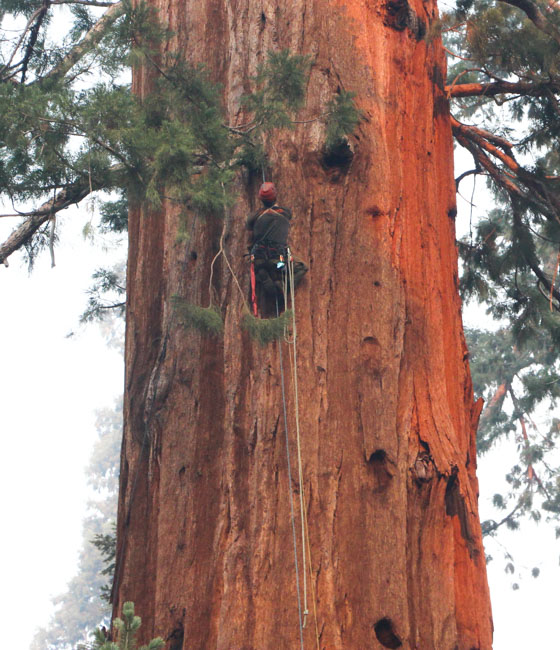
 Rick Rataj and Tyler Anderson, USFS California Smokejumpers, climb a giant sequoia to investigate an area on the tree that is burning. Windy Fire, Sept. 30, 2021. BIA photo by Laura Scott.
This article was first published on Wildfire Today.
Smokejumpers who usually arrive at a fire by parachute have climbed at least one of the giant sequoia trees on the Windy Fire in California to investigate areas on the tree that were burning. The initial reports were that they would climb an adjacent tree and use a fire hose to apply water onto the burning tree. Smokejumpers are trained to climb trees in order to retrieve hung up chutes, but this is not a common task for them, climbing a tree that is burning. Usually they simply cut it down.
But these huge trees that can live for more than 3,000 years have been suffering during the multi-year drought and dry windy weather that has caused very low fuel moistures and intense fires that can penetrate the foot-thick bark. Last year the Castle Fire, just to the north (see map below), destroyed an estimated 7,500 to 10,600 large sequoias with trunk diameters of more than four feet, which was 10 to 14 percent of all large sequoias across the tree’s natural range in the Sierra Nevada.
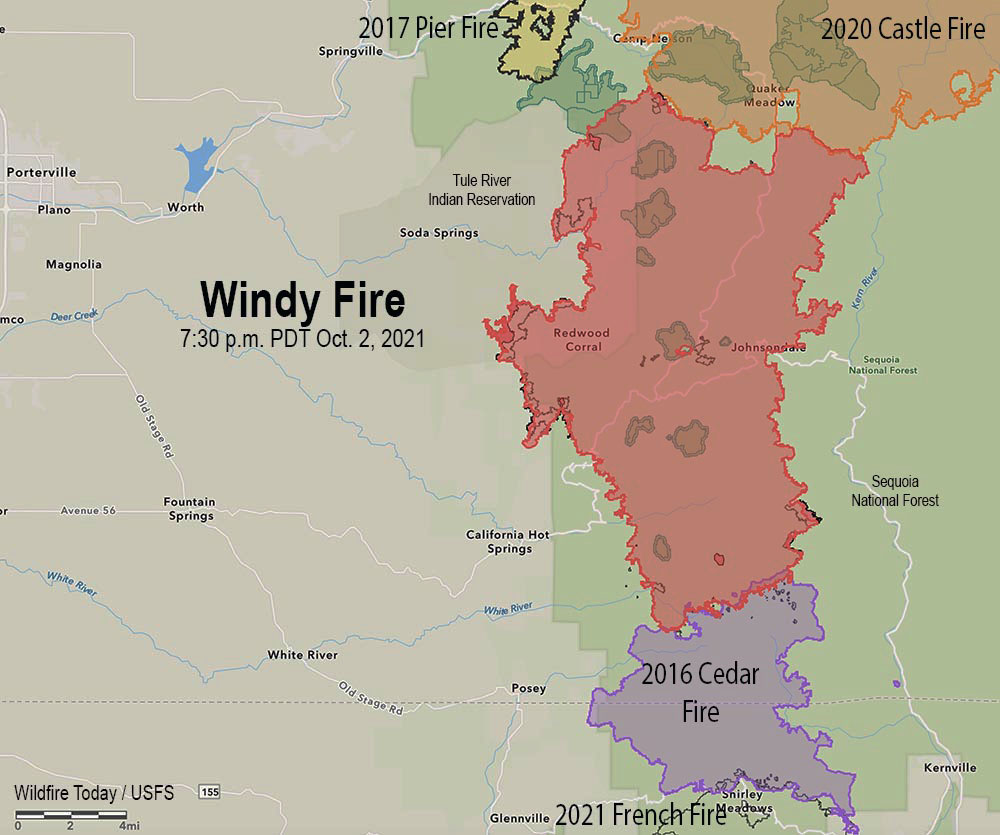 The red line on the map was the perimeter of the Windy Fire at 7:30 p.m. Oct. 2, 2021. The black line inside that, was the perimeter about 48 hours before. The green areas are groves of giant sequoias.
The 92,473-acre Windy Fire has not spread as much in the last two days as it did earlier. Most of the additional growth was on the west side in and south of the Tule River Indian Reservation. During the Saturday night mapping flight the only large area with intense heat (dark red area on the map) was on the reservation.
Most of the north one-third of the fire has contained fireline, as do some of the areas around California Hot Springs, Pine Flat, and Sugarloaf Village but there is still work to do west of Fairview, on the Tule River Indian Reservation, and other locations near Sugarloaf Village.
Very dry daytime and nighttime conditions are expected to persist into early next week. On Sunday, the Kern River drainage will be very prone to strong winds, with gusts of 25–30 miles per hour; elsewhere, gusts will be up to 20 miles per hour. The result will be several hours of near-critical to critical fire weather conditions along the Kern River valley and adjacent slopes.
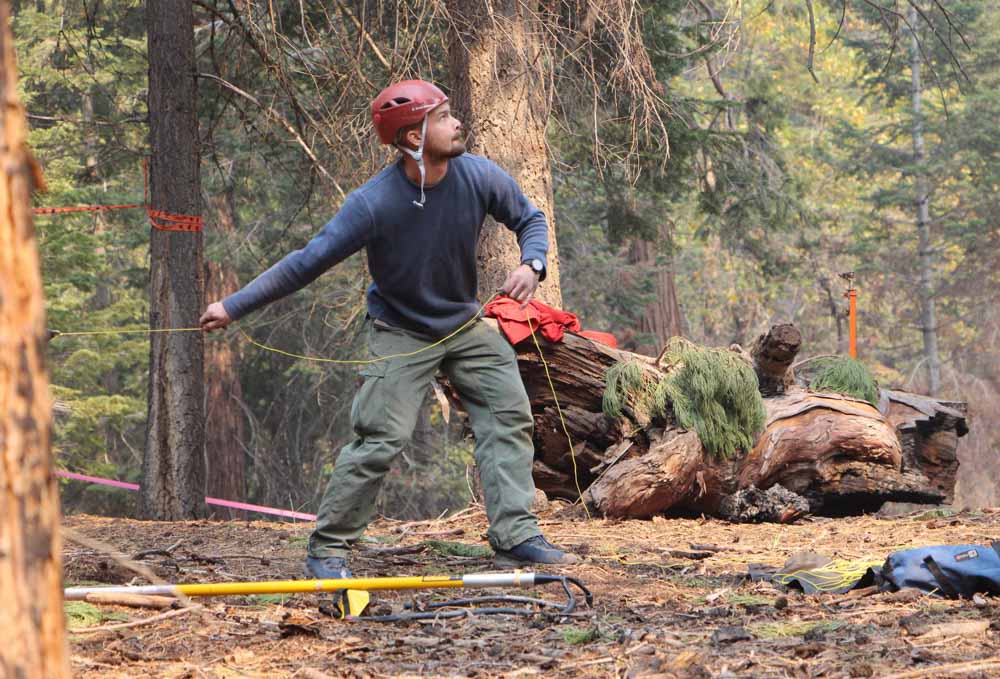 Rick Rataj and Tyler Anderson, USFS California Smokejumpers, utilize a “bigshot” to launch ropes into the branches of a giant sequoia tree so they can climb up to investigate heat left by the Windy Fire on September 30, 2021. BIA photo by Laura Scott.
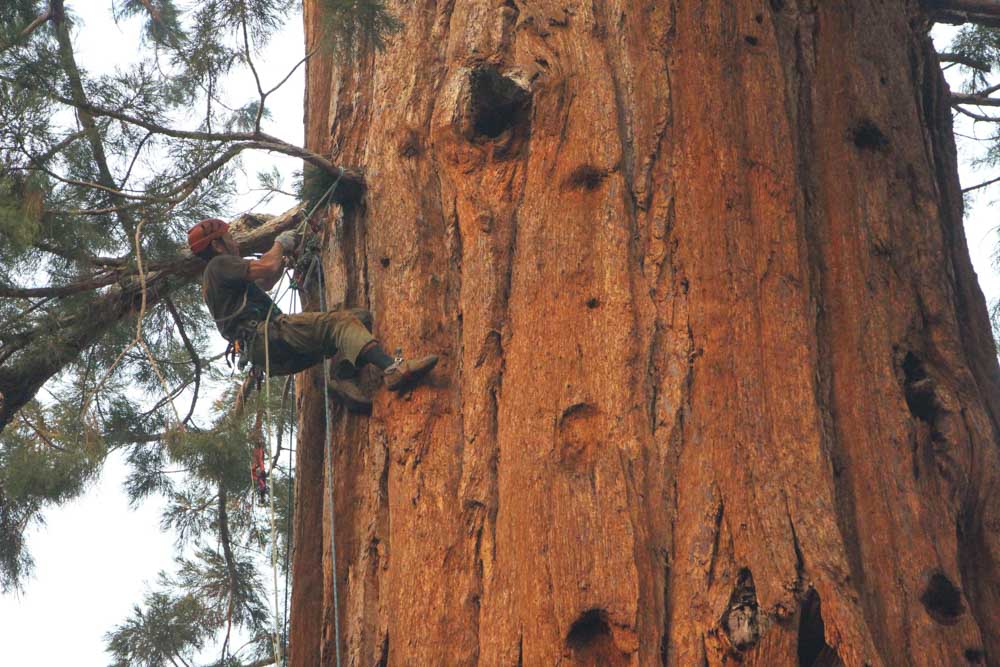 Rick Rataj and Tyler Anderson, USFS California Smokejumpers, climb a giant sequoia to investigate an area on the tree that is burning. Windy Fire, Sept. 30, 2021. BIA photo by Laura Scott.
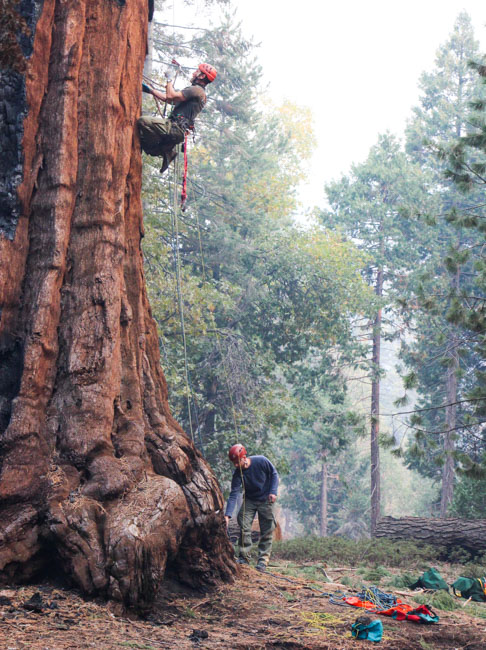 Rick Rataj and Tyler Anderson, USFS California Smokejumpers, climb a giant sequoia to investigate an area on the tree that is burning. Windy Fire, Sept. 30, 2021. BIA photo by Laura Scott.





6 Comments
Just curious-What does climbing a tree have to do with aviation?
To Gordy
PICKY , PICKY ;– BILL GETS A PASS ON THIS . A GOOD PART OF THE ARTICLE IS ABOUT SMOKE JUMPERS ; WHO IN THIS CASE ARE WORKING FROM THE BOTTOM UP . IT TAKES ,DEDICATED BRAVE PEOPLE TO DO WHAT THEY DO ;EVEN IF IT INVOLVES ROPING UP .
MMMM Hero Worship. I think the case can be made that while smokejumpers are extremely hard working individuals; the one word reason for jumping; “Tradition” has reached a point to where the folks in the WO need to really evaulate ALL Aerial fir fighters with a modern algorithem. Its then that rappelling will take its seat at the front of the line. Training costs, injuries, down time, mission completion ratio, Aviation costs of maintaining WCF jump planes to vendor helicopters ratios. I await the boo birds with their belt buckles and illusions to fillet my analysis. Side note Bill, Tree climbing qaulifications are not exclusive to fire. Timber techs climb trees to harvest pine cones all over the lower 48.
Ok Chuck, whatever……..so much testosterone, so early in the day.
I live beside a tanker base in California and enjoy watching all of the tankers come and go. And I have come to rely on this website for any and all tanker updates, especially the 747. And like I said, I was curious what climbing a tree had to do with anything aviation. And the other contributor (Rappel Bro) did a much better job of explaining what is going on, besides you just saying roping up.
There’s a bit more to fire aviation than just tankers.
Smoke Climber…….
Hey! That would look great on a resume!
Comments are closed for this article!