


 Recoil R60-E retractable water tank. Recoil photo.
I first wrote about retractable water tanks for firefighting helicopters in 2009 for Wildfire Today when the Department of Defense Appropriations Bill for FY 2010 appropriated $4,160,00 for fixed belly tanks for National Guard Blackhawk helicopters. It was not until 2013 after the creation of Fire Aviation (in 2012) I found out the tanks would be retractable and made by Recoil Aerospace. This enabled a 900-gallon tank to be mounted on the belly of a UH-60 without having to make major modifications to the helicopter, such as lengthening the Blackhawk’s landing gear to make room.
When the tank is empty the flexible material is withdrawn into a frame close to the belly. As it hovers over a water source and fills the tank the bottom of the tank extends.
Recoil retractable tank
Recoil and at least one other company, Helitak, are manufacturing retractable tanks.
The Recoil R60-E designed for the UH-60 is still available, but the company has designed a new model. The new R60-E Tsunami Tank is made out of carbon-fiber composite material which makes it possible to be manufactured in an assortment of different shapes while keeping the weight at no more than 300 pounds.
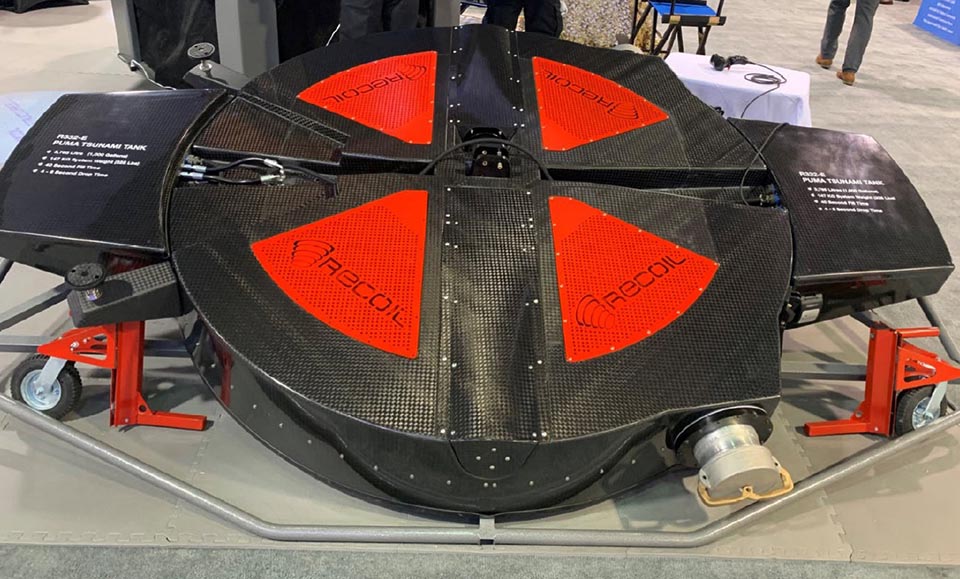 Recoil R60-E Tsunami retractable water tank. Recoil photo.
 Recoil R60-E Tsunami retractable water tank, being tested. Recoil photo.
 Recoil R60-E Tsunami retractable water tank, installed. Recoil photo.
Joseph Rice, the Managing Director for Recoil, told Fire Aviation a Supplemental Type Certificate (STC) from the FAA for the tank is pending. He said two operators are currently using the tank under an FAA Form 337 process, “Major Repair and Alteration,” until the agency can process the STC.
Mr. Rice said their R60-E retractable tank holding 1,000 gallons is available for 10 models of helicopters, including : UH-60, S-70i, SK92, SK61, SK 76, EC225, AW13.
Helitak Firefighting Equipment retractable tank
Paul Blundell, Operations Manager for Helitak, said the FAA issued a STC for their FT4500 expandable fire suppression tank in May, 2021 for installation on UH-60/S-70 series aircraft. The tank shell is manufactured from carbon-fiber composite with a maximum capacity of 1100 gallons US (4500 liters). No extended landing gear or modification to the airframe is required.
 Helitak retractable tank
 www.valleyimagery.com
 Helitak tank, HAI Jan. 28, 2020. Photo by Bill Gabbert
Helitak retractable tanks are available, or soon will be, for about 11 models of helicopters, Mr. Blundell said, including Airbus S350/Super Puma, Bell 212/412/214, Sikorsky S-61/UH-60, S-70, and Boeing CH-47. They are currently being used in the USA, Australia, Europe, and New Zealand.
I took the photo below at the HAI conference in Anaheim, California January 28, 2020. It shows a Helitak tank not only with a conventional fill hose, but with a scooper device which is intended to be lowered into a lake as the helicopter flies across the surface. Mr. Blundell told us it was “a concept model we had been working on. Mainly a conversation starter!”
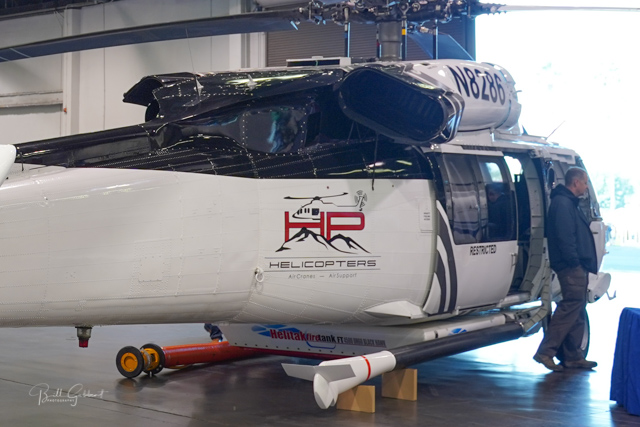 Helitak tank w-scooper, at HAI conference in Anaheim, California, Jan. 28, 2020. Photo by Bill Gabbert. The scooper was experimental.
A similar device is mounted on some Air-Crane Helicopters.
 SDG&E’s Sunbird Air-crane helicopter, scooping water at Lake Hodges, shortly after it was delivered in August, 2010. SDG&E photo.
Safety issues
Both Recoil and Helitak say they have systems to ensure that the tank can be emptied even if there is a loss of power. There are also redundant methods to retract the tanks.
A fixed tank has several advantages over an external bucket, including having fewer restrictions about flying over populated areas. An external tank attached to the belly rather than being internal avoids a safety issue that an executive with Sikorsky told me they were concerned about regarding an internal tank in a Blackhawk. Not that the floor could not support the weight — it can — but a 7,000-pound (or more) internal tank, when filled, “might become a projectile” inside the ship during a hard landing endangering the crew. A belly tank, their theory contends, would not threaten the crew as a projectile, but could crush under the aircraft, serving as an impact attenuator— not unlike the crumple zone in the front of a well designed automobile, or a plastic barrel of water or sand seen in front of obstacles at race tracks or on highways.







7 Comments
Maybe you could use it as a portable HOT TUB out of fire season?
I thought I would comment on this on the off chance someone reading this article may not understand the problems faced when modifying aircraft, especially mounting heavy things internally.
The operators manual for the UH-6oM(S-70i) tells you the restraint criteria when securing internal loads, which is 12g Forward, 8g Lateral and 3g Vertical(up/down) and Rear.
So to secure a hypothetical 800 gallon internal tank weighing 6600lbs requires a restraint capability of just over 80,000lbs Forward, 53,000lbs Lateral and 20,000lbs Vertical/rear. Floor loading limitations must be considered as well, although it appears my hypothetical internal tank comes in below the 2.08lbs per square inch the UH-60 floor can take. I know companies have tackled these problems, I just don’t know how and would be interested to know if anyone reading this could describe how the internal tanks are mounted.
So as you can see, the Sikorsky comment about the tank becoming a missile is pretty spot on and is always a consideration when something is in the aircraft cabin. These under belly tanks seem like an interesting solution to the challenges of internal tank use.
Dan
The general solution typically involves creating an attachment frame that links with the existing mounting plates in the aircraft floor. The key for certifying the internal installation is getting most of the water out prior to the crash case. The FAA has provided some guidance on how to show that in AC 29-2C, Section MG-5.
Nathan thanks for the info. I figured the floor tie down points had to figure in but I wasn’t getting to enough restraint capabilities with just those. Do they also incorporate the mounting points where the cargo hook is attached in these systems? I have an A&P but I’ve only ever worked in aviation for the US Army for 20 years so not very knowledgeable on the regs you mentioned, I’ll have to check them out.
Dan
Huge proponent of the tanked aircraft, no hanging bucket to be dragged or caught on anything. No worries about the bucket accidently being jettisoned (saw this happen three times in two weeks with the same ac). I’ve seen these tanks drop water on fires and are very effective. Personally think all water-dropping helicopters should be tanked. Looks like this is a great option, especially for the Blackhawks.
Jeff, I agree. In my observations, besides eliminating the prospect of jettisoned buckets and bucket operational issues, tanked helicopters are generally more efficient in the circuit and drop accuracy is better and more consistent across pilots. Having said that, I have worked with several pilots who were/are truly masters with the bucket-credit to them.
There are two potential drawbacks to this. For some operators, using ground filling is pretty common, either from a hydrant or from a truck. I don’t see this as a possibility for the collapsing fixed tanks. The second also applies to these as well as some of the hard tank installations and that is ground clearance. I’ve seen more than one punctured tank , even on a Huey with high skids and good clearance. Sometimes LZs are not as nice as you’d like. OTOH, the more tools in the box the better. Extended height gear added to a Hawk is an expensive proposition and this does offer an alternative to the internal tank that is available.
Comments are closed for this article!