


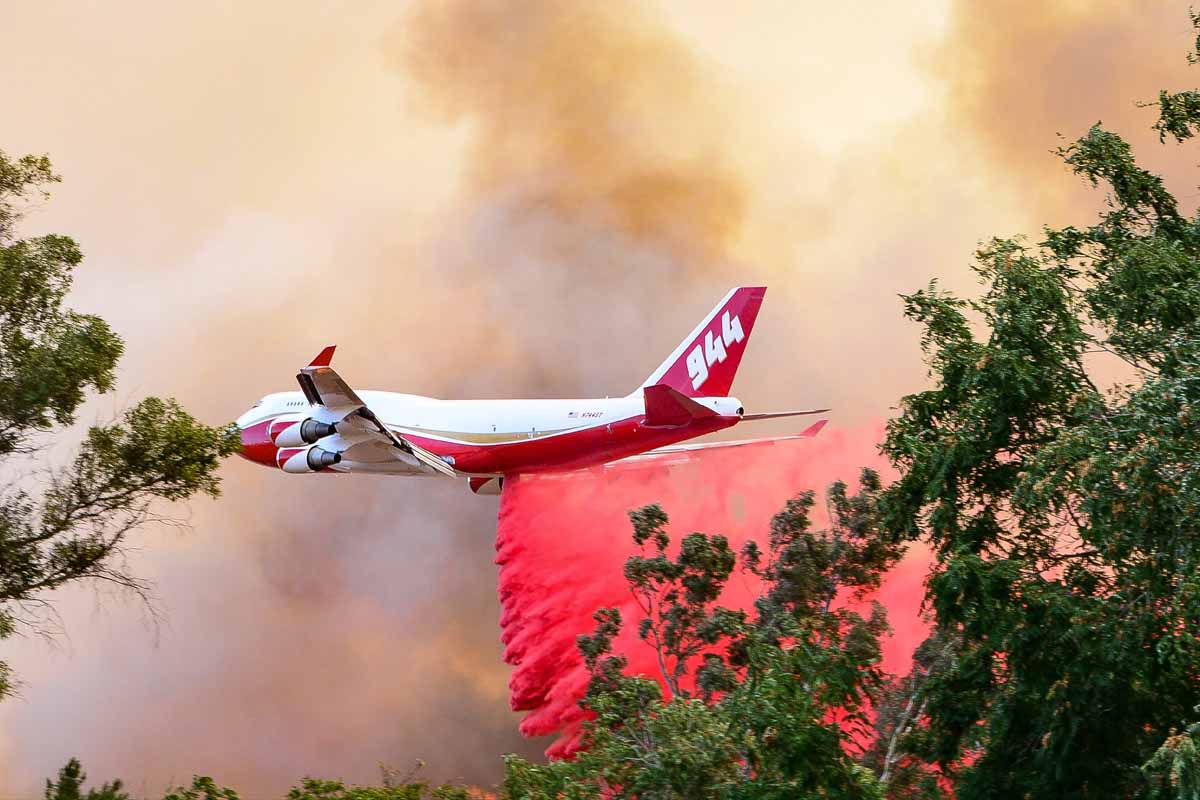
 The 747 SuperTanker 944 drops on the Palmer Fire south of Calimesa and Yucaipa in southern California, September 2, 2017. Photo by Cy Phenice, used with permission.
The 747 Supertanker is on track to be available to fight wildfires again by the end of this year.
Vandi Cooyar, President of Logistic Air, told Fire Aviation that the nose-loading 747-200 that will be equipped with the retardant delivery system (RDS) is going through scheduled maintenance, including a C-check. During that process the necessary modifications will be made to the air frame including installing the retardant doors in the belly, the wiring, and other components in the cockpit to operate the system. After that is complete, the hardware, the tanks that hold retardant and compressed air that are on cargo pallets, will be installed, then ground testing will begin by late summer or early fall.
Mr. Cooyar said the ground testing, which involves dropping water while the aircraft is parked on the ground, will confirm the recently improved algorithms and determine if any additional modifications are needed. The next step will be airborne tests.
After the complete RDS is installed, tested, and fine-tuned, if there is an opportunity to submit a bid for a contract with the US Forest Service, the company will schedule the Interagency Air Tanker Board’s (IAB) grid or cup test which measures the amount of retardant that hits the ground over a large grid.
 The 747 Supertanker at Santiago, Chile, January, 2016. Photo by Bill Gabbert.
But regardless if there is an opportunity for a US Government contract or not, after installing the RDS, conducting ground and air tests, and fine-tuning the algorithms if necessary, Mr. Cooyar said at that point the aircraft will be available again for deployment internationally. In fact he said he is in preliminary discussions with officials in multiple countries. In addition to previously having contracts with the US Forest Service, Colorado, Oregon, and the California Department of Forestry and Fire Protection, the Supertanker has fought fires in Mexico, Israel, Bolivia, and Chile.
Just before the Supertanker was mothballed last year the drop controlling system, algorithms, and other components were significantly modified to improve the delivery of retardant, reduce the trailing off of retardant after a drop, and meter the volume dispersed based on the ground speed of the aircraft. It then went through dozens of tests on the ground. The operators were waiting for it to be scheduled for the IAB grid test. But before that took place, the owner, Alterna Capital, shut down the company and sold the aircraft and the RDS. The 747 was purchased by National Airlines to be used as a freighter, and Logistic Air bought the RDS.
 Some of the tanks inside the 747 Supertanker while the system was basically in place but not fully installed and operational. McClellan Air Field, March 22, 2016.
The SuperTanker’s RDS is comprised of approximately 20 tanks that hold retardant and enough compressed air to pump the retardant out of the four nozzles that were in the belly of the huge aircraft. At various times the air tanker had interim certification by the IAB to carry 20,000, 19,200 and 17,500 gallons of retardant.
 Evergreen 747 SuperTanker 979 at San Bernardino, May 30, 2004. Photo by Steve Whitby.
The first version of the Supertanker was in a nose-loading 747 operated by Evergreen. Then it was in a conventional 747-400 freighter, and now it will be in a nose-loading 747-200 operated by Logistic Air.
This article was edited to indicate that the aircraft is expected to be available to fight fire by the end of this year.





14 Comments
Let the bitchin begin about the 747 and how we should bring the B757 and every other aircraft on. Let the chirping begin about gravity vs compressed.
Lol …better have something available because it ain’t 1995 anymore and that study needs to be reworked by those in industry
Good on Log Air!!
The 747 airframe has compressed and decompressed as much as the DC 10.
It’s as old in the fleet like trying to drop out of an L10-11.
We all should be thankful for this quite yet gental giant in the sky.
Expensive? Yes…but effective. In the right fuels and conditions.
I remember ordering the evergreen 747 . It cost a quarter million dollars just to launch it off the tarmac.
Life safety. Air safety. Ground support.
If utilized as a tactical air support.
The bang is worth the buck.
Whatever it takes to keep our ground tactical personnel safe… do it!
Cool, I’ll be looking for it chocked up on a ramp… again.
Blessures
Could happen. The next few years will tell about availability of aircraft. When there becomes an aircraft shortage….one can not be too picky about what aircraft is making the delivery.
Some folk chirp about the ’47 and the C130 and their delivery method …most folks don’t know the depth of work and cost on an airframe to make a gravity dump system…
Last I heard very few aeronautical engineers and large transport category aircraft pilots in the stables of the land management agencies and on the fireline . So yeah, it could on the ramp chocked up
Then there will be that one day or one year that folks will wish that those RB211s, GE CF6 or those Platts were burnin kerosene…
Correct your grammer, then talk to us about lack of pilots and mechs. Jesus
Wow
Great I look forward to filling that bitch up 🙁
More than welcome here in Australia. We were close in getting GSTS out in the 2018 season, but politics (as usual) got in the way! Now we are close to an election and change of leadership – so just maybe! Fires and the lack of Government action on an aerial fleet are foremost in those in badly hit communities on the east coast. Sure hope they managed to hire on some of the original GSTS staff. A lot of knowledge and skill just waiting to be used!
Mike, you wrote,
“Correct your grammer”.
Maybe you should correct your spelling before you start throwing abuse. It’s grammar.
And please stop blaspheming.
I’m not religious but many readers are. Blasphemy and swearing in a post removes any credibility that a post had in it.
Hopefully the Editor can delete that remark. It serves no purpose, (regardless of whether readers are religious or like the 747 as a tanker).
Having worked with some of the staff while they were here in Australia, I can say I did become religious-about this aircraft and it’s engineering! Fires are not getting any smaller or less intense. Hope we see the crew downunder!
Just to correct the record, the 747 Supertanker has never worked on a fire in Australia, and as far as I know has never been on the continent. However, DC-10s have had firefighting contracts in Australia.
True! But we did put in a bid to have GSTS come over and set up at Avalon Airport in Victoria. Close, but no cigar!
Was great to work with the staff and learn all about the tank system. We were hoping to trial an alternative retardant to PhosChek at the time, safe to use over catchment areas and waterways. A great project to be involved in. Hope all goes well with testing and they land a contract in U.S.
Look, the only way this ends is with the Stratolaunch ROC putting down dual lines of coverage level 75 while simultaneously dropping jumpers with Pyroshot miniguns blazing the whole way down
Bring on the big Boeing, its needed and it looks beautiful no matter what is inside.
Right now we have a big fire in western Nebraska. Among several aircraft, they flew in a DC-10 from Helena Montana Saturday. I couldn’t believe it. It circled over town a half dozen times. It was the first time I had ever seen one in real life even though it was 4500 feet above. Other than the fire it was a great day. Bring the 747 back, I’m sure mother nature will keep it and many planes busy.
Comments are closed for this article!