


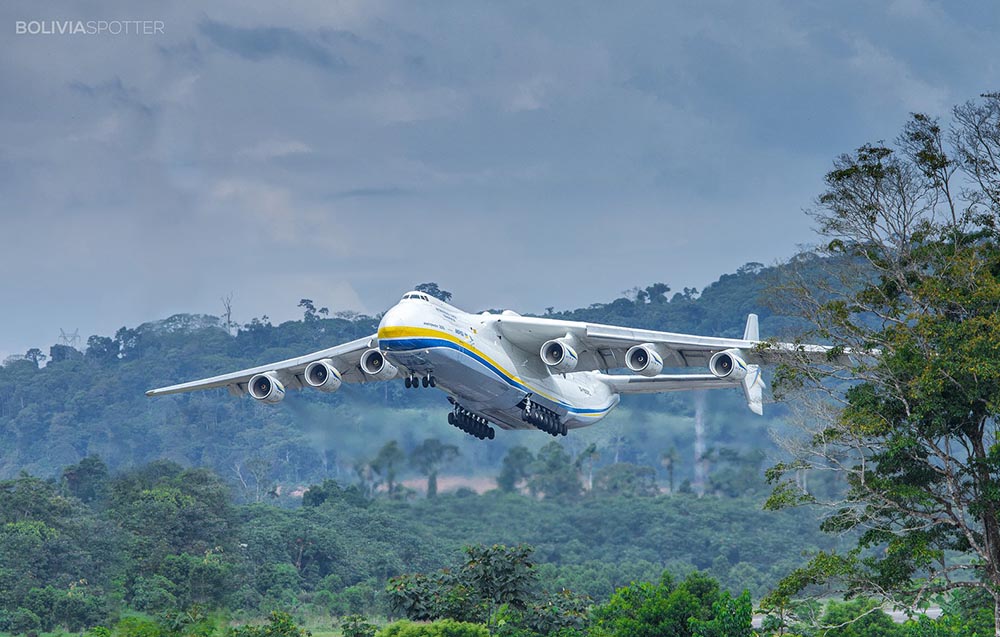
 Antonov An-225. Photo by Eduardo Salvatierra Aliojin. Posted on Antonov’s Facebook page in 2018. Russia destroyed the aircraft on February 24, 2022, the first day of the war with Ukraine. The aircraft was undergoing maintenance near the Antonov facilities at Hostomel Airport near Kyiv. It was never configured to drop water or retardant on wildfires.
The standards and contracting requirements for aircraft that assist wildland firefighters can vary widely among countries. This can create roadblocks for sharing these important tools if a company wishes to operate their aircraft in more than one country.
Flight Global reports that a group of fire aviation industry representatives, the International Coordinating Council of Aerospace Industries Associations, is urging a United Nations agency, the International Civil Aviation Organization (ICAO), to establish international standards for certification and operation of firefighting aircraft.
“Lack of a common approach to certification, validation and operation of these aircraft has led to jurisdictionally-unique and often cumbersome regulatory approval processes, often resulting in impractical limitations for the missions intended,” the council claims in a paper submitted to the upcoming ICAO Assembly in September.
The relatively small size of the market for firefighting aircraft can make it impractical to configure them to meet the standards in multiple countries.




9 Comments
Transport Canada is one of the few if only aircraft certification body that has rules for certifying firefighting aircraft including aircraft retrofits and new designs. Since many of the world’s new fire fighting aircraft of the last decades were developed in Canada (FireCat, Convair 580, CL215T, CL415, DHC-8-400MR, RJ85 and DHC-8-400AT) this area has been well covered.
Although the thought is certainly valid it seems like a Sisyphean task. A perhaps even bigger hinderance to global sharing of firefighting aircraft is airspace management. I’ve done “ATGS” work in New Zealand, Indonesia, Portugal, Australia, Greece and of course the U.S. The way all these countries manage what the U.S. and Canada call the FTA are vastly different and mostly non existent.
Maybe start with what the U.S. and Canada have in terms of the FTA and standardize it across the globe and THEN move on to aircraft. From what I’ve seen, the juice is worth the squeeze.
Right on
John Billsmith: Affirm. And I’ve been saying that a few AFF conferences. The FTA is a proven concept, and it should become the common procedure worldwide.
The FTA is indeed a proven concept, but it’s not even a common one between Canada and the US. I’m willing to wager none of the US airtanker pilots or ATGS staff could explain the differences without Googling it. Let’s work to make it standardized here first, and then worry about jurisdictions further afield.
Excellent “shot” of the An 225 coming off a drop. Importunely this aircraft was destroyed in overseas conflict.
The AN 225 was never used as an airtanker.
Yes. There needs to be safety standards and enforcement of them. I know very little about Aerial firefighting or even ground fighting. But I know one thing. My son died in the Iron 44 tragedy in Northern California in 2008 along with 7 of his comrades. The bottom line is the lives of firefighter, dads, sons daughters, etc. . I understand fighting fire is urgent etc. I understand the desire to cut corners to speed up the end result but please remember the “bottom line”. Mom to Scott Charlson LODD 2008
I suspect if the can of worms that is international certification of airtankers ever be opened, it could have devastating effects on some of the more high-profile airtanker operators in terms of their export opportunities outside the US. The US FAA allows operators to use a “Special Airworthiness Certificate” for aircraft assigned to a “restricted category”, neither of which are – nor likely will ever be – recognized in other countries.
Such recognizable airtankers as the BAe-146, C-130, MD-87 and B737 are limited to perform only the special purpose identified in their applicable type design (ie: “forest conservation” use). They are not permitted to carry cargo, passengers, etc, which is why we haven’t seen types such as the 737 – heavily marketed to carry firefighters & their gear as well as operate as airtankers – carry a single firefighter to date. I don’t believe Avro, Lockheed, Boeing etc want anything to do with their products that have been significantly modified beyond their original design without their involvement and approval.
The possibilities are brighter for those aircraft which were either expressly designed for firefighting (CL-series, AT-802 variants) or those who have the support of the original manufacturer or Type Certificate holder (Q400 AT/MR versions, DC-10(?), RJ-85 etc). None of them will likely ferry passengers at any time (except the -MR version of the Q400), but they are maintained to the same high civil standard as their counterparts in non-firefighting use, and were developed in conjunction with and enjoy support from their original manufacturers. None of them had a history of military use, and so each & every component has a paper trail from the time the aircraft was assembled, unlike former military transport aircraft in the same industry. Just as crucially, none of them cut holes in the pressure hull of their airplanes to install an internal bomb tank.
So why do we see American restricted-category aircraft operating for hire in places like Australia and Chile? That’s a very good question, and I suspect the answers lie obscured in a web of marketing, some selective blindness and/or lack of understanding on the part of the hiring agencies, and a pretence that extraordinary incidents require extraordinary solutions…even though fire seasons are very ordinary, predictable and repeatable. They come as no surprise to anybody.
Comments are closed for this article!