


 70 knot (80 mph) indicated tail wind at 2,700′ agl at Cooma, NSW January 23, 2022. The aircraft was preparing to land at about the same time as the ATGS. Photo taken by a single engine air tanker pilot before landing at Cooma. The speeds, True Air Speed and Ground Speed, are circled, and the photographer’s reflection was obscured.
An aerial firefighter who supervised the use of air tankers and helicopters on the fire at which a C-130 air tanker crashed killing all three on board, told Fire Aviation that hours before, he had ordered the grounding off all firefighting aircraft due to the extreme wind event with “40-knot wind shear and zero visibility.”
On January 23, 2020 at 1:15 p.m. a C-130, Air Tanker 134, Bomber 134 (B134) as it was known in Australia, crashed just after dropping retardant on the Good Good Fire for the Rural Fire Service in New South Wales, Australia.
The person who reported this to Fire Aviation (and asked to remain anonymous) was serving as the Air Tactical Group Supervisor (ATGS) at the time, a position that coordinates incident airspace over an incident, manages the air traffic, and is the link between ground personnel and incident aircraft. The ATGS is an airborne firefighter who coordinates, assigns, and evaluates the use of aerial resources in support of incident objectives.
Earlier that morning on January 23 the ATGS had attempted to fly in a helicopter to the Adaminably Fire to evaluate conditions prior to assigning aircraft. Below are excerpts from his email:
Upon lifting we noticed a brown Haboob to the north with extremely stiff headwinds. Only 2-3 minutes out from Polo Flats Air Base in Cooma, the pilot and I looked at each other and each agreed to return to base immediately. When we did we had a hellacious tailwind. Upon turning final our aircraft (AC) was pushed down by wind shear very hard. We landed and had to wait in the AC for 20 mins as the main rotor would not stop spinning (Bell Long Rangers have no rotor brake).
Eventually we got out and struggled to tie the AC down. I entered the Air Base and immediately told the pilots to secure their AC and return to their hotels. This was going to be an all day extreme wind event and we were done for the day. This was at 0917 a.m. (I forever have it noted on my kneeboard.) I notified Cooma FCC [Fire Control Center] of conditions and that I had sent the pilots away. This was within the purview of Air Attacks over there so that was a good day to exercise my power as the “big bad American”. I did this so they would not get pressure to launch all day, as was the custom. It put the already bedraggled pilots at ease and I was glad to take any heat that would’ve come out making a decision to call it off for the day.
Hours later, while eating lunch with my pilots, I got a call from Queanbeyan FCC asking if I had any aircraft up, to which I replied “Hell no, do you?” the reply from them was the same. I was then told of T134 ‘missing’. I rushed to Cooma FCC and very strongly asked why a tanker was sent there in the first place AFTER I shut down all AC due to 40kt wind shear and zero viz. I was incensed. The Good Good fire was dead as well and there were no structures threatened. I saw the real time Firebird footage of the wreckage when it was discovered and almost flew off the handle. I think about those pilots almost daily and wonder, if I was more forceful in my shutdown, perhaps they never would have been dispatched!
In the United States, firefighting aircraft are sometimes dispatched on the initial report of a fire along with ground units depending on the standard operating procedures and the current fire danger. But after a command has been established at the scene additional resources are requested by the Incident Commander on the ground or an ATGS or Air Operations Branch Director.
The person who was the ATGS in NSW on January 23, 2020 explained that aviation resources are deployed differently in that state:
In NSW, the Sydney Air Desk is almost omnipotent and they unilaterally deploy Large Air Tankers (LATs) to a fire in which they believe structures are threatened. This means, as an ATGS, a Birdog and LAT may just show up at your fire hunting for work because the Sydney Air Desk Sent them. It’s terribly flawed.
He said units at a fire could request drops from an air tanker but the process was cumbersome:
You had to put in a request with a starting coordinate and ending coordinate for the requested drop. Once the request was submitted, it could be 24 to 48 hrs before it was approved and then the Bird dog and tanker would show up. Well, at that point, the intended line was typically miles interior and you could not “adjust” the drop so that it was actually on the edge, you had to put in a new request altogether. In short, usage of LATs was very tightly controlled by the Air Desk and it wasn’t at all uncommon for them to unilaterally send LATs to any fire they felt it was necessary. You usually got one drop, there was no load and return, or tag and extend so the drops were all but worthless.
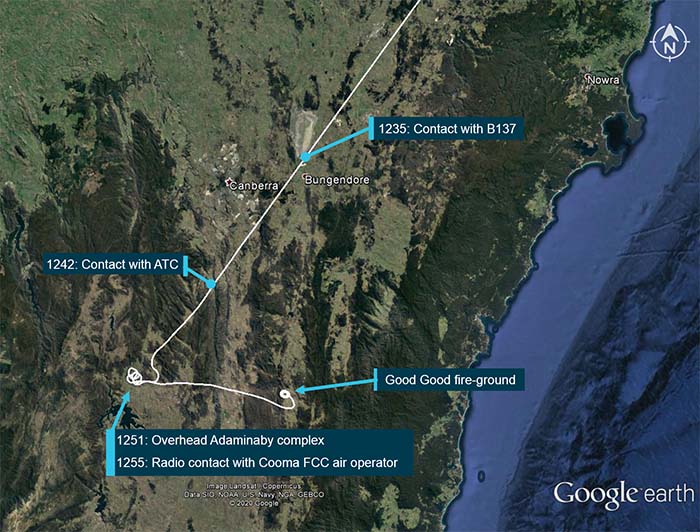 Flight path overview (in white), including the times and locations of where the crew of B134 was in communication with others. From the report.
On that day the C-130, B134, was dispatched by the RFS to the Adaminaby Fire. A 737, Bomber 137, had already dropped there shortly before but reported having experienced uncommanded aircraft rolls up to 45° angle of bank (due to wind) and a windshear warning from the aircraft on-board systems. The B137 crew sent a text message to the bird dog pilot indicating that the conditions were “horrible down there. Don’t send anybody and we’re not going back.” They also reported to the Cooma FCC that the conditions were unsuitable for firebombing operations. During B137’s return flight to Richmond, the Richmond air base manager requested that they reload the aircraft in Canberra and return to Adaminaby. The Pilot in Command (PIC) replied that they would not be returning to Adaminaby due to the weather conditions. A bird dog (lead plane) had been dispatched also but after taking off it refused the assignment due to weather conditions.
The PIC on B134 was aware of the report from B137 but they continued to the Adaminaby Fire. The C-130 was built in 1981 before on-board wind shear warning systems were available, and none had been installed in the following 39 years. After checking out the conditions they refused to drop, saying it was too smoky and windy. Then they were told by the Cooma FCC to drop on the Good Good Fire instead, about 58 km to the east. After arrival, they made three circuits over the fire, then dropped, encountered a strong tail wind and wind shear, stalled, and crashed onto rising terrain, killing all three crewmembers.
 B134 flight path showing wind direction and 3-D terrain at the Good Good Fire.
From the ATSB who contacted Fire Aviation:
On that fateful day on the Good Good Fire no tankers were ordered, it was a secondary target that was done in order to avoid jettisoning retardant, which is like liquid gold over there. The prudent thing to do would have been to not launch or, once launched merely jettison the load and return to base instead of casting about in that weather for a target. It’s a very sad situation that was wholly avoidable!
The ATSB told Fire Aviation that he was not interviewed by the Australian Transport Safety Bureau when they were conducting the investigation.
Our Take
This accident is a good example of the James T. Reason’s Swiss cheese model of accident causation. It likens human systems to multiple slices of Swiss cheese, stacked side by side, in which the risk of a threat becoming a reality is mitigated by the differing layers and types of defenses which are “layered” behind each other. Therefore, in theory, lapses and weaknesses in one defense do not allow a risk to materialize, since other defenses also exist, to prevent a single point of failure.
 James T. Reason’s Swiss cheese model of accident causation
Over a two or three hour period there were many acts, decisions, and policies that if they had occurred one at a time would not necessarily have caused the fatal crash. Such as:
- A standard operating procedure of a person sitting at a desk to routinely make decisions to launch firefighting aircraft sometimes after the initial attack phase without knowledge of conditions that affect safety of flight and the need and likely effectiveness of the drop. They may be thinking, “task them, and let the pilots sort it out”.
- A system that encourages an aircraft to continue to an assignment to “check it out for themselves” even after one or more other aircraft have refused the assignment or reported unsafe flying conditions at or en route to the incident.
- A system that allows two different Fire Control Centers to dispatch the same aircraft to a fire shortly after the crew reported to one of the FCCs that weather conditions at the fire made air operations unsafe.
- Dispatching air tankers when the wind speed would not only result in unsafe operating conditions for aircraft, but would make the drop ineffective by blowing it off target.
- Maybe the crew of the C-130 was not aware of the possible wind shear that may have been caused by the ridge west of the fire. Before the drop they made three circuits, at 1,500′, 500′, and 1,000′ AGL before the final pass at 500′ and 144 knots ground speed. Weather observations suggest that after the drop they may have had a tailwind gusting up to 43 knots. The report concluded it was likely the aircraft aerodynamically stalled, resulting in a collision with terrain. The aircraft was not equipped with an on-board wind shear warning system.
The Crew
Captain Ian H. McBeth lived in Great Falls, Montana and served with the Wyoming Air National Guard and was still a member of the Montana Air National Guard. He spent his entire career flying C-130’s and was a qualified Instructor and Evaluator pilot. Ian earned his Initial Attack qualification for Coulson in 2018.
First Officer Paul Clyde Hudson of Buckeye, Arizona graduated from the Naval Academy in 1999 and spent the next twenty years serving in the United States Marine Corp in a number of positions including C-130 pilot. He retired as a Lt. Colonel.
Flight Engineer Rick A. DeMorgan Jr. lived in Navarre, Florida. He served in the United States Air Force for eighteen years as a Flight Engineer on the C-130. Rick had over 4,000 hours as a Flight Engineer with nearly 2,000 hours in a combat environment.
May they rest in peace.





4 Comments
Very sad. Those actions cannot be taken back nor the outcome erased. So sorry for the families and firefighters.
As an Australian to say that I am disgusted about this accident it could have been very easily avoided, one of the problems that we have with firefighting in Australia is the bureaucrats they always get in the road one my brother-in-law’s is a captain of a rural Fire
brigade and the nonsense they had to go through to get new equipment is ridiculous in the end they had to have a fundraiser to replace pumps on their tanker. These fine men came to Australia to help us out during our time of need and I cannot help but be saddened on the fact that we let them down.
Mr. Hoswell,
I am the person mentioned in the article. First off, let me just say, the Australian people absolutely did not let us down! We were all honored to be there and would do it all over again. Nobody ordered us there, we all came of our own accord. The Australian people were/are fantastic to us and showed us the utmost respect. 2020 was a catastrophic year for your Nation and we all recognized that going in, we were champing at the bit to get plugged in to the effort and help our friends from down under. It was my please to come to your great country and the Australian people made us feel very welcomed!
This incident was positively terrible and a lot fell through the cracks to make it happen but it was largely due to bureaucracy, something we Americans are all too familiar with as well. If anything, I think it illustrates the perils of centralizing decision makers far away from the operations…something we too are familiar with. Take care good sir and thank you for having us.
Sympathies and regards to the families.
The “Good Good” really wasn’t.
And, isn’t there an STC for rotor brakes for LRs?
Comments are closed for this article!