


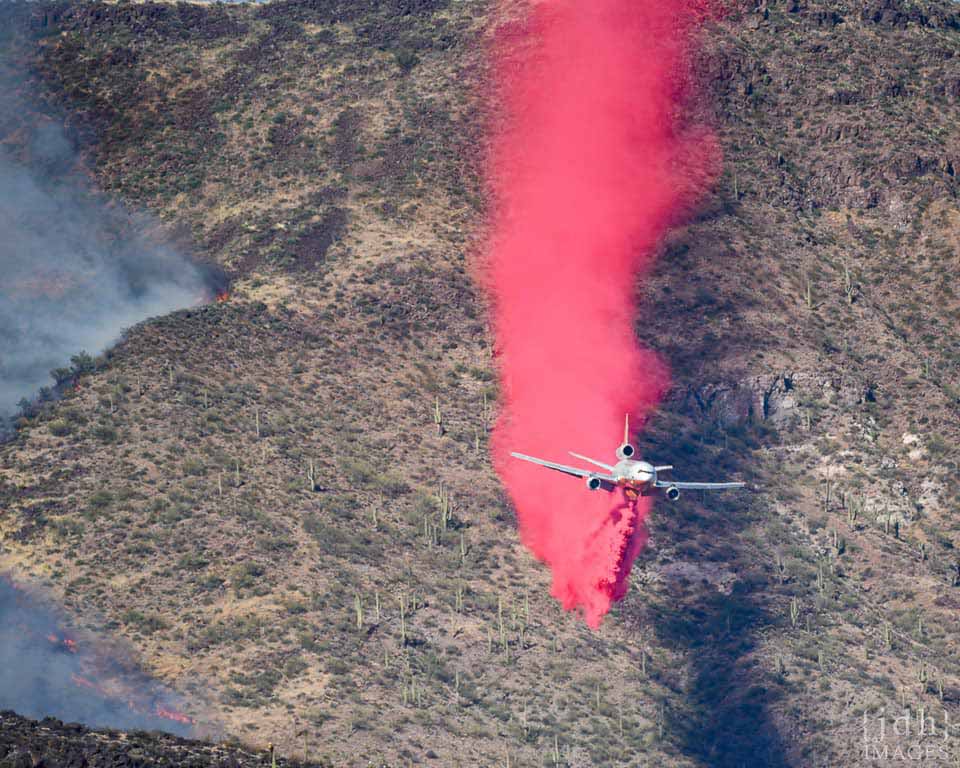
 Air Tanker 914, a DC-10, drops retardant on the Central Fire, June 20, 2020. Photo by JDH Images.
This article was first published at Wildfire Today.
An environmental group filed a lawsuit in a Montana federal court Tuesday alleging that the US Forest Service has polluted waterways by inadvertently dropping fire retardant in or near waterways. The retardant was dropped by aircraft under contract with the Forest Service while assisting wildland firefighters on the ground.
The suit says government data released earlier this year showed more than 760,000 gallons of fire retardant was dropped into waterways between 2012 and 2019. The lawsuit alleges the continued use of retardant from aircraft violates the Clean Water Act and requests a judge to declare the pollution illegal.
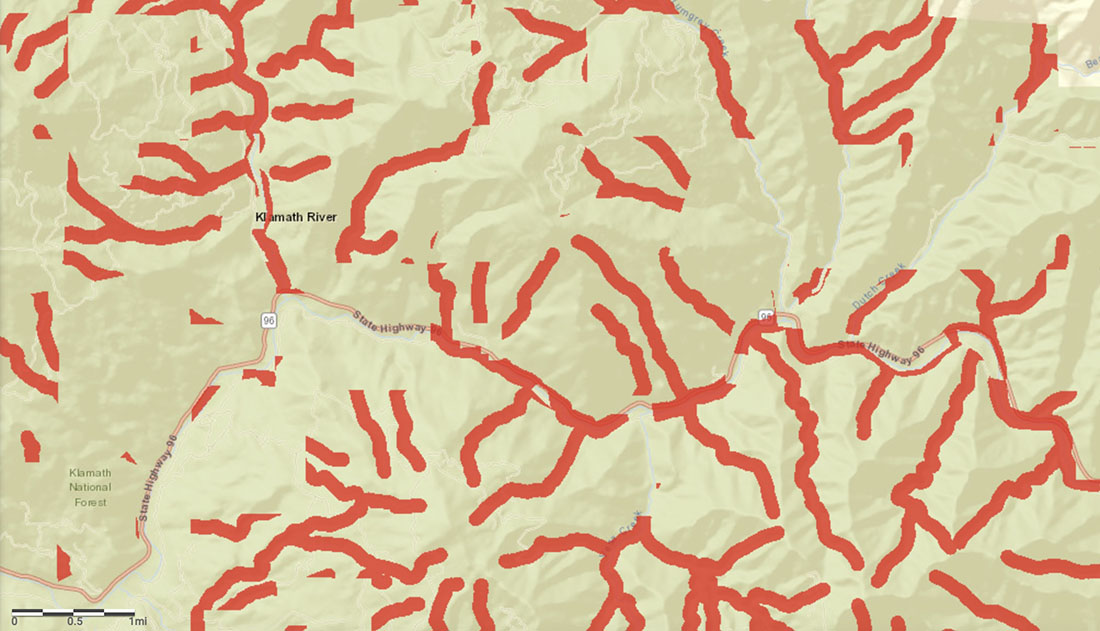 Example of retardant avoidance areas (red) in Northern California along Hwy. 96 near Klamath River.
The Forest Service has established retardant avoidance areas along waterways where the liquid is not supposed to be applied. This puts buffer zones around waterways and habitat for some threatened, endangered, and sensitive species in order to avoid applying retardant in those areas. When they were first established in 2011 it resulted in approximately 30 percent of USFS lands being off limits for retardant while fighting fire. There is an exception if human life or public safety is threatened. The policy was the result of an Environmental Impact Statement (EIS) that studied the use of retardant and how it affects water resources and certain plant and wildlife species. The EIS was written in response to a July, 2010 decision by U. S. District Court Judge Donald Molloy in a lawsuit filed in 2008 by the Forest Service Employees for Environmental Ethics.
The same organization, FSEEE, filed the new case yesterday. An attorney in Missoula, MT who specializes in environmental law, Tim Bechtold, will be representing FSEEE. Presiding over the case will be District Court Judge Dana Christensen. He joined the court in 2011 after a nomination from President Barack Obama. Before, he was a partner in the firm of Christensen, Moore, Cockrell, Cummings, and Axelberg, in Kalispell, Montana. One of the 15 practice areas the firm deals with today is environment and natural resources.
In 2012 FSEEE issued a statement criticizing the use of air tankers on fires, claiming it is “immoral”. The group argued that aerial firefighting is too dangerous and ineffective and that “retardant doesn’t save homes; proper construction and landscaping save homes.”





12 Comments
so,its better in their eyes to have millions of acres burn creating widespread environmental destruction (yes fire is good for the forest) and the rapid spreads and acres burned,polution from smoke and the widespread human health issues, along with the populations in the USA,which will put human life in danger.this is all less important to them than the waterways,yes those fish and small creatures mater, but more than human life?
I worked wildland and wildland urban interface fires for 25 years. Then worked with light and heavy helicopters on wildland suppression. For another another ten seasons.
In my opinion fixer wing retardant delivery has always been what ever agency was managing a particular incident, a tool to shot the public, look here we’re doing something. See the aircraft in the air.
Big waist of money and time that could be better spent on heavy router aircraft with 1,000 to 2,000 gallon buckets.
My opinion.
Clyde, Which Type 3 crew did you work on?
Sometimes the decision makers vote the night before at the local watering hole. fixed? rotary? How many? Both or just one type ac? If you an older Adult im sure you’ve been at votes and sometimes wonder what some think. Way Way back it was all about what’s in it for us $$$$. Nobody questioned it. Well those Days are done….. but recent College Grads with a slide rule with 0 experience make the end decision. (sometimes). In my born years I’ve/we’ve had some Great Team Work and Experienced Missions go Flawless. Its Miller Time after Success. the only thing that doesn’t change is the Method of Pointing Fingers when things git Fuzzy.
Leads and ASM’s just had their entire existence put in jeopardy.
An alternative might be the use of a less toxic retardant. Tried to get a trial underway here in Australia of a product that is safe to drop over waterways but was advised that it has to be on the President’s approved list – yes, that is the U.S. President’s list! Not sure what the options are going forward, other than the use of water around river systems and catchments. Very important to look around and evaluate alternatives, if you want to stop fire, preserve the catchments and save drinking water for communities. A terrible example of the use of toxic chemicals is the recent program on the Fiskville training facility in Victoria. Continued used of PFAS went on to devastate volunteers with cancer and impact the farmlands around the centre. PFAS is known as the forever chemical and was killing the very thing it was meant to protect. The action taken by a couple of firefighters went on to echo around the world.
USFS is going to wish they had done a better job on the “effectiveness” part of the AFUE study.
Well Bouys and Gulls 2023 is almost here and things aren’t getting better….again as you may know I am a former Crane F/E for a bunch of years. Fire Bucket qualified. Think our fiberglass bucket was 1000 or 1200 gallon. one way or another that’s a lot of water X two Cranes at a usual CT. woods fire or a Drum Impact area (Army was ok with us using water). our Crew was introduced to the Beautiful People of CT. Flight Ops called when we had the Fight in control and called off the Mission. Why? worried Citizens complained we were using too much of the lake water and they were afraid we were gonna empty the Lake. this mission was around mid 80’s. I feel your Pain from you people in the air Fire Fighters Brigade.
If it is harmful to waterways it is probably safe to assume it is harmful to all life. Yes, this includes human life.
Too any are making too much money off of the sale and delivery of a product that is ineffective.
The money would be better spent in prevention, at the very least, helicopters are far more effective.
Suppression over retardation!
A blanket ban on retardant use is a bad idea, because there are situations where it is necessary and effective. However, as an Air Ops, there have been many times I have been pressured and at times overruled when I objected to its use because in my professional opinion it would have been ineffective and an unnecessary transfer of risk to the air crews just to make a visual statement that the incident team was doing everything they could.
It sounds like maybe that judge should recuse himself for conflicts. Many good thoughts here. I believe there is no single solution to proper use of air assets. They are a useful tool when properly deployed. From SEATs to VLATS and everything in between. I am frustrated to hear the unknowing crying for “more DC 10’s or more super scoopers”.
To those who say retardant drops are a waste of money I say I owe my home to them. A few years back, in a high wind event, four large air tankers dropping Pos-Check ‘painted’ a perimeter on the south flank of a fire to steer the fire away from the little town I live in. This was before a dozer line could be built, which they did with seven dozers the next day. The fire skirted my home by less than 500 yards.
If some retardant ended up in the Deer Creek drainage because of this I consider it to be a good trade off for a small town possibly being saved as a result.
Comments are closed for this article!