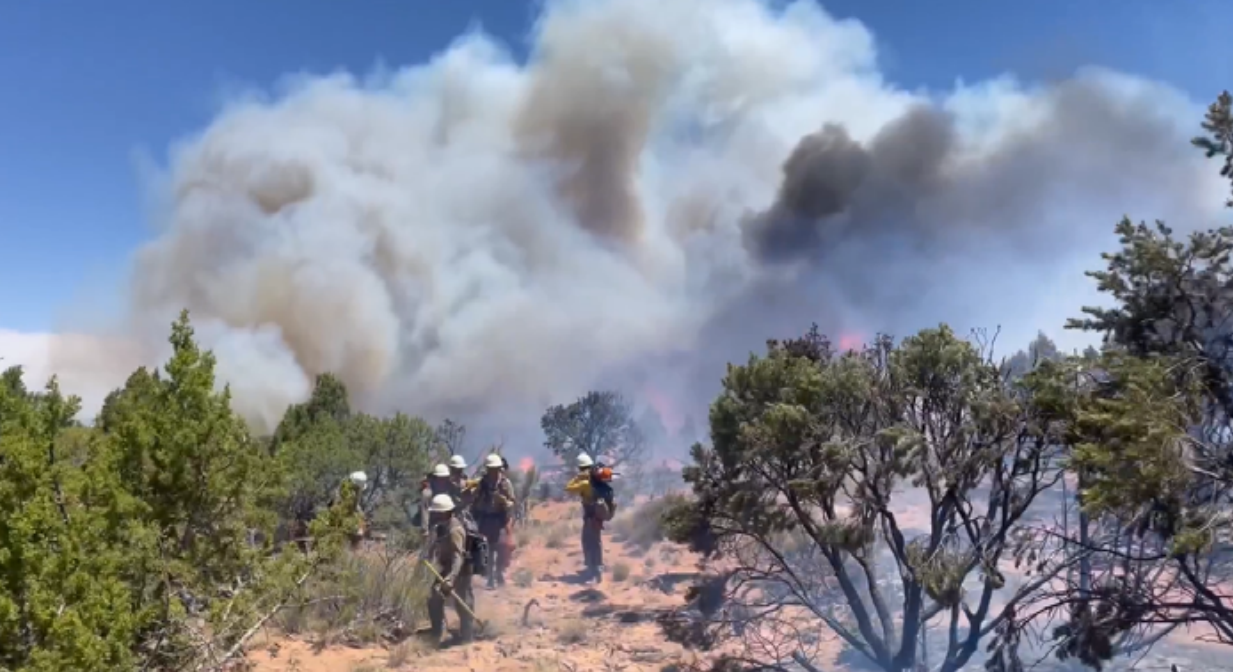
All of these photos, except the satellite image of course, were taken on the White Draw fire on June 29 a few miles northeast of Edgemont, South Dakota, between 7:54 p.m. and 9:41 p.m MT. They were taken by Bill Gabbert and are protected by ©opyright.
(We posted an update on the fire July 1, 2012.)
UPDATE at 6:30 p.m. MT, June 30, 2012:
We just talked with Brian Scott, a spokesperson for the fire, who told us that a thunderstorm dumped a small amount of rain on the fire in mid-afternoon, but far too little to have any long term effect. The fire was still active at 6:30 p.m., but with the higher humidity following the rain, not as active as it was early in the afternoon.
I checked the data at the Red Canyon weather station near the fire and it only recorded 0.03 inch of rain at around 3 p.m.
=============================
UPDATE at 4:12 p.m. MT, June 30, 2012:
A Type 2 Incident Management Team, with Bob Fry as Incident Commander, will be reassigned from the Dakota fire near Sheridan Lake, to the White Draw fire
==============================
UPDATE at 2:49 p.m., MT, June 30, 2012:
Brian Scott, a spokesperson for the fire, told us that the fire is very active this afternoon, and in the morning exhibited fire behavior that you would expect to see in mid-afternoon, when the humidity is lower and the temperature is higher. They have not had a chance to accurately map the fire perimeter from an aircraft, but he said they estimate the size at about 2,000 acres.
Two military MAFFS C-130 air tankers are working on the fire. Since the U.S. Forest Service Air Tanker base has not been approved for handling MAFFS C-130s, the two aircraft are flying to Billings, Montana, 290 miles away, to reload with retardant. Rapid City would have been a 57-mile hop.
Gordon Schaefer, the new Base Manager who just transferred into the position a few weeks ago, told Wildfire Today that until yesterday the Rapid City Air Tanker Base had not been inspected for MAFFS compatibility. The Air Force Lt. Col. who conducted the inspection said the physical layout and the ramp strength appeared to meet the specifications, but they require a written copy of the ramp specs which was not immediately available. Mr. Schaefer said that next week he hopes to supply the required paperwork to the Air Force, and then MAFFS air tankers should be able to reload at Rapid City.
====================
12:05 p.m MT, June 30, 2012
We talked with Cindy Super, an Information Officer for the Dakota fire, another fire in the Black Hills, who told us that a ball park estimate for the size of the White Draw fire is 1,000 acres, but they intend to fly the fire and map it to get a more accurate number. As of now, the aircraft working the fire will be about the same as yesterday, one single engine air tanker, four helicopters, and no large air tankers.
The Incident Commander of the fire is Jared Hohm. Ms. Super was not certain if a Type 3 Incident Management Team will be assigned to the fire, or if her Type 2 IMTeam, with Bob Fry as Incident Commander, will be reassigned to the White Draw fire. Fry’s team is already loaning some of their members to the White Draw fire.

The map above shows heat detected by a satellite at 12:19 p.m. MT, June 30, 2012. (MODIS/Google)

Here is what we wrote yesterday about the fire:
The White Draw fire started at about 4 p.m. Friday afternoon northeast of Edgemont, South Dakota after a motor home driving up the grade on Highway 18 toward Hot Springs caught on fire. I cruised out there and shot some photos. Here’s one, and I’ll post more over the next few days.
There were quite a few engines working on the fire from the local communities, as well as the U.S. Forest Service, the State of South Dakota, and the National Park Service. There were no large air tankers on the fire at any time as far as I know, but there was one Single Engine Air Tanker, plus two Type 3 Helicopters and a Blackhawk. When I left the fire at about 9:45 p.m. I could not see the entire fire, but I’m guessing it had burned hundreds of acres.


More photos are below.