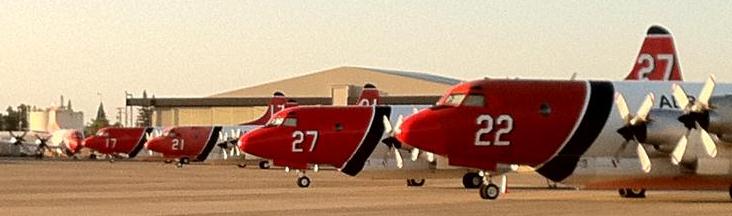
Four employees of Aero Union contacted Wildfire Today and followed up with a letter, saying the company still exists, in spite of the attempt to sell their assets in a February auction. The air tankers and the items related to the Modular Airborne FireFighting System (MAFFS) did not sell in the auction. Aero Union still controls the assets and they have not been turned over to a bank, according to Thomas F. Dooney, the Chief Financial Officer, who called us and signed the letter along with Leigh Ann Ackermann (Director of Operations), and two Co-Directors of Maintenance, Jerry Edwards and Mike Prunty.
CNN did a story on the state of the air tanker fleet (below) and pointed out that the Aero Union P-3 air tankers meet the FAA standards but “sit idle because they don’t meet US Forest Service requirements”.
The Forest Service cancelled the contract for the company’s eight P-3 air tankers saying that the company did not meet the safety standards which were specified in the contract. The USFS requires a Continued Airworthiness Program be followed for the air tankers they have under contract, all of which are at least 20 to 50 years old. The last P-3s were produced in 1990, and 8 of the 9 large air tankers remaining under exclusive use contracts are P2Vs that were built in the 1950s.
The employees that contacted us said the USFS has recently indicated a willingness to consider the P-3 under a “legacy contract” in 2013, for older, not “next generation” aircraft. The four of them said some of the eight Aero Union P-3s could be flying over fires in 4 to 6 weeks if they had a contract with the USFS. In order for that to happen some financial issues would have to be resolved and maintenance would have to be done on some of the aircraft. Seven of them are sitting at McClellan Air Force Base near Sacramento, and one was in the middle of major maintenance when the contract dispute occurred and is still torn down.
However, the P-3 appears to meet the USFS specifications for their next generation air tankers, which require turbine engines, a cruise speed of 300 knots, and a 3,000-gallon capacity.