


The Associated Press, in an article written by Tracie Cone, quotes Jay Miller, a U.S. Forest Service “Fire ecologist”, as saying the area burned by the Rim Fire in California has been “nuked” and “everything is dead”.
…The fire has consumed about 400 square miles, and within that footprint are a solid 60 square miles that burned so intensely that everything is dead, researchers said.
“In other words, it’s nuked,” said Jay Miller, senior wildland fire ecologist with the U.S. Forest Service. “If you asked most of the fire ecologists working in the Sierra Nevada, they would call this unprecedented.”
Smaller pockets inside the fire’s footprint also burned hot enough to wipe out trees and other vegetation.
In total, Miller estimates that almost 40 percent of the area inside the fire’s boundary is nothing but charred land. Other areas that burned left trees scarred but alive.
The excerpt below was written by the Rim Fire Burned Area Emergency Response (BAER) team which paints a very different picture than the one above from the Associated Press and Mr. Miller.
SONORA CA (September 16, 2013) – The BAER team completed the soil burn severity map for the Rim Fire. The map using burned acres as of September 13 shows that approximately 56% of the 254 926 acres within the Rim fire perimeter are either unburned or received a low-severity burn 37% sustained a burn of a moderate severity and approximately 7% burned at a high severity.
BAER specialists concluded that the amount of high severity burn is fairly low given time of year and comparison to other fires. The moderate and low severity burned areas are fairly high for similar reasons. These values are for the entire burn area of the Rim Fire. The soil burn severity BAER map can be downloaded at the “Rim Post-Fire BAER” InciWeb site as JPEG or PDF.
Near the end of the AP article there is a different point of view from Mr. Miller’s”
“It really burned here much like a prescribed fire would to a large degree because of land management practices,” Holbeck said. “Fire plays a natural part of that system. It can’t all be old growth forests, though Yosemite holds some of the oldest trees in the Sierra.”
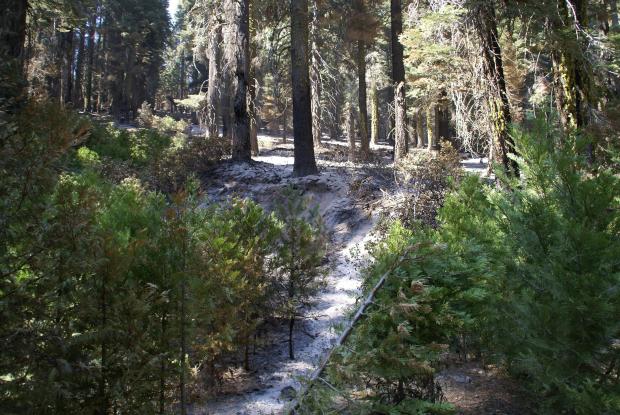
The Rim Fire, which started August 17, has burned 256,895 acres in and near Yosemite National Park in California and is listed at 84 percent contained. It still has 1,371 personnel assigned.
Our take on the Associated Press article
We don’t know if Tracie Cone accurately quoted USFS “Fire Ecologist” Jay Miller, but if so, it is inconceivable that Mr. Miller’s description of the burn severity would appear so starkly in contrast to that presented by the BAER team. It would also be interesting to know if Mr. Miller was on the BAER team or if he has been on the ground at the Rim Fire. We are not aware of any reputable, experienced wildland fire manager or fire scientist who would ever use the terms “nuked” or “everything is dead” to describe the effects found on a very large fire that burned for weeks in various weather, topography, and vegetation conditions.
Based on the AP article and the reports from the BAER team, we have little confidence in the accuracy of the information attributed to Mr. Miller that was presented by the Associated Press.
A call to Mr. Miller, who is listed in the USFS directory as a Remote Sensing Specialist, was not immediately returned. We also called the Rim Fire incident Management Team for a comment on the article, and spokesperson Sean Collins told us it was their policy to not comment on the “opinions” of others in regard to the burn severity.
(UPDATE September 23, 2013: more information about different kinds of maps showing vegetation and soil severity.)







