After years of effort the National Cohesive Wildland Fire Management Strategy has been released. The 93-page document helps managers make decisions about short and long-range planning and how their choices fit into the broader goals of the Cohesive Strategy, which revolve around:
- Vegetation and fuels
- Homes, communities, and values at risk
- Human-caused Ignitions
- Effective and efficient wildfire response
The document calls for increased emphasis in all four of the above categories. One of the surprises was how often managing “fires for resource objectives” (we don’t call them “let burn” fires any more) was suggested as one of the tools for reducing fuels. The phrase was mentioned 15 times, not including the table of contents. It usually included a caveat of a possible increased risk due to putting fire on the ground, and that it is not suitable in all areas. Prescribed fire was another tool that was often recommended.
The elephant in the room
While the topic of “effective and efficient wildfire response” was listed several times in headings, little in the way of specifics of how to improve the response was mentioned. Here is an example from page 51:
Management efforts to simultaneously emphasize structure protection in combination with efforts to reduce fire size through either increased response capacity or pre-fire fuels management seem warranted.
And on page 57 it looked at first like they were taking a strong stand to improve fire response, but then the writers minimized the value of it to a certain extent:
General guidance regarding response includes:
- Enhance wildfire response preparedness in areas more likely to experience large, long-duration wildfires that are unwanted or threaten communities and homes.
- Enhance wildfire response preparedness in areas experiencing high rates of structure loss per area burned.
- At the community level, emphasize both structure protection and wildfire prevention to enhance the effectiveness of initial response.
It would be shortsighted to assume that a safe and effective response to fire is the only priority. Indeed, one could argue that the suppression challenges today are symptomatic of more fundamental underlying issues. The current trajectory of increasing risk cannot be headed off by simply adding more preparedness and suppression resources.
As we have often said on Wildfire Today, the prescription for keeping new fires from becoming megafires is:
Rapid initial attack with overwhelming force using both ground and air resources, arriving within the first 10 to 30 minutes when possible.
Most of the people that contributed to the report are government employees. Expecting them to say that their bosses have failed to provide them with the resources they need to do the job effectively and safely is not realistic. So we get timid statements like “increased response capacity or pre-fire fuels management seem warranted”, and, “It would be shortsighted to assume that a safe and effective response to fire is the only priority.”
The only way that “increased response capacity” is going to occur is if a leader or group of leaders take a bold stand and talk openly about the elephant in the room — the current inadequate funding for an effective and safe fire response. Some will say it costs money so it’s impossible. No, it is not impossible. Leaders could garner support for firefighting. We have a window of opportunity now, less than a year after a 19-person hotshot crew was killed while fighting fire, and a recent emphasis on climate change which frequently mentions more and larger wildfires.
Spending money up front to prevent small fires from turning into fires that can kill people and cost tens of millions of dollars to suppress, is an extremely good investment and can reduce overall expenditures.
And yes, more effort should also be directed at managing vegetation, convincing homeowners to be responsible for making their property fire-safe, and reducing human-caused ignitions. Those three along with an effective fire response comprise four essential elements of the land manager’s toolbox.
Action Plans
A year ago three regional “Action Plans” were released that provide more details of how the national goals will be implemented:
We checked the Western plan and it said very little about improving the response to wildfires.
A “National Action Plan” is referenced several times in the National Cohesive Wildland Fire Management Strategy document. We are attempting to locate a copy. When we are successful, it will be included here.
If you are interested in which states are included in the three regions, it is not a quick and easy process to figure it out. Only one of the plans has a map, the Northeast region:

(Unfortunately most of the graphics in the reports are very low resolution.)
The Western Region includes the 11 western-most states, plus Alaska, Hawaii, North Dakota, South Dakota, Nebraska, and Kansas. It follows that the Southeast Region includes the states not listed above or on the Northeast map.
More graphics
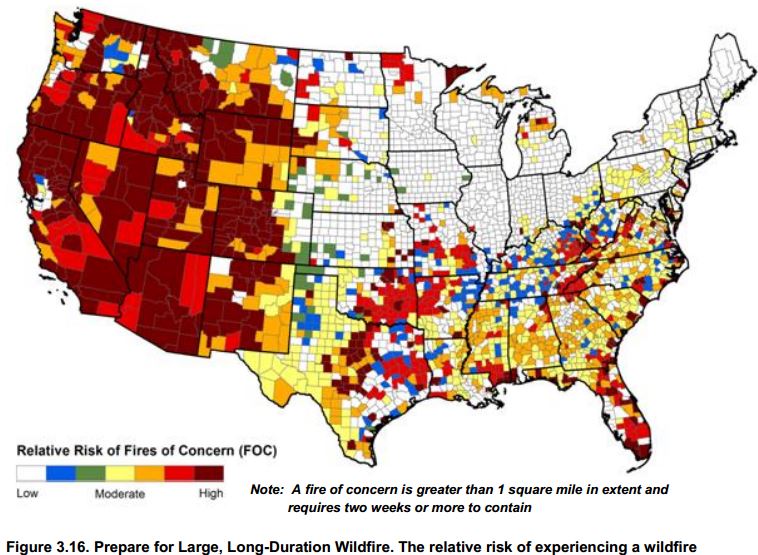
To wrap things up, there were quite a few interesting graphics in the report. A couple of them are below. (Click on them to see larger versions.)