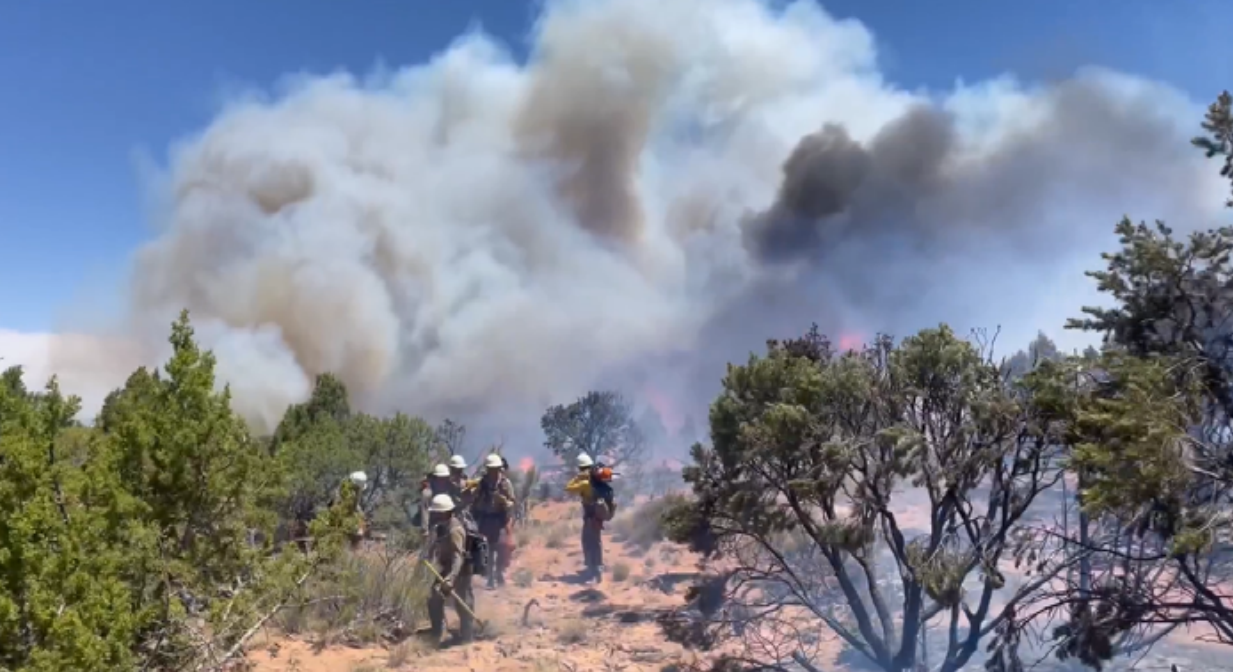
(Video: fire shelter testing in June, 2015.)
After 19 firefighters were killed while fighting the Yarnell Hill Fire in Arizona in 2013, many people called for better fire shelters, since the shelters used then were not effective in preventing the 19 fatalities.
This January, NASA reached an agreement with the US Department of Agriculture’s Forest Service to test prototype fire shelters made from the space agency’s next-generation thermal protection systems (TPM) materials.
The team of engineers from NASA is developing flexible heat shields that will protect spacecraft from the high temperatures of atmospheric entry under NASA’s Hypersonic Inflatable Aerodynamic Decelerator (HIAD) project. NASA and the Forest Service have found that there are common performance requirements between fire shelters and flexible heat shields that can be used to benefit both organizations.
In September, 2014 small scale testing on 39 material samples began at Missoula Technology Development Center (MTDC). Thirteen materials that showed no obvious shortcomings were sent to Mark Y. Ackerman Consulting in association with the University of Alberta for the first round of third party lab testing. The only materials that had an improvement in the thermal protective performance tests were those that were bulkier and heavier than the current shelter material. Third party test results are being shared with those who have submitted materials for possible improvements.
Prototype shelters were tested for the first time in a forest fire setting in late June, 2015 when NASA’s Langley Research Centre, University of Alberta adjunct professor Mark Ackerman, and the US Department of Agriculture’s Forest Service travelled to Fort Providence in Canada’s Northwest Territories to conduct a series of controlled outdoor burns.