


It will probably not come as a surprise to many, but the number of acres burned in the United States in 2017 came close to breaking a record. The numbers are preliminary and could change over the next few weeks as the data is finalized but the acres burned in the 50 states, 9,781,062, was the second highest since reliable records have been kept. That is 49 percent higher than the average over the last 10 years. Even as the trend line for the acres burned has increased dramatically since 1990 the total number of fires has generally been slowly decreasing. In 2017, 66,131 fires were reported, which was 4 percent lower than the 10-year average.
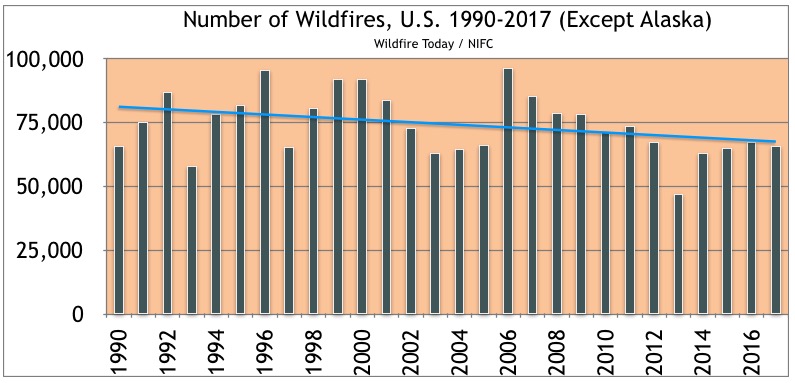
But to look at the big picture, at Wildfire Today we like to analyze the national trends without the stats from Alaska, and there are two reasons why. Fires in that huge state are managed far differently from the other 49 states. Most of them are not fully suppressed since they are less likely to endanger people or private property than in the lower 49 states. The second reason is that the fire occurrence is extremely variable, with the acres burned since 1990 ranging, for example, from 43,965 acres in 1995 to 6,645,978 in 2004. Including the Alaska numbers would skew the data for the other 49 states making it more difficult to spot trends.
In case you are wondering why our charts only go back as far as 1990, we are not convinced that the information before that is reliable. In the data provided by the National Interagency Fire Center there was a very sudden, long lasting major shift in the numbers beginning in the early 1980s.
The sloping horizontal lines in the charts represent the statistical linear trend.
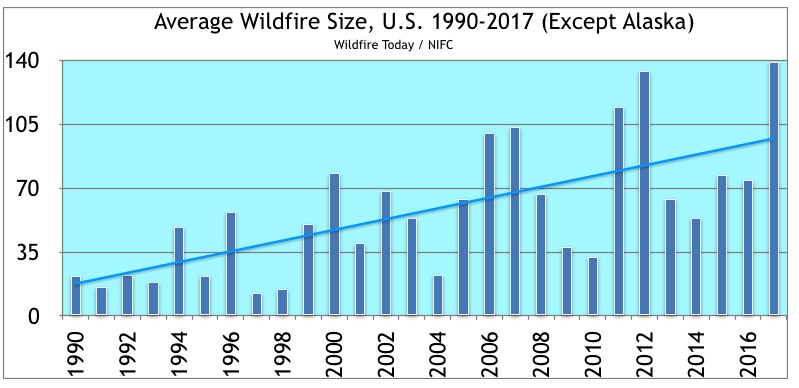
A statistic that is quite interesting is the average size. The linear trend line starts at about 22 acres in 1990 and reaches close to 100 acres by 2017. In fact, the average size in 2017 was 139 acres. There could be a number of reasons for this huge increase:
- Weather that is warmer and drier making fires more difficult to suppress.
- One hundred years of fire suppression has led to forests that are more dense and fires that burn with greater intensity.
- A less aggressive strategy is being used on large fires more often for safety reasons.
- More fires are allowed to burn naturally without full suppression for environmental concerns.
- There may have been a change in the initial attack of new fires, responding with less equipment and personnel.
Another factor to consider is that there was a gradual 30 to 70 percent reduction in the number of large air tankers on exclusive use contracts from 2002 until 2014 when the fleet began to be partially restored.







