


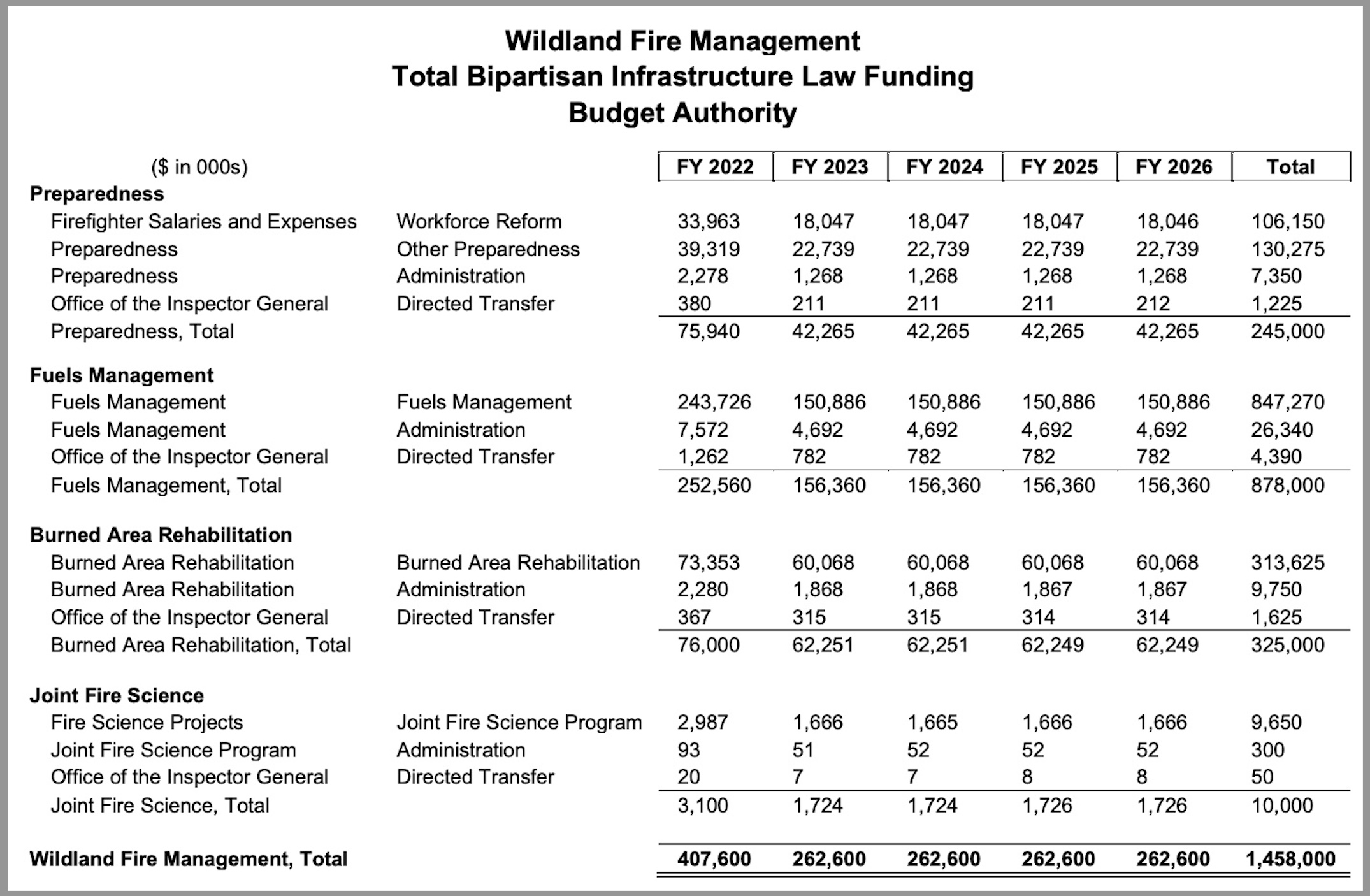
 Department of the Interior’s outline for spending funds appropriated by the Bipartisan Infrastructure Law for wildland fire, fiscal years 2022 through 2026.
The Department of the Interior (DOI), as required by the Bipartisan Infrastructure Law signed by President Biden on November 15, 2021, has released an outline for spending the $1.5 billion that the legislation appropriated to be used by the Department for wildland fire. Four agencies within the DOI have significant wildland fire responsibilities: Bureau of Land Management, Park Service, Fish and Wildlife Service, and bureau of Indian Affairs.
In January the US Forest Service announced how it will spend the $2.42 billion the agency will receive, and also here in February.
Before the bill was passed, we compiled a summary of the legislation’s provisions that relate to wildland fire.
Below are excerpts from a 13-page DOI document that explains how the new funds will be used.
…The Bipartisan Infrastructure Law (BIL) provides a total of nearly $1.5 billion to DOI for the Wildland Fire Management (WFM) programs and activities shown in the table below. Specifically, Division J appropriates $1,458,000,000. This funding is provided as emergency appropriations and is available for obligation until expended. Division J further specifies in which fiscal year (FY) amounts become available for obligation from FY 2022-FY 2026, as reflected in the table [above]. The U.S. Department of Agriculture (USDA) Forest Service received complementary appropriations for wildland fire management, and the two agencies are collaborating on and coordinating implementation of the BIL.
Preparedness – Workforce Reform: The BIL provides $120.0 million over five years to increase the compensation of Federal wildland firefighters, convert more firefighters to permanent, year-round employment, and support the health and safety of firefighters. The law directs DOI and USDA Forest Service to increase compensation for firefighters in some geographic areas and to work with the Office of Personnel Management (OPM) to establish a wildland firefighter occupational series. Further, DOI and USDA Forest Service are required to establish mitigation strategies for line-of-duty environmental hazards and firefighters’ mental health.
Other Preparedness: The law provides another $125.0 million over five years for other activities that will increase America’s preparedness to respond to wildland fire. They include support for workshops and training for firefighters, equipment, satellite detection and reporting, and wildfire detection and monitoring, and a pilot program to support Tribal Nations and local governments in wildfire response.
Fuels Management: The law provides $878.0 million over five years to plan and implement fuels management. This work will protect vulnerable communities from wildfire while preparing our natural landscapes for a changing climate. The law’s funding is intended to support mechanical thinning; prescribed fire; employing contractors, young adults, veterans, and Tribal Nations’ youth; and other fuels management.
Burned Area Rehabilitation: The law provides $325.0 million over five years to complete post-fire restoration activities. These actions help mitigate the damaging effects of wildfires and set landscapes on a path towards natural recovery and climate resilience.
Joint Fire Science Program: The law provides $10.0 million to DOI over five years to study and research wildland fire through the Joint Fire Science Program, which DOI and USDA jointly administer. The program will use the funding to conduct research on climate change interactions, smoke management concerns, impacts on diverse populations, and management actions that will make ecosystems more wildfire and drought resistant.
Funding for the Office of the Inspector General and Administration: The BIL requires that 0.5 percent of the appropriations be transferred to the Office of the Inspector General (OIG) and provides that DOI may use up to 3.0 percent of the appropriations for “salaries, expenses, and administration.” These amounts are reflected in the table on page 3.
Timeline for Implementation – FY 2022 and Later Years
The law establishes several deadlines that will serve as milestones for implementation, including the following:
- Beginning October 1, 2021 (no deadline for completion set in the law): DOI and USDA Forest Service will:
- Seek to convert not fewer than 1,000 seasonal wildland firefighting positions to permanent year-round positions that are full-time and reduce hazardous fuels on Federal land not fewer than 800 hours per year (each position); and
- Increase the salary of wildland firefighters by an amount equal to the lesser of $20,000 or 50 percent of base salary if the DOI and USDA Secretaries and the OPM Director determine that a position is in a geographic area where it is difficult to recruit or retain Federal wildland firefighters.
- Mid-December 2021: DOI, USDA, and DHS (through the FEMA Administrator) jointly established a Wildland Fire Mitigation and Management Commission to (1) study and make recommendations on preventing, mitigating, suppressing, and managing wildland fires, and (2) rehabilitate land devastated by wildfires. The Secretary of the Interior, the Secretary of Agriculture, and the FEMA Administrator serve as co-chairs, and other Commission members will be appointed. The Commission will issue a report within one year of the first Commission meeting.
- March 14, 2022 (120 days post-enactment): DOI and USDA Forest Service will establish a five-year monitoring, maintenance, and treatment plan.
- May 13, 2022 (180 days post-enactment): DOI and USDA Forest Service will develop a distinct wildland firefighter job series, in coordination with OPM.
- Annually December 31, 2022-2026: DOI and USDA Forest Service will submit a report to Congress on the number of acres of land on which projects carried out using the BIL’s treatment funds improved the Fire Regime Condition Class of the land.
- October 1, 2022: DOI and USDA Forest Service will develop and adhere to recommendations for mitigation strategies for wildland firefighters to minimize exposure to line-of-duty environmental hazards; and to recognize and address mental health needs, including post-traumatic stress disorder care.
- September 30, 2027: By no later than this date, DOI and USDA will conduct restoration treatments and improve the Fire Regime Condition Class of 10,000,000 acres of Federal or Tribal lands identified as having a very high wildfire risk potential and that are located in the wildland-urban interface or a public drinking water source area.
Workforce and Compensation
- Workforce Reform: The BIL provides DOI a total of $120.0 million over five years for firefighters’ compensation, position conversions, and health and safety. DOI will work with USDA Forest Service on strategies to increase firefighters’ compensation; convert hundreds more firefighters to full-year, permanent positions; and address firefighters’ mental health needs.
- Workforce Assessment: Human capital is the most important investment for effective wildland fire management. Prior to enactment of the BIL, DOI decided to undertake an assessment of the wildland fire management workforce. This assessment will be valuable in implementing the BIL. DOI’s Federal Consulting Group, which is assisting the WFM program, has contracted for a Wildland Fire Workforce Assessment that will serve as baseline information about wildland fire personnel, including geographic location, pay and compensation, diversity, classification, and other factors to inform the determination of sustainable and effective workforce capacity needs. The assessment will be delivered to DOI by May 31, 2022.
- Coordinated, Interagency Workforce Working Groups: To lead toward the establishment of a wildland firefighter series (deadline 180 days: May 13, 2022), DOI is participating in interagency working groups with OPM and USDA Forest Service to review the current classification series of wildland fire personnel. In addition to position classification and job series, these groups are also evaluating pay, compensation, and other benefits.
- Compensation Increases for 2022: On June 30, 2021, the President announced compensation increases and retention incentives for the lowest-paid wildland firefighters. These increases were implemented over the summer for a six-month period covering through December 31, 2021. For 2022, DOI and USDA Forest Service issued guidance that no firefighter should be hired at a salary of less than $15 per hour. (Subsequently, OPM issued guidance that applies to positions governmentwide.) DOI and USDA Forest Service are coordinating with OPM on an analysis to propose a special rate request for firefighters.
- Pre-Planning Fire Response Workshops and Training: DOI and USDA Forest Service, in coordination with stakeholders, will hold workshops and training for staff, non-Federal firefighters, and Tribal fire crews to effectively respond to wildfires and assist in increasing the pace and scale of vegetation treatments. The plan is for USDA Forest Service to lead on pre-planning fire response workshops that develop potential operational delineations and select potential control locations, and for DOI to lead on wildland firefighter training.
Equipment and Technology
- Satellite Detection and Reporting of Wildfires: DOI and USDA Forest Service will jointly undertake an agreement with NOAA/DOC to establish and operate a program that makes use of geospatial information to rapidly detect and report wildfire starts in geographic areas for which either DOI or USDA is financially responsible for wildland fire protection and prevention. DOI and USDA will determine whether an Interagency Agreement is the appropriate mechanism for implementing this provision and, if so, which department will prepare the agreement.
- Radio Interoperability of Incident Management Teams: DOI will determine the most appropriate method to acquire technology for each Type 1 and Type 2 incident management team to maintain interoperability with respect to the radio frequencies used by any responding agency. DOI plans to consult with USDA Forest Service and other partners.
- Pilot Program for Slip-On Tanker Units: DOI will work with stakeholders to develop and implement a pilot program to provide local governments and Tribal Nations financial assistance to acquire slip-on tanker units to establish fleets of vehicles that can be quickly converted to be operated as fire engines.
- Wildfire Detection and Monitoring Equipment: DOI will work with partners to procure and place real-time wildfire detection and monitoring equipment such as sensors, cameras, and other equipment in areas at risk of wildfire or in areas undergoing post-fire rehabilitation
Performance
For Preparedness, a primary focus of the BIL is the firefighting workforce. DOI will measure and monitor progress by (a) tracking conversions to permanent DOI positions among the 1,000 (or more) Federal positions required by the law; and (b) once OPM has the requisite new firefighter occupational series in place, tracking conversions and hires into the new series.
Fuels Management
The strategic management of burnable vegetation (known as “fuels”) before a wildfire is an effective approach to reduce the negative effects from wildfires to highly valuable resources and assets. DOI has an existing program to manage fuels in collaboration with multiple partners, including USDA Forest Service, other Federal agencies, Tribal Nations, States, counties, local organizations, and private landowners. Bureau specialists plan, implement, and monitor fuels management projects to mitigate wildfire risk and achieve priority land management objectives. This work occurs year-round. It encompasses a diversity of geographic locations, vegetation types, and treatment methods.
DOI will allocate the BIL’s Fuels Management funds (including thinning, prescribed fire, and fuel breaks) through the WFM bureaus to carry out priority work on Federal and Tribal lands. DOI will leverage contracts and agreements to carry out portions of this work—providing job opportunities for youth, Tribal Nations, and veterans.
Implementation Strategy, Fuels
DOI Fuels Management program will initially rely on the WFM bureaus’ existing three-year programs of work to identify projects consistent with the law’s requirements. DOI will use the following criteria identified in the BIL to prioritize funding for projects that:
1) Already have completed National Environmental Policy Act compliance;
2) Reduce the likelihood of experiencing uncharacteristically severe effects from a potential wildfire by focusing on areas strategically important for reducing the risks associated with wildfires;
3) Maximize the retention of large trees to promote fire-resilient stands;
4) Do not include the establishment of permanent roads;
5) Would commit funding to decommission all temporary roads constructed to carry out the project; and
6) Fully maintain or contribute toward the restoration of the structure and composition of old growth stands consistent with the characteristics of that forest type, taking into account the contribution of the old growth stand to landscape fire adaption and watershed health, unless the old growth stand is part of a science-based ecological restoration project authorized by the Secretary concerned that meets applicable protection and old growth enhancement objectives, as determined by the Secretary concerned.







