


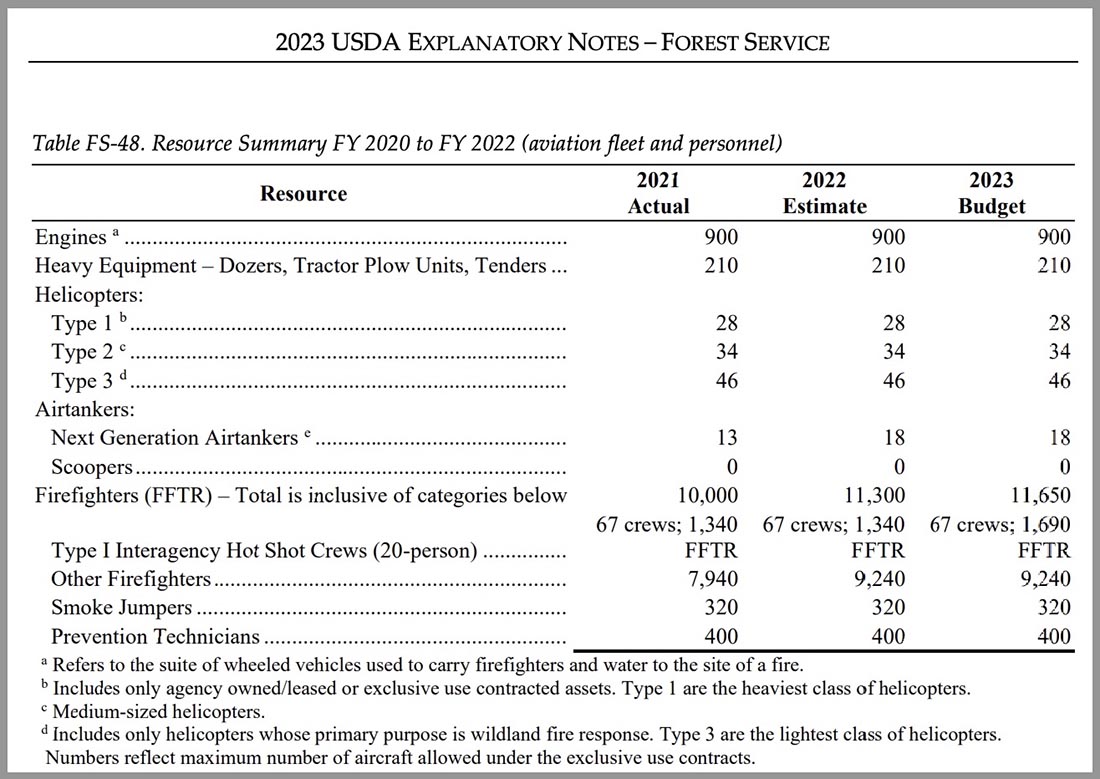
The Biden administration has prepared their request for funding wildland fire management for fiscal year 2023 which begins October 1, 2022. Congress did not do their job and pass an actual FY22 budget for the Departments of Agriculture and Interior (DOI), they only passed a continuing resolution, which is basically the same budget as the year before.
There is nothing binding about these requests. Congress determines the federal budget, but the justification documents provide an insight into what the agencies say they need, after being filtered through the upper echelons of the administration. The requests also detail how taxpayer money was spent during the last two years compared to what they want to do next year.
US Forest Service
The Forest Service (FS) is requesting no change in the numbers of engines, dozers, helicopters, air tankers, smokejumpers, or prevention technicians, but they do want additional “crews” and “other firefighters”, totaling 1,650 personnel.
In 2017 the FS reduced the number of Type 1 helicopters from 34 to 28, and since then the size of the fleet has been stuck there in most years. There were 44 large air tankers on exclusive use contracts in 2002 and the agency is requesting 18 next year. Two studies said there is a need for 35 or 41 large air tankers.
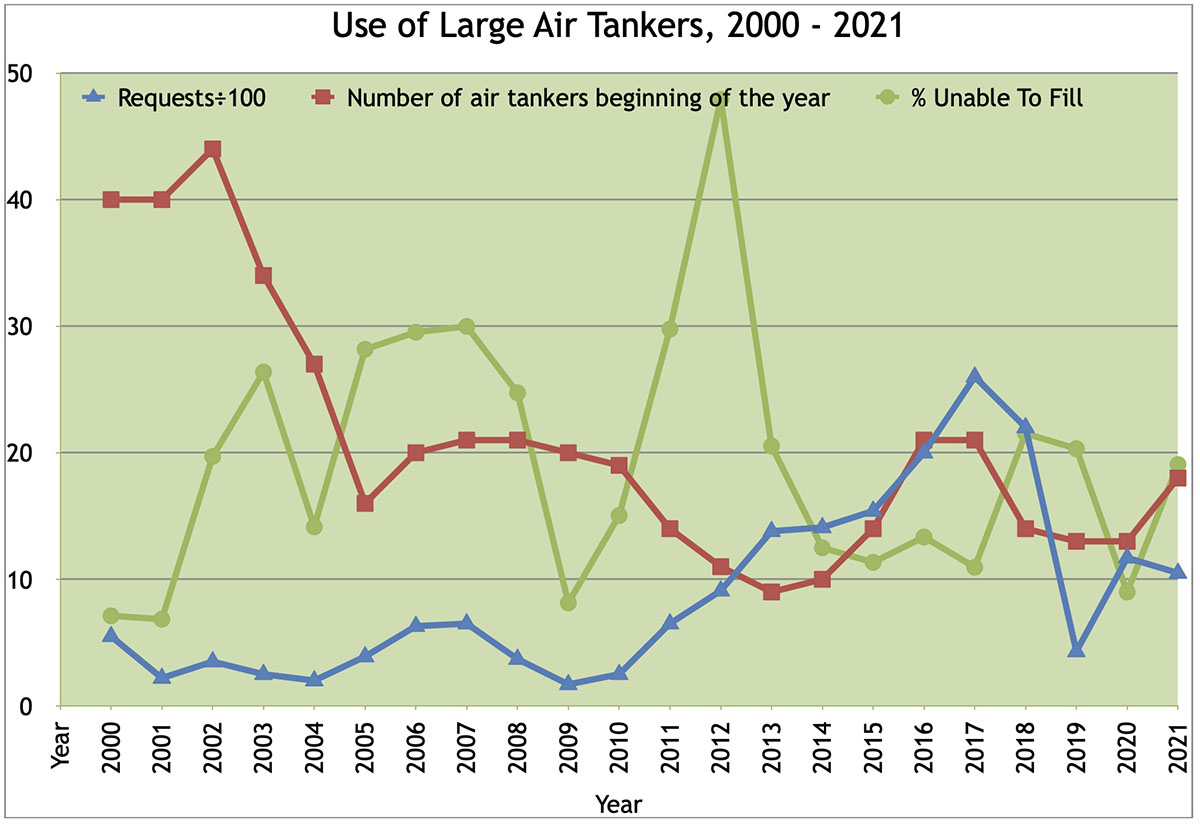 Use of large air tankers on exclusive use contracts by US Forest Service, 2000 through 2021. Shown are the number of large air tankers on exclusive use contracts, the number of requests by firefighters for air tankers (divided by 100), and the percent of requests by firefighters for air tankers that were unable to be filled. Data from NIFC, compiled by FireAviation.
The requested budget for the entire FS for FY23 is $9.0 billion. Of that, $2.7 billion, or 30 percent, would be for wildland fire.
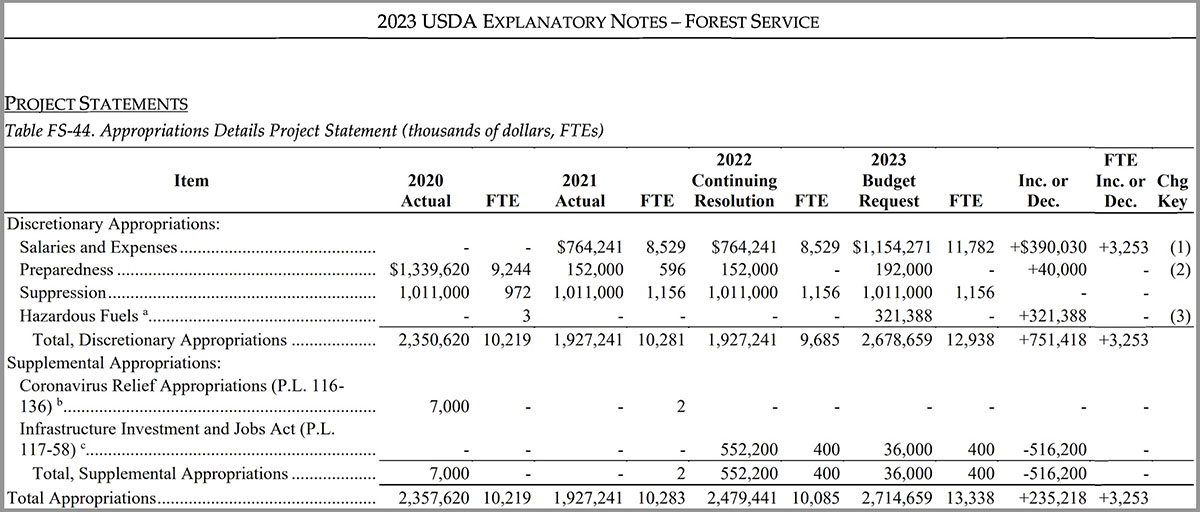
In the current fiscal year, FY22, the US Forest Service (FS) received $916,140,000 for fire preparedness and salaries, which covers most expenditures related to wildland fire except for that which is spent on actual suppression of fires. For FY23 they are asking for $1,346,271,000, an increase of 47 percent.
The “Explanatory Notes” justification for the FS fire budget lists no previous or current expenditures for fuels management in the fire budget but wants $321,388,000 in FY23. This is because the hazardous fuels program will be shifted from National Forest System accounts to Wildland Fire Management beginning in FY23. But this will be an increase of $141,000,000, or 41 percent.
The total FS budget appropriation for wildland fire including suppression went from $2.3 billion and 10,219 FTEs in FY20, down to $1.9 billion and 9,685 FTE’s in FY22. The agency is requesting $2.6 billion and 12,938 FTEs in FY23.
The summary below of the entire FS budget shows a few interesting details, such as how the total spent on personnel compensation and personal benefits has dropped in the last two years. Travel costs nearly doubled while rental payments to GSA dropped about 80 percent. The average salary in dollars for GS personnel, about $59,000, is expected to remain relatively flat for the fourth consecutive year and the average grade decreased from 8.3 to 8.2 over the last three years.

Department of the Interior
The four land management agencies in the DOI with significant wildland fire budgets are the Park Service, Bureau of Land Management, Bureau of Indian Affairs, and Fish and Wildlife Service.
The DOI is not requesting changes in aircraft numbers, but they do want increases in virtually every other category of resources, including all personnel (+309), Full Time Equivalent (FTE) positions (+528), smokejumpers (+4), engines (+6), and heavy equipment (+21).
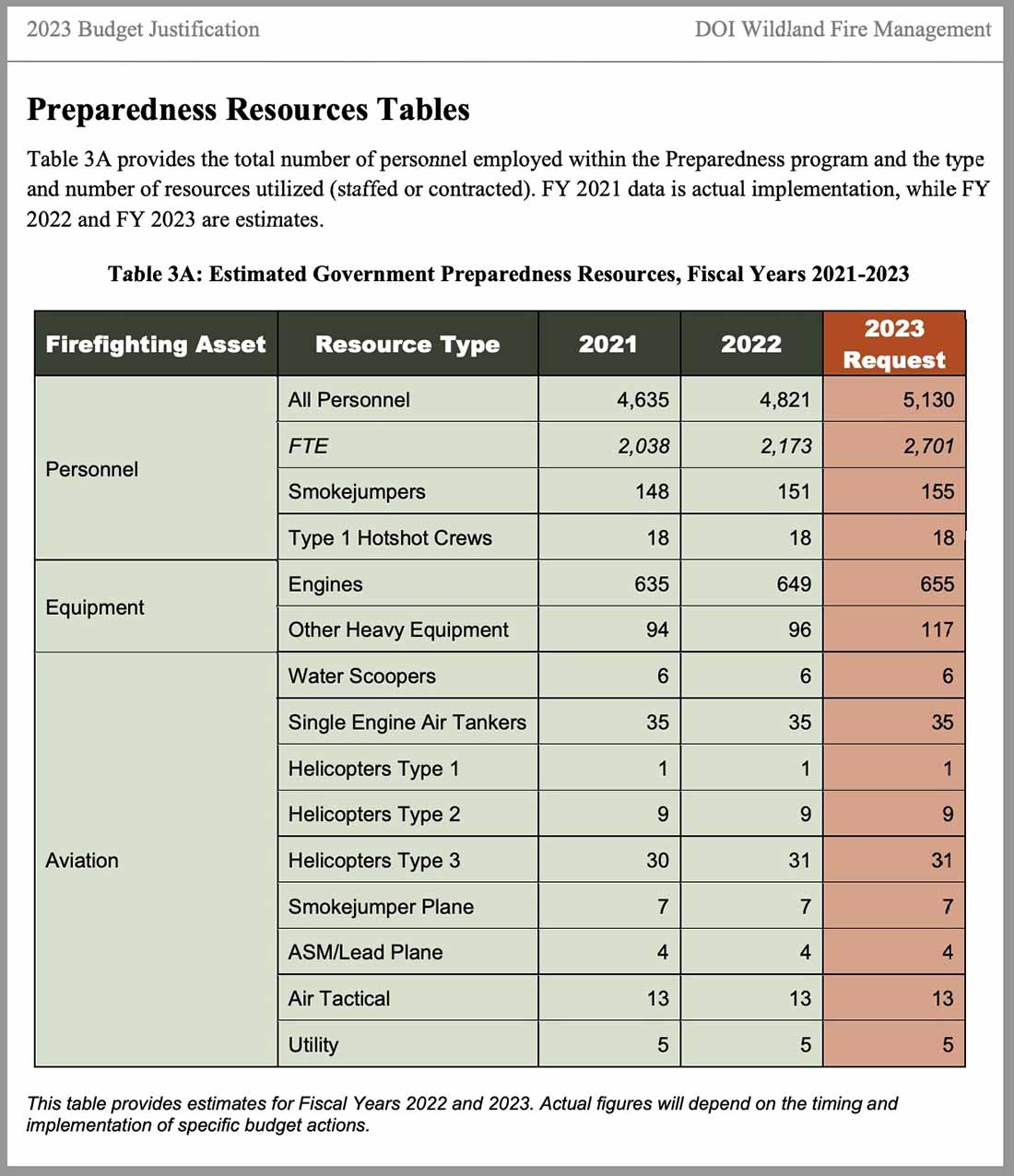 DOI Budget request, fire resources, FY 2023.
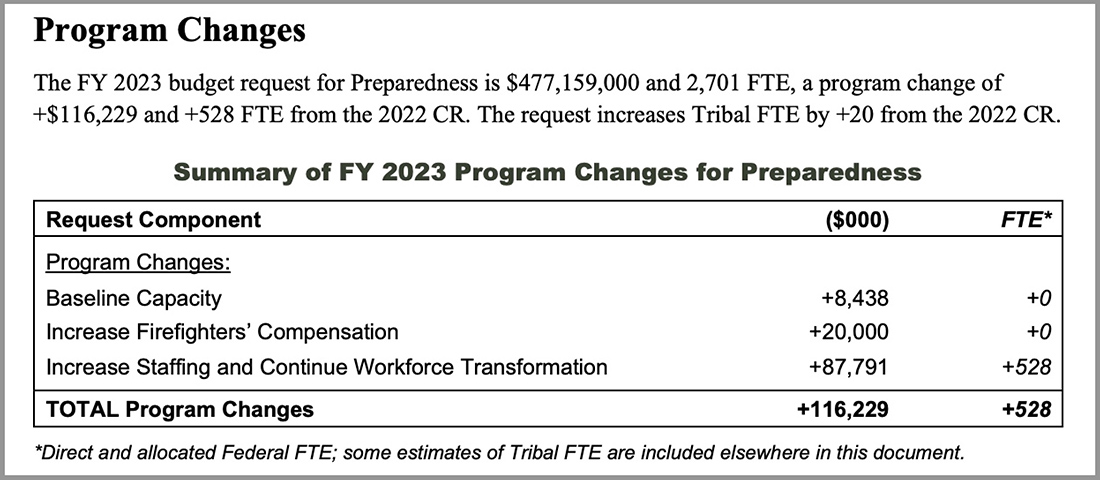
In the current fiscal year, FY22, the DOI received $347,105,000 for fire preparedness and salaries. For FY23 they are asking for $477,159,000, an increase of 37 percent. For hazardous fuel treatment they have requested a 38 percent increase, an additional $84,380,000 for FY23.
The DOI is asking for a 33 percent increase in the Joint Fire Science Program, from $3 million to $4 million. This program had a near death experience during the previous administration.







