


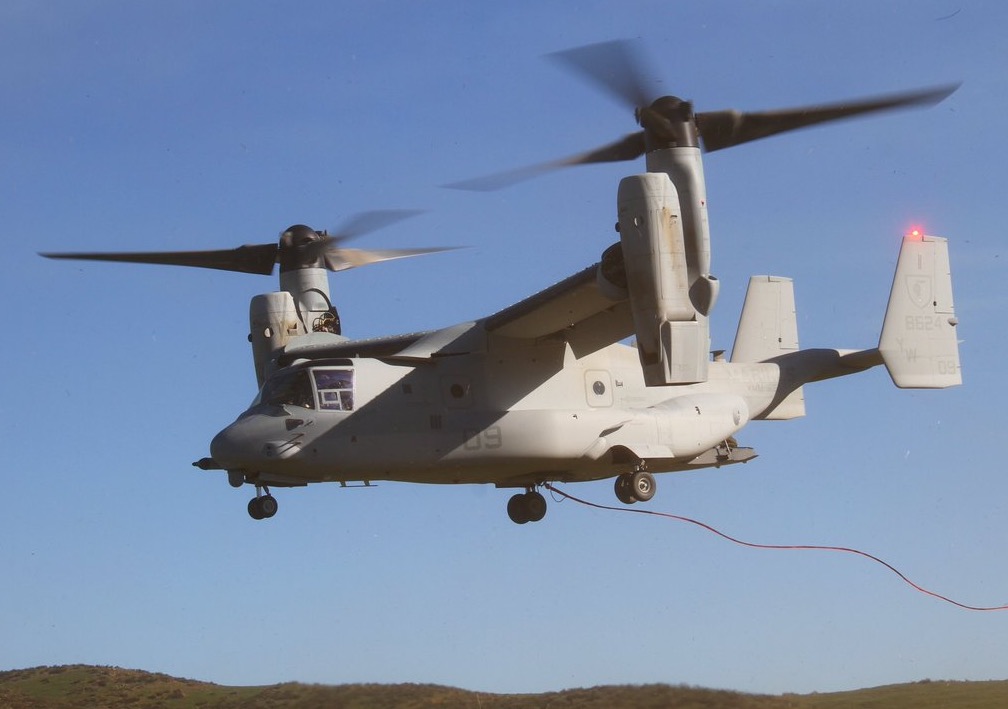
Photo above: MV-22 Osprey being evaluated near Diamond Valley Lake in Riverside County, California, February 11, 2015. Photo by Mike Murawski, CAL FIRE, Riverside County FD.
On February 11 representatives from CAL FIRE and the U.S. Marine Corps evaluated the feasibility of using an MV-22 Osprey to drop water on wildfires. The Osprey is a hybrid aircraft with large rotors that can be tilted 90 degrees, enabling it to take off and land vertically and cruise at over 300 mph once airborne and the rotors are tilted down to front-facing.
 MV-22 Osprey dropping water near Diamond Valley Lake in Riverside County, California. Photo Mike Murawski, CAL FIRE Riverside County FD.
One of the primary issues being looked at yesterday was that strong downwash coming from the large aircraft with the twin 38-foot diameter three-bladed rotors. We have written before about this downwash that has injured people nearby, the extreme heat that comes out of the engine exhaust which has started wildland fires and damaged flight decks on ships, and the high cost of $83,256 dollars an hour.
Travis Alexander, a CAL FIRE Division Chief for Tactical Air Operations, said on this latest generation of Ospreys the exhaust has been modified with a diversion system which reduces the extreme heat and downwash that hits the ground while taking off and landing. In spite of this modification he said it is unlikely that the Osprey while working on a fire would be allowed to land at an unimproved site that had any flammable vegetation. A firefighting aircraft that starts fires is not what anyone wants to see.
Chief Alexander was present yesterday during the tests which involved drops while hovering (a spot drop) and while moving forward. He told us that a significant downwash was expected, as seen with large helicopters, but the turbulence that impacted the ground was not to the degree that it would eliminate the Osprey from consideration as a firefighting aircraft.
It was using a 660-gallon Bambi bucket on Thursday which was choked down to hold less than 660 gallons.
The photo at the top of this article is interesting, I thought, due to the slack that appears in the synthetic rope. Chief Alexander figured that it could have been taken while the aircraft was preparing to land. It may have already set the bucket on the ground and could have been moving backward a bit so as not to drag the bucket as it descended to the ground. The synthetic rope may be apt to be less straight than a wire rope or cable, especially when influenced by the strong downwash.
A final decision has not yet been made about using the Ospreys on fires. If it is approved, it could be added to the Memorandum of Understanding with the military that allows the use of helicopters (UH-60, CH-53, and UH-1Y) to assist with fire suppression across the state. The CH-46 was previously on the list but the Marines have phased it out and replaced it with the Osprey. The MOU was last activated to fight fires southern California in 2012.
In March, 2011 the Marine Corps tested the Osprey with a 900-gallon Bambi Bucket suspended from 50-foot and 100-foot long lines attached to the rear cargo hook while flying at up to 90 knots. After the tests, they came up with the following recommendations:
- Maximum airspeed with bucket empty – 90 KIAS
- Maximum airspeed with bucket full – 90 KIAS
- Maximum airspeed when dumping – 50 KIAS
- Max angle of bank- 30 degrees AOB
- Use of Automatic Release Mode is prohibited.
- Bambi bucket should be positioned to the 6 o’clock position of the aircraft prior to takeoff or landing.
- Aircrew shall continuously monitor load for oscillations or unusual load movement.
The report can be found here (2.6MB).
Another interesting fact about the Osprey. They are being added to HMX-1, the fleet of aircraft operated by the Marines for transporting the President and other VIPs. They have several already that are painted dark green with a gloss finish, like the helicopters you see taking off from the south lawn of the White House. But they don’t have a white top, which means the President is not allowed to get anywhere near the Ospreys. That’s because they fall out of the sky too often.
From Wikipedia:
The V-22 Osprey has had seven hull-loss accidents with a total of 36 fatalities. During testing from 1991 to 2000, there were four crashes resulting in 30 fatalities. Since becoming operational in 2007, the V-22 has had three crashes resulting in six fatalities, and several minor incidents. The aircraft’s accident history has generated some controversy over its perceived safety issues.
HERE is a link to a video that supposedly shows three “Presidential” Ospreys landing at Burbank Airport during a Presidential visit.
More photos from the February 11 MV-22 Osprey exercise.
Wildfire Today story about an MV-22 that ran low on fuel, made precautionary landing in a swamp, and started a wildland fire.
Articles on Fire Aviation and Wildfire Today about the MV-22.





4 Comments
I think that before the MV-22 is considered for the Fire Fighting role it should
under go an extensive inspection,and all the kinks and problems resolved.
There have been too many crashes and too many lives lost with this fairly new
aircraft.
Only $126 per gallon compared to a CH-54/S-64 at about $3 per gallon…sounds like it’ll be a great firefighting aircraft…SMH.
In April, 2011 we received an invitation to bid an internal tank system for the MV-22…We designed the internal tank, evaluated it (on the bench) and submitted it to Boeing, specifically Ms. Carol R. Quinn. We received a call and was told the Engineer working this project had been “re-assigned” To this date we haven’t received any other feedback, Hmmmmm… Although a Bambi Bucket may not work, I believe our internal system would be just the ticket for long term fire fighting use of the MV-22.
It’s a roll-in, roll-out system that converts in short time, allowing the use of the aircraft to drop troops and convert quickly to support suppressive services.
At a cost per hour of $83,256 why can’t they get a more expensive platform to drop water, something like tanker 944 or the Martin Mars. I can imagine a type 1 team wanting a squadron of these to run up the cost of fire fighting. Who pays for the MV22? The military with its’ broke budget or the cash cow fire coffers. These machines, the MV22 was made for hauling troops to fight the bad guys (I’m sorry, not in this administration)
Ex Military and retired USFS
Comments are closed for this article!