


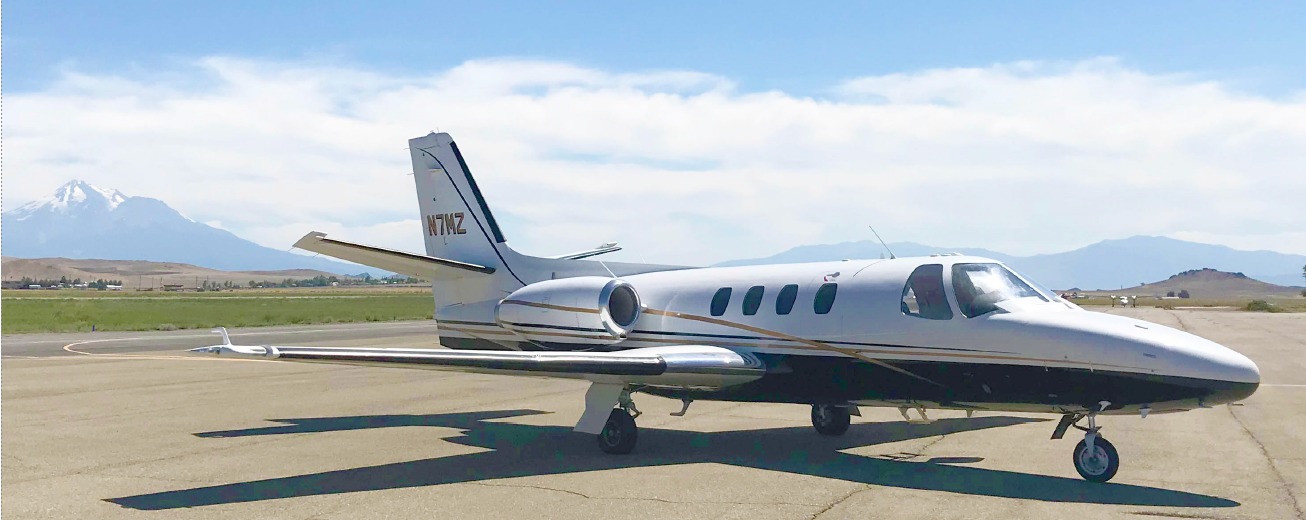
 BLM contracted Cessna Citation 501, registered to Suburban Air Express, Fairbanks, AK. Air tactical group supervisor platform. BLM photo. Date uncertain; probably 2020 or 2021.
The Bureau of Land Management is evaluating the use of Cessna Citations as air attack platforms. The agency first used jet powered aircraft for air attack in 2014 when they contracted for a Cessna Citation from Dynamic Aviation to serve as a lead plane and Air Supervision Module. The following year they added two more. It was not the first time a jet had been used in a similar role. British Columbia had already been using two as Bird Dogs.
In 2014 at Boise I photographed the first one to be contracted by the BLM.
 Citation lead plane, N10R, at Boise, July 19, 2014. Photo by Bill Gabbert.
Later the jets disappeared, but last week the BLM posted an article on Facebook saying they “evaluated the Cessna Citation” in 2020 and 2021 as a platform for air tactical group supervisor. They don’t mention it being used as a lead plane.
Here is the information from the BLM:
“The Bureau of Land Management Fire program consistently strives to assess innovative tools and technology to increase safety, efficiency and overall wildland fire suppression efforts. In #FireYear2020, and again in #FireYear2021, the BLM evaluated the Cessna Citation, a staple in the business jet market. The aircraft successfully performed as an on-call contracted air tactical group supervisor (ATGS) aircraft platform for Alaska and the lower 48 with its great visibility, speed and range. For example, the aircraft flew from Fairbanks, Alaska, to Boise, Idaho – 1,660 miles – in 4 hours 40 minutes, non-stop, with remaining fuel reserves. It has a maximum altitude of 43,000 feet, cruise speed of 360 knots (414 miles per hour) and can sustain an air attack mission for 4.5 hours. These specifications are critical for wildfire suppression air operations, as wildfire suppression air attack missions are often long duration and require proficient aircraft speed, fuel efficiency and altitude safety.
“The Citation continues to accomplish missions that would otherwise not have been achieved with other aircraft. In 2021, two aircraft were used 167 days on contract with 300 hours of flight time in Alaska, Idaho, Utah, Minnesota, Oregon, Washington, and California. One of them was used specifically by exclusive use ATGS and toured bases in four lower 48 states during an evaluation period. During this period, it was evaluated by 12 exclusive use ATGS, four trainees, and visited 17 bases. The Citations have proven themselves to be a reliable aircraft with no maintenance interruptions (unavailability) over a two-year period in which they flew over 600 hours. The Citation CE-501’s performance has been lauded: it has more fuel capacity than other comparable platforms, allows 360-degree visibility for air attack personnel, and it boasts state of the art avionics.”




22 Comments
Fantastic and about time. The Aero Commander has been an Air Attack workhorse for a long time but it has reached the end of it’s useful atgs life. The Citation makes sense from just about every measurable metric. It’s time to bid the trusty Commanders a worthy farewell and part ways.
What took so long? Higher cost or performance of a Turbo-Prop vs Jet? Cheers!
Just a few that would be/are suitable ATGS platforms, IMO.
Citation
Phenom 100
Piaggio Avanti
Honda Jet
TBM 900
T6 Texan
OV 10 Bronco
Pilatus PC12
Piaggio Avanti would be SOOO dope! I doubt they would though, repairs, available parts, etc….kind of reminds me of the LM002 Lamborghini for the Army, cool but little chance of it making it reality.
Air attack platforms should be chosen on the basis of being “dope?”
I have a thousand hours or so in the P180. It would be a terrible choice, starting with the cockpit visibility, and followed closely by the expense. Someone has to buy these platforms and pay for them year-round, as well as train crews and keep them current. They have very small wings, suffer considerable loss of lift in any moisture or with any wing contamination (flying through a cumulus cloud, even), have fairly high maintenance upkeep and expensive parts that must come from Italy, poor factory support, etc. In a class of eight at Flight Safety International, the instructor asked how many of us experienced an emergency in the aircraft in the last year: we all raised our hands. A poll quickly determined that between eight of us, we’d experienced every abnormal and emergency condition in the aircraft manuals and QRH, and a number that weren’t listed, too. Mine included an engine failure, rapid depressurization, brake failure, generator failure, landing gear stuck in transit, and a host of others. Go figure.
The P180 flies like a Learjet, burns fuel like a King Air 200 (but 100 knots faster), goes to FL410 (41,000′ above sea level), is quiet inside (very noisy outside), has an almost-stand-up cabin, hauls 6-8 passengers, and is the fastest production civil turboprop. It also has pressurization issues, landing gear issues, carbon brakes and no antiskid (flat-spotted tires and landing /rejected takeoff issues not uncommon), propellers that sit in the hot exhaust stream, electrical issues (small wiring, up to five terminal ends ganged together and up to five butt splices in a wiring run, per Itallian allowances), and so on. It’s okay for a corporate airplane that does out and back trips with maintenance in between. For a hard-use utility airplane, not so much.
If single engine platforms are named (eg, TBM, PC12, etc), then what is the point of making a comparison with a two-engine aircraft? Cool factor?
How much per hour will the taxpayer get soaked for a “dope” or “cool” aircraft to fly in circles over the fire?
It’s an air attack platform. It goes up, goes in circles. It needs long loiter capability. It needs good visibility. It needs to be affordable to both the government and the operator. It needs to be field maintainable, reliable, single pilot operable, good from shorter runways. Today pressurization is expected and air conditioning a plus: the aircraft needs to be something someone can work in for an entire fuel cycle over the fire.
I don’t understand the mentality that the flashier and shinier and “dope” aircraft is somehow better, or an improvement. I’ve flown air attack in twin commanders, turbo commanders, 421’s, king airs, 340’s, 337’s, even Cessna 210’s, etc. While an OV-10 would be nice (and are nice for CalFire), they’re expensive to operate, not certificated aircraft, and in short supply. Good visibility. Expensive platforms with one engine like the PC-12, still have that one, big limitation. The twin commander and turbo commander is a hard platform to beat on many counts, not the least of which is visibility. A Citation has good visibility, flies relatively slow (a plus when orbiting a fire). Loiter time and fuel burn is an issue. Certainly the cost to the operator and the government is an issue.
Dope and cool aren’t necessarily the best criteria for selecting an observation platform.
That’s fine, Matt. It seems you like to share your “dope” opinion, but don’t want to hear from anyone else, or allow them theirs.
If you intend to make aviation a career, grow a thicker skin. You’ll need it. Good luck.
We need some voices of reason from folks like this who have operated, not necessarily contracted for, aircraft. This is where rubber hits the road folks….guys who have FLOWN these not just ridden in them. Agreed on the loiter time of the straight wing Cessna Citations and the ol P&W JT15D series……fuel burn. AC 690s are probably the best way to go for the near future while the “evaluations” continue!!
When are they coming out with an all electric powered twin with good vis, loiter capability, pressurization, avionics, etc that would make a suitable air attack platform? …lol. The DOI should stop hoping for the next iteration of aged airframes and get the check book out. There’s enough airframes out there that, combined with Infrared capabilities, would provide improved for improved aerial tactics and intelligence.
We looked into the Piaggio and determined it was too risky (financially) to take that plunge. We ended up with a 551SP which should see action this summer.
The article as written is purposely vague. The two aircraft used, N501MZ was Mfd in 1979, N7MZ was Mfd in 1981. Next-Gen aircraft? Hardly. Old Converted Turbo-jet to Williams Fan-jets and added fuel by Sierra Industries. Certified as Single pilot, but barely. Aircraft have an added Angle of attack indicator on the center windshield pillar in the pilot’s face. Any research of the flight history on Flight Aware of either of these two aircraft clearly shows the aircraft are doing huge circles on auto-pilot over the fire. 360 degree view? 4 hours of fuel is hardly enough, with many current aircraft having 6 to 6.5 hours. Sierra didn’t make a ton of these conversions and any straight 501SP with JT15D turbo-jet engines would have no range in the lower level fire environment. This is looking backward for Next-Gen at its worst.
Yep straight wing Citation vs whats pictured (N10R) JT15 vs Williams FJ 44 series….maybe I can get a viewpoint from an operator who operates at least a half-dozen straight wing Citations to discuss those 360 degree views….maybe 360 degree orbits….Next Gen….Next Gen ( jets) have been here since they mounted on the P2V and C119. Next Gen is just a name for folks who couldn’t follow history or transition closely enough to properly name it. All the current jet technologies being used for the myriad of suppression and related work are probably in their 40th year, approaching 50 yrs like all the old recip technology. About time a new moniker is found for Next Gen…..pfffft…Next Gen….mostly all what’s flying now….
I will preface this comment by saying that I’m an outsider and have never been associated with fire suppression activities. I’d like to know if a tiltrotor would make sense for this mission? Think Leonardo’s AW609. Does this type aircraft even enter the minds of the agency authorities when considering aircraft and making decisions? High acquisition cost? Probably. High life cycle cost? Maybe. But what about value?
I have enjoyed reading articles on this website and following the commentaries, but I can’t recall seeing any discussions on the possible utilization of a tiltrotor. Has any agency done a cost/benefit analysis? I would be interested in seeing people’s opinions.
Dave,
There are helicopter air attack platforms, usually referred to as Helittack or helco (helicopter coordinator), but generally the air tactical group supervisor (experienced firefighter who rides on the air attack platform, doing communication and helping direct the fire) is in a fixed wing aircraft.
One of my sons did Tiltrotors in the US Marine Corps, and is still with them now that he’s out. The tiltrotor concept offers some unique and interesting operational capabilities, but they’re extremely maintenance-intensive, and they’re extremely expensive to operate. They’re not really a civilian asset.
If an Osprey were used over the fire, it would chiefly be used for bucket work, rather than flying the air attack, though an Osprey would be be a very utilitarian aircraft to have. It does require two pilots, which means an air attack can’t occupy the other cockpit seat.
Doug,
For many of the same reasons you stated, I intentionally did not mention any variant of the V-22 in my post. I was thinking of a smaller platform, and thus the AW609 came to mind. I’m not aware of any other tiltrotor type aircraft that might be evenly remotely being close to being fielded.
I can’t tell from Leonardo’s online information, but what is conspicuously absent is whether or not the aircraft is FAA certified yet. I suspect that it is not. You also mentioned the two pilot requirement for the Osprey. The AW609 brochure mentions a crew of two so maybe they plan to certify for dual pilot operation as well.
Dave,
The AW609 isn’t certified by the FAA yet, and presently, while Leonardo claims it’s aiming for certification in 2022…it’s been making that claim for sometime, as have the designers and previous owners of the program…always just a little way away.
Leonardo projects a purchase price in the order of thirty million dollars a copy…very expensive for an air attack platform. It will be a two-crew aircaft, rather than seeking single-pilot certification, meaning an air attack would need to reside in the back of the aircraft. There’s a lot of engine nacelle out there, to block the view. Two pilots doubles the cost of wages to crew the airplane.
There were four prototypes built. Three remain. Two were at the expo in Dubai this last fall. One crashed in 2015; it broke up in flight, killing both test pilots.
I mentioned the Osprey because there aren’t any other tilt rotors under production. One can expect the maintenance costs to be equally high for the 609, if it ever gets certificated. Bear in mind that Bell originally handed the project over (sold it) because it didn’t see viable economic success, and wanted to wash its hands. Presently, the Osprey is the only tilt rotor under production, and the only one available on which to comment. it’s just not a viable air attack platform. At thirty million a pop, the AW609 isn’t likely to be the darling of companies fielding air attack contracts.
Consider that while there are exclusive use air attack contracts guaranteeing x-number of days of income over a season, most are call when needed (“on call”), meaning there are no guarantees for income for the season. Whether the airplane flies 100 hours or works 100 days, or flies ten minues and works a day…the operator still has to make payments on the aircraft year round, insure it for the season, insure the pilots, and pay for the training. Those costs exist even if the airplane makes no money…so paying off a thirty million dollar aircraft in return for a few dollars a day and a few dollars an hour…is a wild gamble at best…for an aircraft that’s ill suited to the job.
The pilot training is expensive and comprehensive; it will be the full equivalent to getting a type rating, and can be expected to run 40,000 yearly or more per pilot.
It would be far less expensive to fly a certificated helicopter on the air attack mission, than a tilt rotor, and a helicopter in that role is going to cost considerably more than a present air attack platform. The helicopter offers no significant advantages, has a lower loiter time, higher maintenance demand, will be single engine in most cases, and won’t necessarily have the range or speed of a typical fixed wing air attack, if called to relocate to another fire…perhaps one or two states away. Additionally, many air attack platforms do duty as fire patrol aircraft, and perform mapping and other missions. Helicopters and rotorcraft have distinct unique advantages that make them valued over the fire in other roles. This is one of the many examples of different tools in the toolbox.
Citations, etc, may yet be the future of air attack platforms, and lead or ASM platforms. Time will tell. I had a SEAT mission some years ago on a fire in southern Oregon; in which I worked closely with a Citation lead. Until that fire, I wouldn’t have given the Citation much credence for a lead, especially with a SEAT. The fire was inside a large bowl canyon, same entry and exit, and when we got in the bowl, we were circling a inside a fairly tight area with only one exit. I’ve been behind King Air’s acting as Lead on a number of occasion when the wake turbulence from a King Air 200 was enough that it took full stick and power to keep from sinking into the hillside. I wasn’t sure what to expect from the citation, but the wake was considerably less. It flew slow enough to lead SEATs, and did an excellent job. I can see it being a great multi-role airplane, air attack platform, or the future of leads/ASM’s. Again, time will tell.
The AW-609 is likely to be less utilitarian and more strictly personnel-transport. Its short term future, if it ever exists beyond prototypes, is slated to be transporting oil executives and workers to oil rigs in the ocean. I wouldn’t expect to see it as a bucket platform or much else in that arena, for some time to come, if ever, and most likely never in an air attack role. While the AW609 shares no components in common with the Osprey, it will have similarly high maintenance demands, by virtue of being a tilt rotor. It’s going to be expensive to operate and maintenance-thirsty. I look forward to seeing them one day on the market and in use, but for now it’s vaporware (except for the remaining three prototypes). I was excited to see my first Osprey. I’ll be excited first time seeing a 609, if it finally hits the market…but I won’t be holding my breath.
We were asked to put new avionics in them for the USFS years ago. We are now winding the project down.
https://www.canaanavionics.com/CitationRetrofit.aspx
I was one of the evaluators. The visibility was outstanding, better than a 690 for sure. It could get there fast if you wanted, but would go slow enough over the fire, maneuver just fine, and could do 5 hours…also better than the typical 4+30 of a 690. 690 C and D models (695) can go 6 hours or more…if your bladder doesn’t veto, but only a couple of those are out there on fire contracts. They have a bit better vis with the wing being farther back too. Yes, these jets are similar in age to most of the 690 fleet, but their price was actually pretty reasonable.
A tilt rotor would never work, nor be cost effective. Some of the newer light helicopters have some really good possibilities, but they too are a lot more expensive than the current fleet of fixed wing.
The jets didn’t really work for the lead plane mission because in that profile, fuel burn never allowed them to even go 4 hours. In the air attack role, flying slow circles at the same altitude, it’s much more viable. I wonder how a CJ2+ would do…but again, much newer tech = much more $
I have flown air attack in the TC-690/695, the Citation 525, the Caravan EX, and the “new” TC-1000 (690 with upgraded engines & avionics).
The Citation 525 has a lot of niceties. Good communications package, leather seats, climate control, quiet, and a mini fridge. Of those things the only thing that matters is the communications package.
Visibility in the CJ 525 is not better than a TC, with no overhead canopy window and a small windscreen. If you are just orbiting and directing, not a big deal. Those that crank and bank leading tankers through will prefer the TC visibility. Trainers also don’t like the CJ 525 as the visibility from the back seat is poor.
Not saying its a terrible platform, its not, just not as good as it could be, and certainly not worth running out and replacing the TC’s.
The upgraded TC 690/695 that British Columbia uses is a strong platform. Upgraded TPE-331-10 engines, with 5+ hour mission duration, and increased performance. 3 AM radios, 2 FM radios, satellite phone, smoke kit, max-viz enhanced vision system, and climate control. Bose headsets, USB ports for phone/ipad, and a fireproof bag in case the phone batteries ignite.
The commander workhorse isn’t done yet.
Troy….you nailed it….kudo’s
Agreed, the 690 is still the workhorse, and an excellent tool. The 501 Citations evaluated had great visibility, but are about the same age as the 690 fleet. (The last 690/695 ever built rolled off the line in January of 1986). Nice to hear your feedback on the CJ’s (525s) visibility, I have not had the opportunity to use one. The 690C (840) and 690D/695 (1000), the state of Alaska has one of each, they are very nice! Canada has some too. Unfortunately, the lower 48 contract fleet only has a handful of those C or D models.
The C and D have the wet wing which gives much longer endurance if desired, and without the 22 fuel bladders, can be re-fueled in a fraction of the time it takes to fuel a 690 A or B. The fuselage is longer, and the wing set-back which improves the visibility of the C and D models. They can all upgrade to the -10 engines (almost all have) but the A and B models cannot change the fuselage or wing, and hence improve visibility even more, or increase endurance. (Maybe they can, but I suspect it would be cheaper to buy a new plane!).
The vast majority of the lower 48 fleet is all A and B models. Still a workhorse, still pretty awesome overall. All the fed contracts require 3 AM and 3 FM and air conditioning, USB ports, etc. They don’t have enhanced-viz, IR, etc…yet. It’s coming. At some point though, these planes, like the legacy air tankers, will age out. A major A.D. on the AC690 could ground the entire fleet for a good chunk of fire season!
The question is, what will emerge next, and will the government pony up the $$$ it will take? Or will we be doing air attack from a van or office, using a drone?
We have 2 690Cs in our fleet and now added a 551SP. We will have a good idea as to how they commpare after this season. Orbits over the fire area seem to be very smooth and almost hands free and with the AOA we can see the huge buffer between tactical airspeed and stall…very comfortable. The entry point was less money than a C model with -10Ts but the cost of maintenance will be more. Not to mention fuel costs at 5/3 what my 840 burns. The view seems comparable to me, and the aft observer will have an unencumbered view with in the turn without the wing dip and bottom of landing gear nacelle in the way. Although the window will be smaller and not the panoramic window of the Commander
It’s clear that the only solution here is to get some rekindled U2’s as atgs platforms.
Fade to black, roll credits, the end.
Comments are closed for this article!