1:59 p.m. MST Nov. 18, 2021
This article was first published at Fire Aviation.
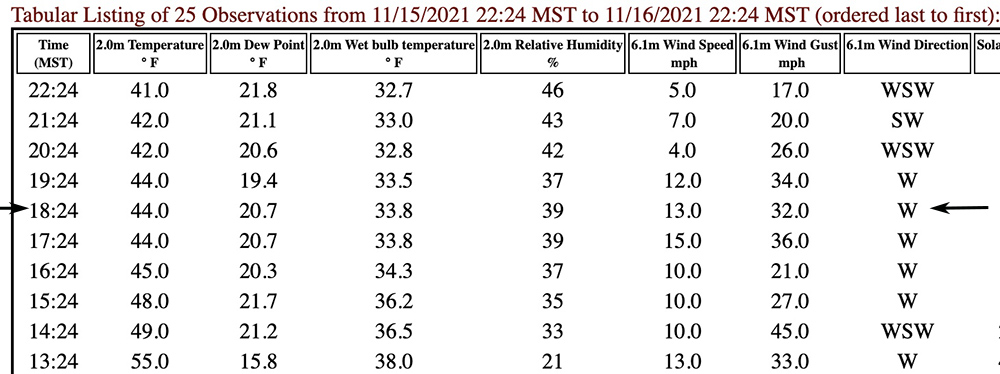 Weather data from Estes Park RAWS, ESPC2. The last observation shown is at 2224 MST Nov. 16, 2021. The observations at the arrows were 12 minutes before the last detected location of the aircraft.
Around the time Single Engine Air Tanker 860 crashed at the Kruger Rock Fire in Colorado at approximately 6:36 p.m. MST on November 16, killing pilot Marc Thor Olson, the Estes Park ESPC2 Remote Automatic Weather Station recorded sustained winds of 13 mph gusting to 32 mph out of the west. The station is 3.7 miles northwest of the fire at 7,892 feet and its anemometer is 20 feet above the ground.
 N802NZ, last 10 minutes of flight tracking data, Nov. 16, 2021. FlightAware.
Looking at the flight tracking log from FlightAware above, the wind appeared to be much stronger at the plane’s altitude, which was 8,950 to 10,450 feet while it was over the fire. The highest peak just south of the fire is at 9,400 feet.
 Map of the Krueger Rock Fire, Nov. 17, 2021. Colorado’s Multi-Mission aircraft and crew.
As it made four orbits near the fire during the 10 minutes it was in the area, the ground speed of T-860, an Air Tractor 802A (N802NZ) varied from a low of 82 mph while flying west to a maximum of 200 mph when east-bound. These shifts in ground speed were consistent during all four orbits. This indicates a very strong wind out of the west, a direction that is consistent with the data from the weather station.
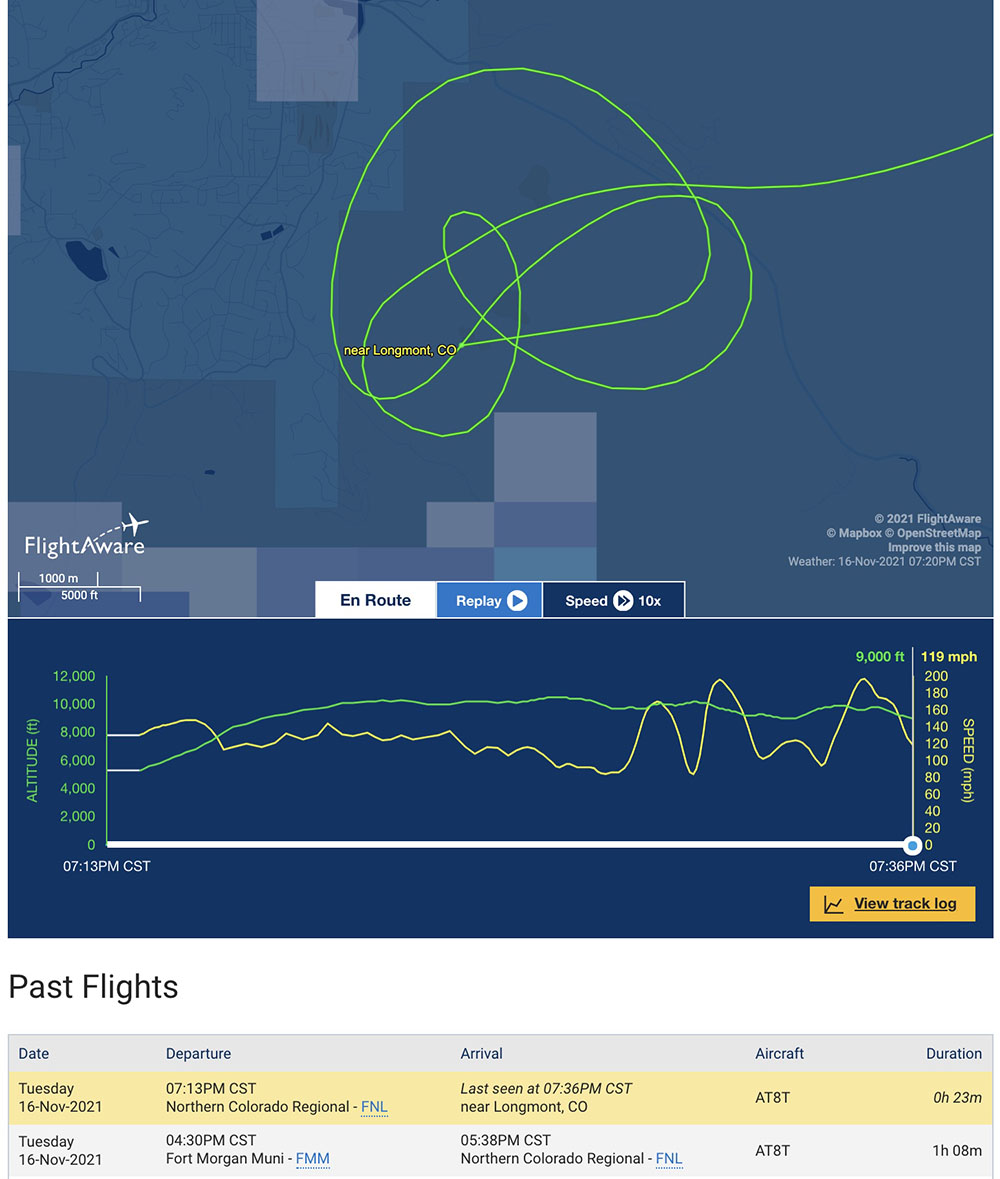 The last flight of Tanker 860, N802NZ. The flight originated at Northern Colorado Regional Airport. FlightAware. Note that the times are in CST.
There are two reasons that fixed wing air tankers avoid attacking wildfires during strong winds. One, the wind makes it difficult or impossible for the retardant to hit the target, getting blown horizontally as it falls from the aircraft to the ground. Second, flying low and slow, as air tankers have to do, is difficult in mountainous terrain with calm winds, but it can be extremely hazardous during strong winds.
When you add a third complexity of dropping at night using night vision goggles, something that has been done very little in the history of aviation, and never before in Colorado, the pilot had the deck stacked against him. The chances of stopping or slowing the spread of the fire with retardant, water, or any other suppresant, were very, very slim. (There is a report that the operator of the aircraft, CO Fire Aviation, experimented with night drops in Oregon in 2020 and 2021.)
NEW: CO Fire Aviation confirms the pilot killed in the air tanker crash last night was Marc Thor Olson. He told me most people called him Thor.
This is a picture I took of him last night as he was prepping his plane. The crash happened about an hour later #9News pic.twitter.com/uEOO4tbXwK
— Marc Sallinger (@MarcSallinger) November 17, 2021
The weather forecast available from the National Weather Service that Tuesday afternoon called for continued very strong winds until sundown and a chance for snow Tuesday night. It predicted dry weather on Wednesday and Thursday with high temperatures in the 30s and 40s under mostly sunny skies with the relative humidity around 20 percent. The wind chill was expected to be below zero from Wednesday afternoon until Thursday afternoon. The actual low temperature Tuesday night turned out to be 11 degrees.
Risk vs. reward
With 20/20 hindsight looking at risk vs. reward, this was a very high risk mission. The potential reward was little, considering the likely effectiveness of 700 gallons of suppressant blown off target by strong winds and the weather forecast of a chance of snow in a matter of hours and wind chills the next day below zero.
Who decided to attempt the night flight?
The short answer is, the Larimer County Sheriff’s office ordered the aircraft to respond to the fire, using a “verbal call when needed contract”, an arrangement that was first agreed to on October 5, 2021.
A preliminary map appears to show that the fire was just inside the boundary of the Roosevelt National Forest. The Larimer County Sheriff’s office said on Wednesday Nov. 17 that as of 7 a.m. that day the fire was being managed by a unified command with the US Forest Service and the Sheriff.
In Colorado, Texas, and Wyoming the local county sheriffs are given the responsibility for suppressing wildfires outside of cities unless they are on federal land. The Kruger Rock Fire was in Larimer County.
As Wildfire Today reported November 16, before the fatal flight, T-860 departed from the Fort Morgan, Colorado airport, orbited the fire about half a dozen times, then landed at Northern Colorado Regional Airport at 4:38 p.m. MST. This flight is listed in the image from FlightAware above as one of two flights that day for the aircraft. It turns out that on the first flight it dropped water on the fire, which the pilot reportedly described as “successful”. After it landed at Northern Colorado Regional Airport it reloaded with “fire suppressant” instead of water, and by 6:13 p.m. MST was airborne returning to the fire.
Sunset that day was at 4:44 p.m. MST. The air tanker disappeared from tracking at 6:35 p.m., about 1 hour and 49 minutes after sunset. Air tankers working for the U.S. federal government are allowed to drop only as late as 30 minutes after official sunset.
The Denver Post reported that CO Fire Aviation said in a statement, “There was no aerial supervision or lead plane required for the mission and weather and wind conditions were reported to be within limits of our company standard operating procedures.”
In the video below Juan Browne has strong feelings about this incident. Shortly after posting it, he wrote a comment saying, “GROUNDSPEED NOT AIRSPEED!”
Below is an excerpt from a statement released November 17, 2021 by the Larimer County Sheriff’s office:
“On the morning of November 16, 2021, the Larimer County Sheriff’s Office and many partner agencies responded to and began fighting the Kruger Rock Fire southeast of Estes Park. The terrain where most of the fire was burning made it too dangerous to insert firefighters to battle the fire directly. The gusty winds, higher than normal temperatures, and low relative humidity suggested great potential for the fire to grow quickly. Incident Command knew the best chance of getting ahead of the fire was with the use of air drops from aviation resources.
“Around midday, LCSO reached out to CO Fire Aviation (Fort Morgan, CO) and asked if they would be able to assist with air operations. CO Fire Aviation said they were available, had a plane, a pilot, and were interested in assisting. They also discussed the fire and weather behavior as LCSO wanted to make sure CO Fire Aviation was aware of and comfortable with the conditions.
“A few hours later, CO Fire Aviation said they were checking the weather and crosswinds at the fire and were comfortable making air drops. The plane left Fort Morgan and headed to the fire with a load of water. With LCSO resources on the ground communicating with the pilot, the water drop was successful. The pilot reported the wind was not too bad at the fire and said he would head to Loveland to get a load of suppressant to make a second drop.
“About an hour later, the plane returned to the fire and the pilot told ground resources it was turbulent over the fire, conditions were not ideal to make a drop, and that he was going to make one more pass and then return to Loveland. Moments later, at approximately 6:37 p.m., ground resources heard the plane crash.
“LCSO’s relationship with CO Fire Aviation began earlier this year when CO Fire Aviation invited LCSO, several fire departments, and other counties to a demonstration they had planned in Loveland. LCSO representatives attended the demonstration and were interested in the services CO Fire Aviation were offering, including night air operations.
“In recent years, we have experienced the severe fire behavior in Colorado as demonstrated by the 2020 Cameron Peak Fire. Recent advances in technology to achieve night air operations already in use in other states has proven to be an effective tactic to help prevent medium-sized fires from exploding and making large runs like we saw last year.
“LCSO also knew that air resources are often stretched thin and sometimes not available when needed. After the Loveland demonstration, LCSO continued talks with CO Fire Aviation to learn more about their services, response times, costs, etc. CO Fire Aviation offered the capability and LCSO was willing to give them the opportunity if it would benefit firefighting operations.
“LCSO entered into a verbal “call when needed” contract with CO Fire Aviation on October 5, 2021 in lieu of an exclusive use contract. A written contract is still being negotiated. LCSO had reached out to CO Fire Aviation about their services during other fires this year, but they either did not have the availability, or it was decided air operations were not needed on those fires. The Kruger Rock Fire is the first time LCSO used the services of CO Fire Aviation.”