


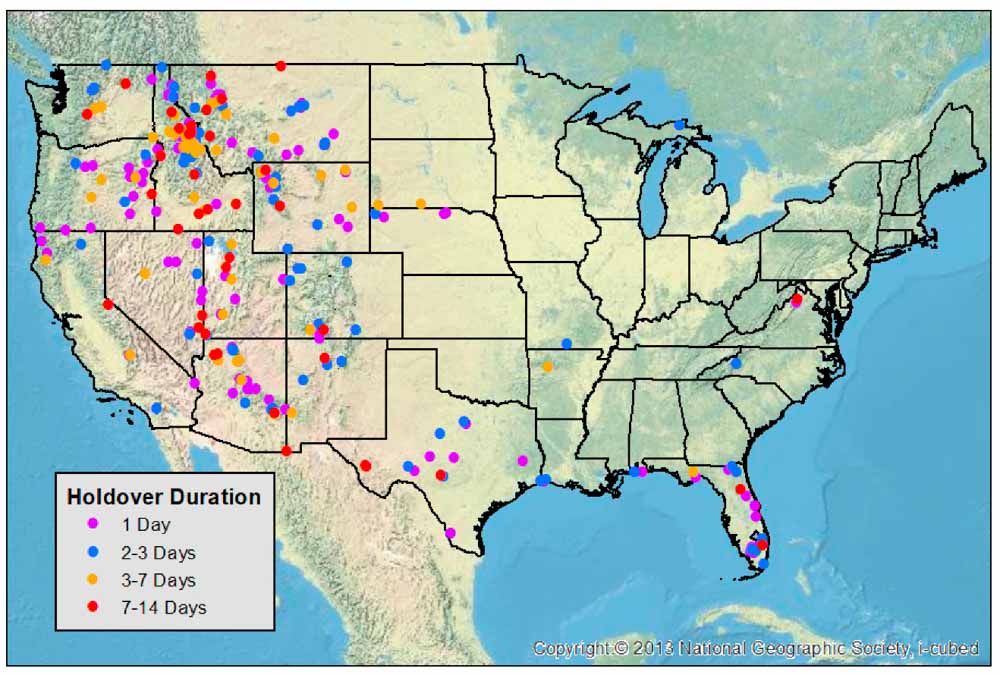
Researchers have found that about a quarter of the fires caused by lightning that grow to more than 4 km² (988 acres) are reported more than a week after they are ignited.
A paper published in the Fire Open Access Journal describes how the National Lightning Detection Network (NLDN) and U.S. Forest Service fire data were used to determine the correlation between lightning strikes and the reported location of lightning-caused wildfires.
The NLDN, which has been used operationally for several decades, consists of 113 sensors across the continental United States and has a reported flash detection efficiency of cloud to ground flashes between 90–95%, with spatial errors that are typically less than 500 meters for the flash data used in the study.
The researchers found, of lightning-caused fires that grew to more than 4 km² (988 acres):
50% reported the same day
71% reported within 3 days
73% reported within 5 days
77% reported within 7 days
Holdover fires that are not reported for days or weeks after the lightning occurs can be problematic for land managers. Shortly after a thunderstorm has left the area, fire detection efforts are often ramped up and may continue in that mode for a few days. Fires that smolder in duff or under snow and suddenly grow can be unexpected. Firefighting resources that may have been staged in anticipation of emerging fires could be released or assigned to active incidents, complicating efforts at quick initial attack with overwhelming force.
Authors of the paper: Christopher J. Schultz, Nicholas J. Nauslar, J. Brent Wachter, Christopher R. Hain, and Jordan R. Bell.







