


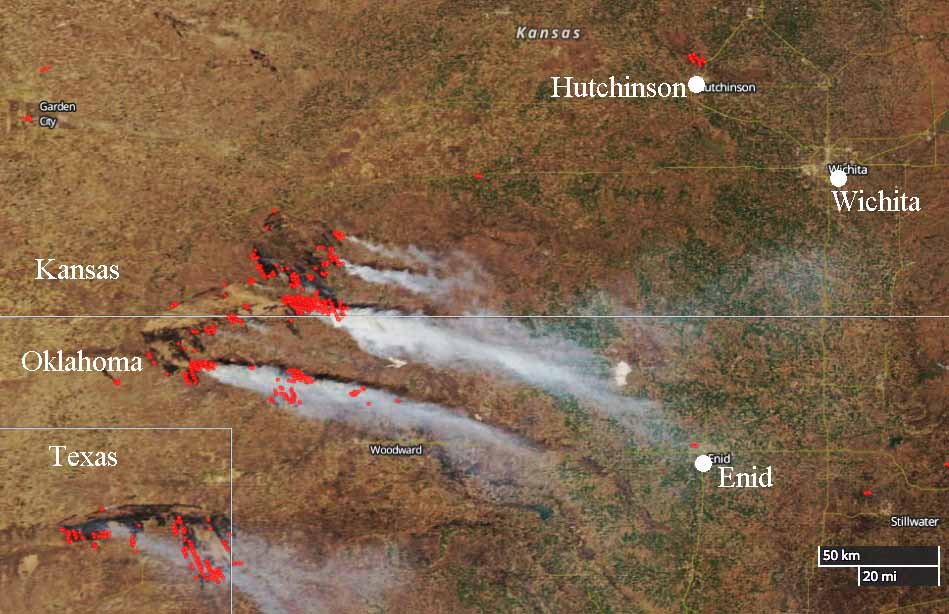
Above: Wildfires detected by a satellite March 7, 2017 in the Hutchinson, KS and Enid, OK area. NASA.
Reno County in Kansas has completed an after action report (AAR) regarding the wildfires that occurred in March, 2017. One of the largest blazes was north of Hutchinson, which is about 40 air miles northwest of Wichita. While those fires were active, hundreds of thousands of acres were also burning around the Texas/Oklahoma panhandle/Kansas border area.
Before we get into the AAR, one thing to keep in mind about Kansas, which we covered April 2, 2017, is that according to the Wichita Eagle:
The state’s forest service is the smallest and lowest funded of any in the country – which puts people and property in danger. Consider the difference in resources and responses between Kansas and Oklahoma:
–The Kansas Forest Service budget in 2016 was about $3 million, with $1 million dedicated to fire service; Oklahoma’s budget was $15 million, with $8 million for fire service.
–The Kansas Forest Service has three trucks and four employees dedicated to firefighting and fire prevention; Oklahoma has 47 fire engines, 47 bulldozers and 84 firefighters.
The AAR was compiled by Deputy Fire Chief Doug Hanen, with the assistance of Emergency Management Director Adam Weishaar and Sheriff Randy Henderson. The 30-page report concluded that generally the work performed on the fires by numerous agencies was positive and commendable, but there was room for improvement.
Here are some of the highlights of the review:
- There is a need for smaller fire apparatus that can get into areas not accessible by 6-by-6 military surplus engines.
- A Polaris side-by-side UTV holding 75 gallons was very useful for mop up, especially in wet areas. They hope to obtain at least one more.
- On days with a Red Flag Warning, they will now immediately dispatch at least three brush engines.
- In order to help manage the span of control, the Hutchinson Fire Department will organize resources into Task Forces comprised of three brush engines, one water tender, and a Task Force Leader.
- The firefighters in Reno County for the last two years have increasingly used backfire and burnout tactics, and more engines are carrying drip torches.
- The Hutchinson Fire Department became the first fully-paid department in Kansas to have all of their firefighters red carded. This will enable them to send resources out of the state, for example, to Colorado or California.
- The Kansas State Incident Management Team provided assistance for a day, but they “seemed overwhelmed by a moving event,” were “inexperienced…in essential positions”, and lacked accountability. At the end of the day the Team left. The state has since reorganized the program, placing teams under the Kansas Department of Emergency Management enabling them to respond nationwide instead of just in Kansas.
- Toward the end of the fire siege a Type 2 Incident Management Team was called in. The difference between that team and the previous State Team was “night and day”. Local officials learned a lot from the Type 2 Team, especially how to re-populate areas following an evacuation and in dealing with victims following an incident.
- There are opportunities for better and more timely communication and coordination with the public and the media.
- The report suggests better guidelines for managing length of first responders’ shifts on wildfires and their rehabilitation in order to reduce exhaustion.


