


(UPDATED at 11:02 am MST Feb. 11, 2020)
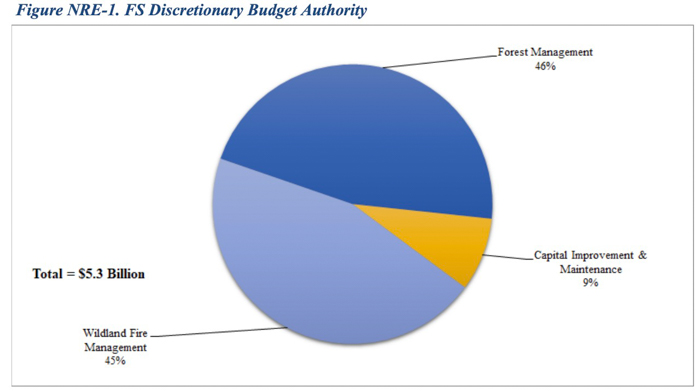
The administration has released its proposed budgets for fiscal year 2021 which begins October 1. If approved by Congress exactly as written, which is unlikely, the wildland fire budgets for the U.S. Forest Service and the four land management agencies in the Department of the Interior would increase. The budget also calls for large reductions in research and the closure of two Forest Service Research Stations which would eliminate 287 positions.
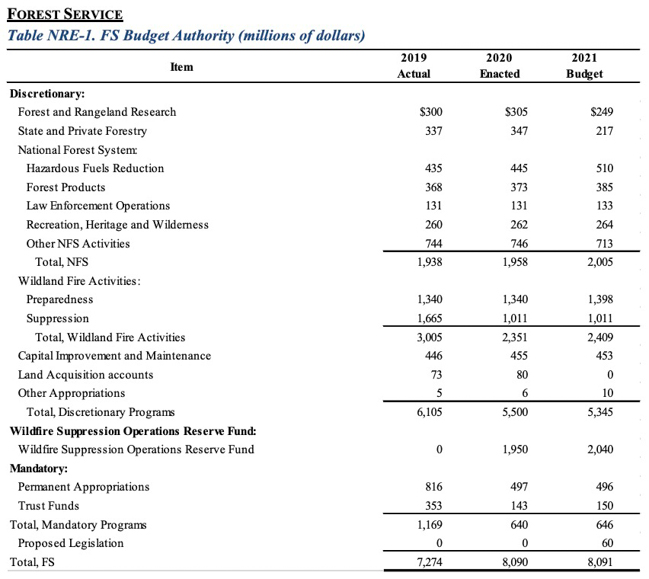
Combined, the DOI agencies’ fire budgets would increase by 5%, while the FS fire budget could see a 2% bump.
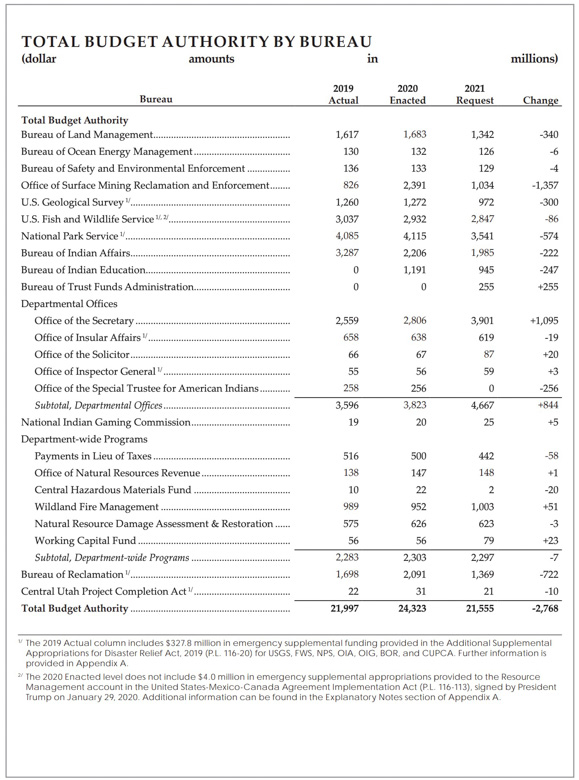
The overall budget for the FS would remain about the same as this fiscal year, but the DOI agencies could see their overall budgets decrease by 3% to 20%. Below are the proposed changes in the total budgets (first) and full time equivalent staff years (second) for the FS and DOI agencies:
- National Park Service: -14%, -5%
- Fish & Wildlife Service: -3%, -0.4%
- Bureau of Indian Affairs: -10%, -10%
- Bureau of Land Management: -20%, +3%
- Forest Service: 0%, -1.5%
These numbers are what the departments and agencies are suggesting for FY 2021 with the approval or at the direction of the White House. As the budget goes through the appropriation process it will change. But as Congress continues to turn over more of their authority to the President, we may see fewer changes this time.
You can read the FY 2021 Budget Briefs by the two Departments. “Brief” may not be the most accurate choice of words, with the DOI document reaching 237 pages and the Department of Agriculture’s totaling 112 pages.
The Consolidated Appropriations Act of 2018 provided new budget authority to fight wildfires, known as the “fire fix.” Beginning this year, FY 2020 and continuing through 2027, the Forest Service and the Department of the Interior will have new budget authority available when Suppression funding has been exhausted. This budget authority is $2.35 billion in 2021 (of which $2.04 billion is allocated to the Forest Service) and increases by $100 million each year through 2027. In a busy fire year this will reduce the “borrowing” of funds from non-fire programs, and make fire programs more self-sufficient.
Both budget documents mention fuel management, active forest management, and timber salvage many times, reflecting what is often heard from White House personnel.
The Trump administration wants to close two research facilities, the Pacific Southwest Research Station (-$18.5 million) and the International Institute of Tropical Forestry (-$2.5 million). These cuts would eliminate 287 staff years. These closures would require the use of reduction in force authority, voluntary early retirement authority, and voluntary separation incentive authority. In addition the agency would eliminate recreation research (-$8.5 million) and wildlife and fish research (-$22.5 million).
The administration also wants to cut Forest and Rangeland Research by $55 million (18%) and State and Private Forestry by $129 million (37%). The FS description of State and Private Forestry: “provides technical and financial assistance to landowners and resource managers to help sustain the nation’s forests and grasslands, protect communities from wildland fire and restore fire-adapted ecosystems.”
A decrease of $8,000,000 would affect research in forest and grassland health, forest soils, air quality, hydrology, silviculture, and forest ecology, as well as in applied science to improve forest conditions, forest inventory and trend analysis, and wood product and market innovations.
The Joint Fire Science Program which has been zeroed out in the budget recommendations in the two previous years, but later funded by Congress, is listed to receive $3 million, which would be the same as it actually received in FY 2020.
The DOI has a $28 million “Plan to Transform the Firefighting Workforce,” a $28.0 million investment to hire more full-time professionals. The budget will also enable Interior to extend the duration of temporary hires and career seasonals as the program seeks administrative authority to extend the duration of temporary hires. Here is an excerpt from the budget proposal:
Interior’s ability to recruit and train full-time fire personnel has steadily declined, leaving the program excessively dependent on temporary personnel and contractors, a workforce model incompatible with a fire season that has now become a fire year, with larger, costlier, and more complex fires. The requested funding will strengthen DOI’s ability to maintain its initial-attack success rate and provide effective wildfire response throughout the fire year.
The FS, which contracts for all large air tankers, very large air tankers, and Type 1 helicopters, only mentioned aviation very briefly in the document, saying they will “…continue to right-size its aviation assets, evaluating the best mix of asset types and ownership models to provide the necessary aviation capability.” No details were given about the number or types of aircraft they plan to use for homeland security — fighting fires. In recent years, the meaningless term “right-size” has been synonymous with down-size.
Another document, FY 2021 Budget Justification, provides more details about aviation. On page 18 it indicates there were 18 Next Generation Air Tankers in FY 2020. But in the middle of the fire season and three weeks before the end of the fiscal year there were only 13 on exclusive use contracts. Occasionally additional Call When Needed air tankers were activated. On page 93 the Justification says the “robust aviation program” will include “up to 18 exclusive use air tankers”. The “up to” modifier allows a great deal of obfuscation, again.
As this is written, there are only 13 large air tankers on exclusive use contracts. It has been 499 days since the Forest Service published the solicitation for another round of Next Gen air tankers Ver. 3.0, on November 19, 2018. Bids were required by February 14, 2019.
Having only 11 to 13 large and very large air tankers on exclusive use contracts is far fewer than is needed.
In some of the past Congressional budget hearings occasionally a Congressman or Senator has asked pointed questions about the fire budget, but only rarely are followup questions asked after the agency person gives a vague response.
This article was edited Feb. 11, 2020 to include more details about aviation and cuts to research noted in the Budget Justification document.


