


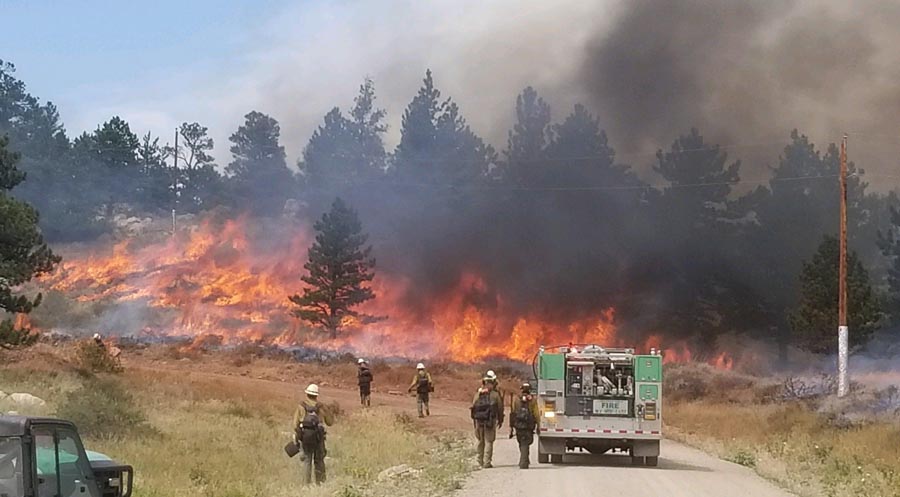
Increasingly complex and large wildfires throughout the world have necessitated a growing collaboration between public, semi-public, and private entities that span across regions and interests. The issue has driven some in the United States, including President Donald Trump and sitting senators, to advocate for a single and overarching wildfire agency to handle the nation’s wildland fire threat.
The movement of multiple varying wildfire-prone regions into a single regime, although successful in some circumstances, may risk undermining the effectiveness of managing a wildfire incident, according to newly published research.
The study, recently published in the International Journal of Wildland Fire, studied 15 wildfire disasters from 2017 and 2018 and the 139 jurisdictions involved in fighting them. The researchers wanted to see whether the “pluralism paradox,” or when the threat of conflict increases when multiple and varied interests are needed to collaborate to address complex problems, held up to scrutiny.
Their findings suggest that trying to create a permanent single wildfire management strategy across numerous jurisdictions opens the door to conflict among involved organizations.
“Given the different missions guiding land jurisdictions, it may be structurally impossible to craft a strategy that optimizes values for all interests,” the researchers said. “Thus, zero-sum logic will apply to some strategies for fire management.”
Researchers found that collaboration among resource use and operational strategy, in particular, has the highest risk of generating conflict because the entities involved are likely to view the decisions made as privileging certain jurisdiction interests over others.
Collaboration between organizations and agencies that disagree, however, doesn’t always lead to conflict. Communication and information management collaboration, for example, has the least risk of creating conflict because they’re least likely to be perceived as a win-lose scenario for agencies involved in fighting fires.
Wildland fire stakeholders can also begin addressing potential conflict by addressing values-based mission differences between federal and state/private fire managers and holding pre-fire season workshops, table-top exercises, and meetings.
“These insights provide some nuanced, empirical insight into the dynamics of organizational pluralism in collaborative settings,” the researchers said. “Providing greater understanding of where we can expect to find conflict can lead to not only more realistic expectations, but also more resilient collaborative designs targeted at specific contexts and potentially better managed outcomes for all involved.”




Comments are closed for this article!