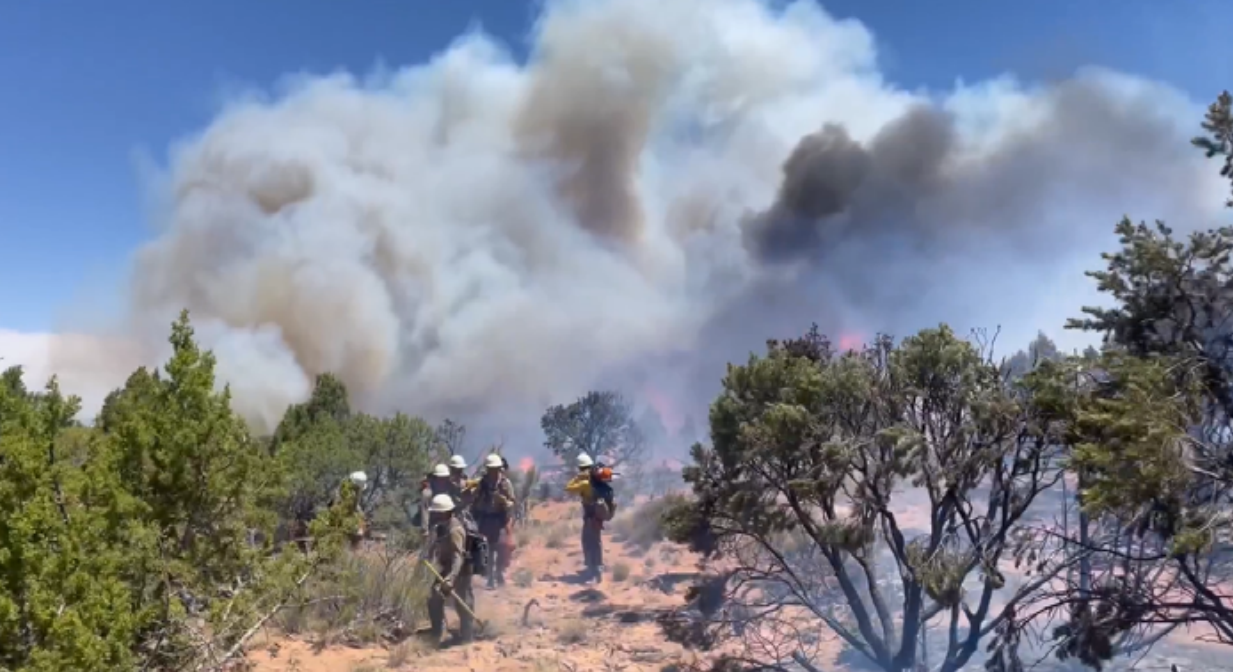
The Caldor Fire southwest Lake Tahoe in California and the availability of firefighting resources were very briefly discussed at the White House press briefing Monday afternoon. The video above should be queued up to where the topic began at 1:07:13.
In response to a reporter asking if there were enough fire resources, Press Secretary Jen Psaki said, “Well, that is our objective. We will continue to assess if additional resources are needed and again I would note that when the President came in he looked at the impact of wildfires and the fact that in the past there have been cases where we didn’t have the resources needed and he wanted to preemptively take steps to prepare for that, to make sure we had those resources as we went into fire season.”
Opinion-
It is unclear to me what steps were taken that made a big difference in the availability of firefighting resources during this Western fire season. However the President did apply pressure to help make all eight military Modular Airborne Firefighting Systems (MAFFS) available that can convert a C-130 into an air tanker. At the time only five were working and the Air Force apparently had difficulty staffing the MAFFS operation with trained and qualified flight and support crews.
And 200 soldiers are being trained now to serve as hand crews. But that does not make up for the fact that Pew Charitable Trusts reported in July the Forest Service’s California Region had not filled 725 of the planned 4,620 fire positions, illustrating a serious problem with retention and recruitment.
There are still only 18 large air tankers on exclusive use contracts, and many of them are working on absurd one-year contracts. On May 17, 2021 Fire Aviation was told by a spokesperson for the US Forest Service that this year they would have 34 large air tankers (LATs) if needed — 18 on Exclusive Use Contracts guaranteed to work, 8 “surge” LATs guaranteed to work for a shorter period of time, and another 8 on Call When Needed (CWN) contracts. Of those 16 surge and CWN aircraft, only 5 could be produced.
COVID has had an effect on the number of federal firefighters available. We asked the five federal land management agencies for the number of firefighters that have tested positive for COVID or had to quarantine after exposure. 1All five refused to release any information on the topic and would not explain their reasoning for keeping it secret. This is ridiculous for organizations that say they care about the health and safety of their employees who have a right to know the severity of the additional risks they are taking on while in a job already recognized as being hazardous.
It tends to indicate that a pandemic can be politicized to the point where the Park Service, Forest Service, BIA, BLM, and FWS will not even discuss to what degree it is degrading their fire preparedness, if at all. What is next? Refusing to acknowledge injuries and fatalities caused by vehicle accidents and hazardous trees?
In the 12-step program for AA, the first is important, admitting to yourself and others that you have a problem. I’ll very loosely paraphrase it, bending it just a bit for this situation: “We admitted we were powerless over [confessing to problems with COVID, recruitment, and retention] and that our [fires] had become unmanageable.”
The act of keeping it secret leads one to believe it is a very serious issue. Welcome to 2021.
The Wildland Fire Lessons Learned Center recently issued information about six examples of COVID exposure on fires. Here is a portion of one about a hotshot crew that was affected in July, 2021, when 18 of them were exposed to a crewmember who tested positive. Two crewmembers left the fire early and were not exposed:
Of the 18 crewmembers who returned from assignment on June 22nd, 3 were fully vaccinated and returned to work on June 25th. The remaining employees (15) have not returned to work; the sick employee was put into isolation and the remaining close contacts on the crew were told to self-quarantine for 14-days by unit leaders. The 2 crewmembers who returned early (1 vaccinated) were not impacted. None of the vaccinated employees got sick while 6 of the unvaccinated employees have tested positive.
(If you would like to leave a comment about this topic, great — as long as it is on the topic of wildfire management, and does not veer into politics or personal attacks. Offending comments will be removed, as stated in our policy, or comments will be turned off.)
1Wildfire Today asked the National Interagency Fire Center several questions last week about the availability of resources, working through Candice Stevenson of the National Park Service whose turn it was last week to serve as PIO for NIFC. Generally, clear answers were avoided or not given, including one about the effects of COVID on the firefighting force. When I asked for more information Ms. Stevenson offered to ask each of the five agencies for the numbers of firefighters affected by COVID. I accepted the offer. She responded much more quickly than expected, saying, “I received notification from DOI and USFS and they are declining to provide further input.” I asked her by email on August 27 what the reason was for them not making the information available. There was no reply.