

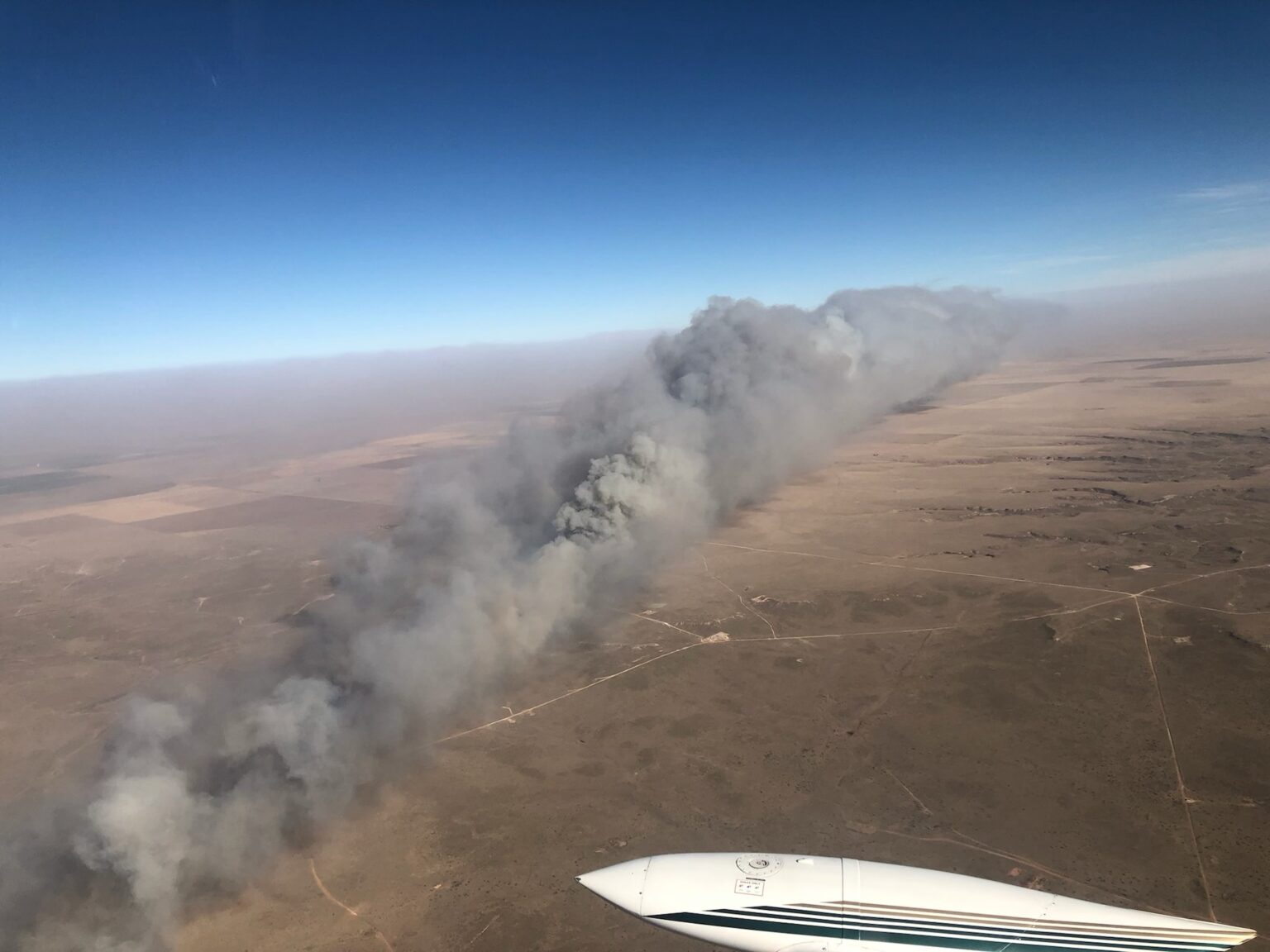
 Parker Creek Fire, December 15, 2021. Texas Forest Service photo.
Sunday night as I watched the Season 4 finale of Yellowstone, John Dutton, played by Kevin Costner, was talking with another character who said, “I’m terrified of the world we’re leaving (for my grandchildren). I honestly don’t know what this place will look like in 100 years.”
“Grass will cover the streets, and weeds will cover the rooftops,” Dutton said. “I don’t think we make it 100 years.”
I have been thinking about wildfire smoke recently, and how during the last two years massive plumes of smoke from fires in the western states have often migrated east, sending hazardous air laden with tiny PM2.5 particles (2.5 micrometers and smaller) across a dozen states. I learned in a Smoke Management class that if you could drop a PM2.5 particle from eight feet high in a room with still air, it would take about eight hours for it to reach the floor. Smoke with these pollutants is easily transported hundreds or thousands of miles across state and international boundaries. Canada and the United States seem to take turns exporting PM2.5 across the border.
 As the sun begins to set on the west coast, gray smoke from wildfires can be easily distinguished from white clouds. NOAA, GOES 17.
In research published online last week in the journal Toxicological Sciences, researchers reported that inhaled microscopic particles from woodsmoke such as PM2.5 work their way into the bloodstream and reach the brain, and may put people at risk for neurological problems ranging from premature aging and various forms of dementia to depression and even psychosis.
Extreme weather conditions that a few decades ago were rare are occurring more frequently, sometime establishing conditions suitable for extreme fire behavior. If this trend continues to increase, where will we be in 10, 20, or 30 years? Or 100 years? Grass on the streets and weeds on rooftops?
Widespread smoke is just one of the symptoms of how climate change is degrading the quality of life for many people on this planet. In the article described below, the author wrote that a researcher told her that “Wildfire is literally making it unsafe to be pregnant in California.”
The article by Elizabeth Weil published Monday in New York Times Magazine is well worth your time. It is a long form piece looking at how wildfires are changing, and the effects. She examines most of the issues that are involved — weather, climate, prescribed fire, indigenous fire, fuel breaks, “managed” fire, human health, fire resistant construction, and the home ignition zone — in a style that makes you want to keep reading, and hoping that you don’t get to the end of the article in the next paragraph or two.
It is behind a pay wall, but that’s the life we have now, or are moving toward. (Yes, even Wildfire Today has considered a subscription fee.)
(UPDATE Jan. 4, 2021: AZFFT found an accessible copy of the article at
https://www.propublica.org/article/californias-forever-fire)
Here are excerpts from the article, titled, This Isn’t the California I Married — The honeymoon’s over for its residents now that wildfires are almost constant. Has living in this natural wonderland lost its magic?
…Aching and eager to escape my own boring loop of depressive thoughts, I met with Alex Steffen, a climate futurist, on the back patio of a bar in Berkeley. Steffen, a 53-year-old mountain of a man with a crystal-ball-bald pate, hosts a podcast and publishes a newsletter called “The Snap Forward.” The idea behind both is that the climate crisis has caused us to get lost in time and space; we need to dig ourselves out of nostalgia and face the world as it exists. As he explained to me in his confident baritone, yes, California, and the world, are in bad shape. But the situation is not as devoid of hope as we believe. “We have this idea that the world is either normal and in continuity with what we’ve expected, or it’s the apocalypse, it’s the end of everything — and neither are true,” he said. That orange sky in 2020? “We’re all like, Wow, the sky is apocalyptic! But it’s not apocalyptic. If you can wake up and go to work in the morning, you’re not in an apocalypse, right?”
The more accurate assessment, according to Steffen, is that we’re “trans-apocalyptic.” We’re in the middle of an ongoing crisis, or really a linked series of crises, and we need to learn to be “native to now.” Our lives are going to become — or, really, they already are (the desire to keep talking about the present as the future is intense) — defined by “constant engagement with ecological realities,” floods, dry wells, fires. And there’s no opting out. What does that even mean?
We’re living through a discontinuity. This is Steffen’s core point. “Discontinuity is a moment where the experience and expertise you’ve built up over time cease to work,” he said. “It is extremely stressful, emotionally, to go through a process of understanding the world as we thought it was, is no longer there.” No kidding. “There’s real grief and loss. There’s the shock that comes with recognizing that you are unprepared for what has already happened.”
…
Relinquishing the idea of normal will require strength, levelheadedness, optimism and bravery, the grit to keep clinging to some thin vine of hope as we swing out of the wreckage toward some solid ground that we cannot yet see. “We’re no longer dealing with a fire regime in the woods that responds to the kinds of mild prevention and mild responses, the sensible responses we have thought about, and that thought alone is a crisis,” Steffen said. “It means the lives we had we no longer have.”
…
This brings us to one other forest- management tool in the knife: “managed wildfire.” This one, however, does not always pair well with the other overabundant species out there in California: people.
…
This summer, in Kings Canyon, as the wildfires approached, firefighters wrapped giant sequoias in aluminum foil. This included General Sherman — 2,200 years old and the largest single tree on Earth. This act was meager, and it was devotional. It’s what we’ve got now. The good news is, some of the moves we need to make are easier, more straightforward and more under our control than we imagined, if we’d just allow ourselves to get them done. The bad news is that there is just going to be loss. We’re not used to thinking about the world that way. We’re not used to paying for our mistakes.
Thanks and a tip of the hat go out to Tom.


