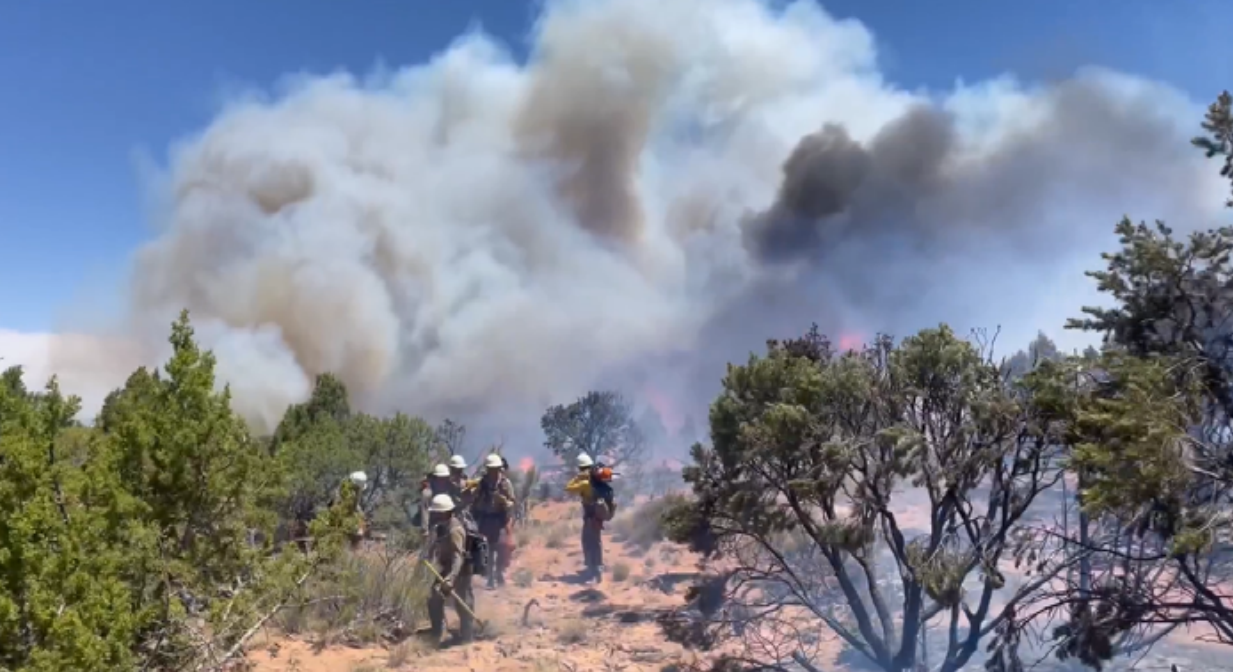
The state of Victoria brought the DC-10 Very Large Air Tanker to Australia during their summer for the 2009-2010 fire season to test the effectiveness of the 12,000-gallon aircraft on down-under bushfires. The ship is operated by 10 Tanker Air Carrier in California and has been previously tested and approved by the Interagency Air Tanker Board for use on fires in the United States.
The Bushfire Cooperative Research Centre tested the DC-10 on one wildfire and five planned missions, identifying serious deficiencies which led to the decision by the Victorian government that:
…the aircraft would be less effective in suppressing Victorian bushfires and would not be suitable for use around the urban interface where the forest meets communities of relatively high populations.
Some of the issues pointed out in the 91-page report that led to that decision included:
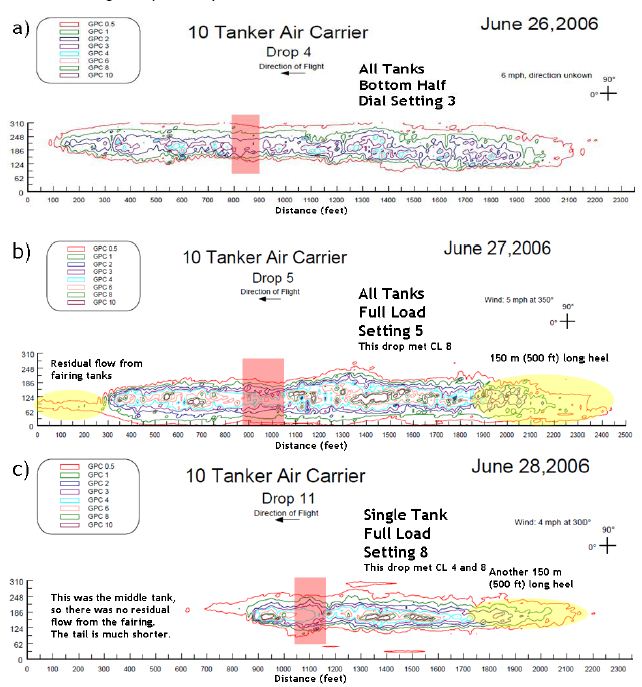
Billowing. The drop cloud released by the DC-10 is not uniform. It has thick and thin sections which leave areas on the ground with insufficient coverage.
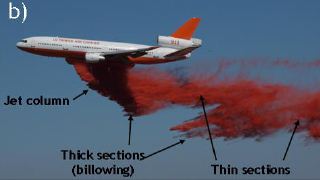
The tests by the U.S. Forest Service’s San Dimas Technology Development Center led to the same conclusion, as shown in this graphic from their evaluation in 2006. The red areas designate insufficient coverage.
Damage. During one planned test in Victoria the retardant impacted a Eucalyptus forest with such force that it broke off a number of trees with diameters of 4 to 10 inches. While the researchers did not have adequate equipment to accurately determine the drop height, it is thought that the aircraft was at less than the 150-foot height that was requested, which meant that the retardant was still moving forward, rather than straight down, when it impacted the forest. Most air tankers drop at a slower speed than the DC-10’s 150 knots, resulting in less chance for impact damage from the retardant. If the drop had been made at 150 feet, there would have been less damage, but apparently the Aussies do not have confidence that the DC-10 pilots can be depended upon to always drop above the minimum specified height. The government’s concern is:
…the potential to cause serious injury should the load fall on a person. There was also the potential for the aircraft to destroy the property it was attempting to protect.
Some other jet-powered air tankers drop at slower speeds. The BAe 146-200, if it ever appears over a fire, is expected to drop at 115-150 knots. The Russian Be-200 drops at 107 knots while the 747 Super Tanker drops at 140 knots. Multi-engine propeller-driven air tankers typically drop at 100-130 knots, while single engine propeller-driven air tankers drop at 104 knots.
Accuracy. In one planned test, the DC-10 pilots completely missed the fire area. A live fire was set in an area that had been prepared with black line, with burned buffers on the perimeter. Their drop, which was accurately designated by a preceeding lead plane’s smoke, was supposed be across the head of the fire but fell totally outside of the fire area, having no effect. Other drops were more accurate, except for a tendency to sometimes begin or end drops a little too early or too late.
Cost: A report by Deloitte found that the cost of the DC-10 was significantly higher than other aircraft.
Base: There is only one airfield in Victoria where the aircraft could land and take off. Smaller air tankers have multiple options.
NOW WHAT?
From a Victorian government press release :
Two new faster and more flexible large fire bombing planes will be trialled as part of Victoria’s firefighting arsenal which will also be boosted by the use of night vision helicopter goggles and infrared imaging technology.
Environment and Climate Change Minister Gavin Jennings today announced that the Victorian Government would invest $12 million for two new Convair 580 fire bomber planes, a new Erikson Aircrane and four extra fixed-wing aircraft for the upcoming fire season.
The new aircraft will join Erikson Aircranes Elvis and Elsie and bring Victoria’s aerial firefighting arsenal to 48 with a further 170 aircraft on standby if required.