

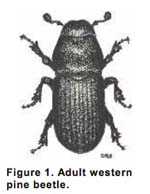
 Some of the forests in California are experiencing a natural phenomenon that other areas in the Rocky Mountains, the Pacific Northwest, and British Columbia have been dealing with for years. Pine beetles, in this case Western Pine Beetles (WPB), are attacking and killing millions of trees. These things run in cycles and in this case the extended severe drought in the state has stressed the trees making it more difficult for them to fend off insects.
Politicians, residents, and even some individuals in fire organizations look at the hillsides with numerous dead or dying trees and intuitively think — dead vegetation — increased wildfire hazard.
Here are examples from the California Department of Forestry and Fire Protection (CAL FIRE):
From a 2015 news release:
These dead and dying trees create an environment more readily susceptible to dangerous and destructive wildfires.
In a video on YouTube the narrator says when referring to a beetle-attacked stand of trees:
…an increase in extremely flammable vegetation which could lead to larger, more intense and damaging wildfires.
SFGate quoted spokesperson Daniel Berlant:
“No level of rain is going to bring the dead trees back,” Berlant said. “We’re talking trees that are decades old that are now dead. Those larger trees are going to burn a lot hotter and a lot faster. We’re talking huge trees in mass quantity surrounding homes.”
A phone call to Mr. Berlant was not returned.
Those warnings are not 100 percent accurate. In increasing numbers, scientists are determining that generally, insect damage reduces burn severity. In one of the more recent studies, researchers from the University of Vermont and Oregon State University investigated 81 Pacific Northwest fires that burned in areas affected by infestations of two prevalent bark beetle and defoliator species, mountain pine beetle (Dendroctonus ponderosae) and western spruce budworm (Choristoneura freemani). The fires spanned the years 1987 to 2011.
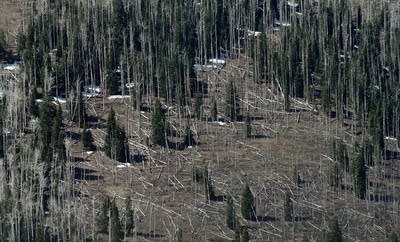
Few of the 81 fires occurred in forests while the needles were still on the trees in the red highly flammable stage of the outbreak shortly after the trees were killed by mountain pine beetles, so more research is needed about this phase. Aside from the one to two year red stage, the burn severity decreased for more than 20 years following a MPB attack. It makes sense that fewer fine fuels in the canopy would reduce the fire intensity and make it less prone to transition from a ground fire to a crown fire. This data was derived from fire behavior and data on actual fires, not laboratory experiments.
We contacted one of the researchers that conducted the study in the Pacific Northwest, Garrett Meigs, a Postdoctoral Research Associate at the University of Vermont, and asked him if their conclusions about reduced fire severity following a Mountain Pine Beetle attack in the Northwest could be compared to California’s situation — a drought combined with a Western Pine Beetle attack:
I am aware of the impressive amount of tree mortality in California but have not seen it with my own eyes. As such, I am hesitant to comment on the current conditions in California forests, which are beyond the scope of our recent studies in Oregon and Washington. My understanding is that most of the dying/dead trees are ponderosa pines, which have been affected by intensive drought and the western bark beetle (whereas in the PNW, we studied lodgepole pines affected by mountain pine beetle and mixed-conifers affected by western spruce budworm).
Another thing that is a bit different in California is that many of these forests are generally closer to large human populations, so there are more human values/resources at risk…and these forests at the wildland-urban interface have elevated fuel/fire hazard with or without dead trees (whether caused by insects or drought).
Regarding your specific questions, I would expect that fire behavior and effects would be similar in forests with similar amounts of dead trees, whether the tree mortality was caused by bark beetles or drought (or some combination).
This does not mean that residents near insect-damaged forests can ignore the dead trees. There is legitimate cause to be concerned about fires during the one or two year red needle stage after a pine beetle attack when fire intensity may be temporarily increased, although more research studying actual fires is needed in this area. And there is danger from falling snags (dead trees) 5 to 20 years after an attack. Snags are dangerous for firefighters and any structures, hikers, traffic on roads, and any improvements that could be damaged by the falling trees.
In a fire prone environment, residents should remove any dead vegetation within 100 feet of structures. If there are numerous trees near homes, thinning them so that the crowns are at least 10 feet apart will not only reduce the intensity of an approaching wildfire, but will make more water and nutrients available to the remaining trees, giving the them a better chance of fighting off an insect attack.


