


The number and size of large, destructive fires in the remote Kimberley region of northern Australia have been significantly reduced, mostly due to Indigenous-led fire management over the last decade.
In a paper just published in the International Journal of Wildland Fire, the authors argue that although the region has historically linked with a high number of large and intense fires – typically in the late Dry Season – the shift to more strategic burns early in that season have limited both the number and size of extreme fires that would have otherwise been impossible to control and damaging to the landscape.
The Kimberley is a fire-prone savanna region, with much of the biodiversity dependent upon regular fire, but not high intensity destructive fires. The area is sparsely populated with around 700 residents across the 102,000 km2 study area. Fire was used for tens of thousands of years by the Indigenous inhabitants until contemporary times – but in the last decade there has been a resurgence in proactive fire management, primarily, but not exclusively by Indigenous groups, with the Department of Fire and Emergency Services (Western Australia), Western Australia Parks and other landowners.

The study was a group effort of researchers and practitioners from the Balanggarra Aboriginal Corporation, the Dambimangari Aboriginal Corporation, the Wilinggin Aboriginal Corporation, the Wunambal Gaambera Aboriginal Corporation and Charles Darwin University (CDU).
Lead researcher Rohan Fisher, from CDU, said the study suggests that since 2015, hands-on people-driven landscape management has been a more significant driver of fire regime change than climate.
“On-ground, Indigenous-led fire management appears to have played a significant role in reducing the number of the largest and most severe wildfire events. Indigenous leadership on fire management works. Climate change impacts on fire regimes can be managed, with lots of hard work.”
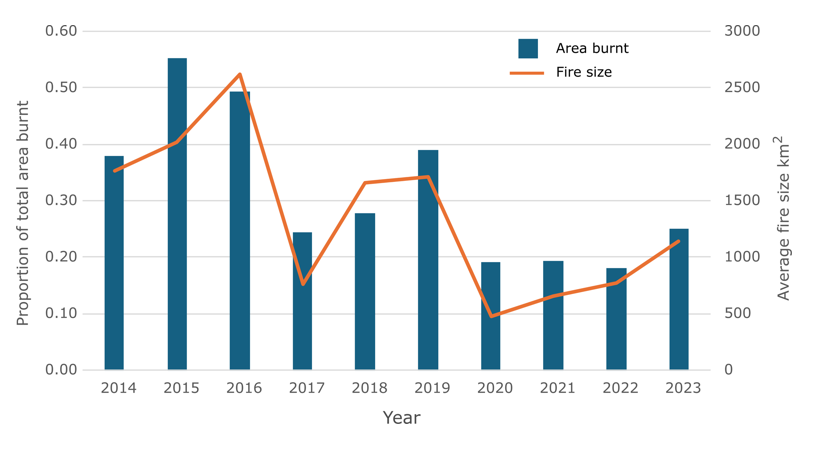
Fisher says the study shows that bushfire mitigation goals have largely been achieved, with a decrease in large fire events’ contribution to total area burned across the North Kimberley over the study period, particularly after 2016.
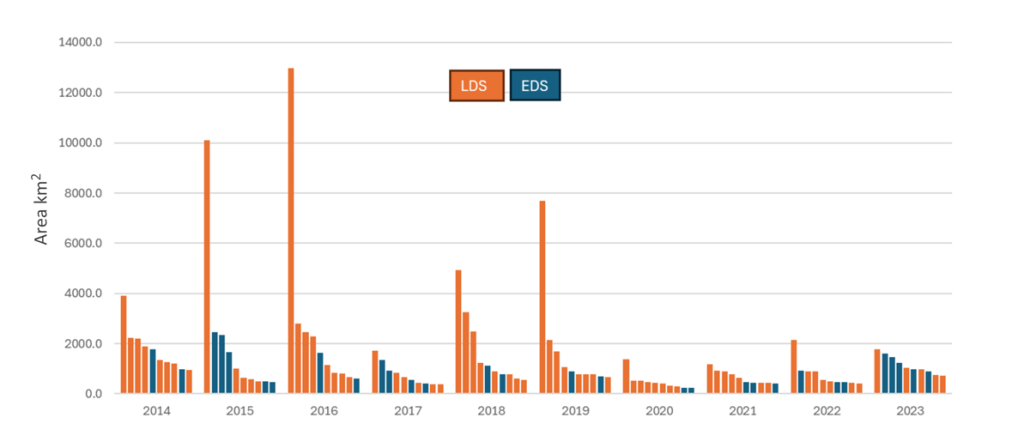
The analysis showed:
- A dramatic reduction in the number of large fires across the North Kimberley over the last 10 years.
- A small number of large fires (1%) were responsible for a large proportion of the total area burned (55%), while 96% of fire events accounted for only 25% of the area burned.
- Large, severe fires mostly began in areas remote from roads or ground access. These remote ignitions accounted for a substantial proportion of the total area burned late in the year and are most likely to have been lightning-ignited. Arson does not appear to be a primary factor in large fire ignition in the Kimberley. So, any assumption that removing people from the area would remove the risk of fire is not true, with lightning playing the biggest role in fire starts.
Read the full article in the International Journal of Wildland Fire, a publication of the International Association of Wildland Fire and CSIRO Publishing.




No comment yet, add your voice below!