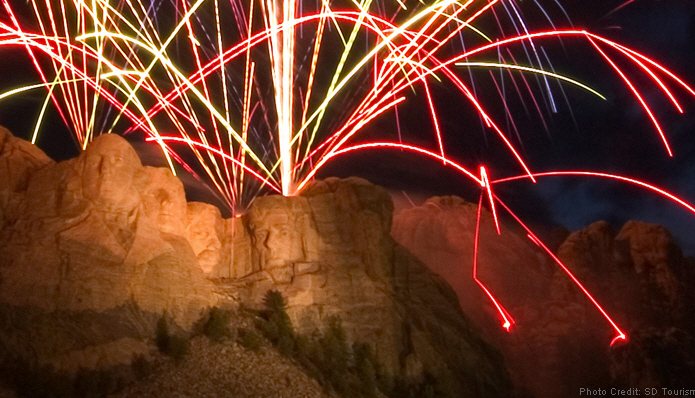
With a large fireworks show slated to be carried out this evening over the Mount Rushmore sculpture and the surrounding pine forest, I solicited a fire expert, a Fire Behavior Analyst, to develop a forecast to predict the danger presented by the burning embers that fall to the ground.
One of the primary reasons the fireworks at Mount Rushmore have not been displayed since 2009 is that during the 11 years they were used, between 20 and 27 fires were ignited. In 2000 one of the fires that started that night burned into the next day, grew to several acres, and required a 20-person crew and a helicopter to bring it under control. There were two injuries; one person had to take time off from work to recover.
During the early years of the events as the National Park Service Fire Management Officer for Mount Rushmore, I helped develop a Go/No-Go checklist of criteria that had to be acceptable to allow the shows to occur. It included items such as obtaining a Spot Weather Forecast from the National Weather Service, wind speed, qualifications of firefighting personnel, and the Probability of Ignition (PI or PIG). The PIG is the chance that a burning ember or firebrand will cause an ignition when it lands on receptive fuels. The beautiful fiery streaks you see after every explosion of fireworks contain hot embers, some of which after landing on the ground can start a fire.
I still have in my files a letter the NPS Midwest Regional Office sent to the staff at Mount Rushmore after the 17 fires in 2000. It directed that in the future the maximum allowable PI be reduced from 30 percent to “less than 10 percent.”
The NPS will not release this year’s Go/No-Go checklist or confirm if the PIG will be a evaluated, citing “security and safety concerns.”
Mike Beasely, a former wildland firefighter with the National Park Service and the U.S. Forest Service, is a trained and qualified Fire Behavior analyst. He is able to predict the spread of fires and is skilled in the science that influences how a fire burns.
Mike studied the weather conditions in the Mount Rushmore area and the weather recorded at a fire weather station at Mount Rushmore. Using algorithms and computer models, he predicts that if the fireworks begin at 9:15 to 9:30 as scheduled tonight, at that time the PIG will be 50 percent. In other words, about half the still burning embers created by the fireworks that hit the ground could ignite vegetation. Mike said that after 9:30 the PIG will drop throughout the night and would likely be 10 percent by 4 a.m. MDT on July 4.
One of the important factors to consider is the first ever broadcast prescribed fire that the NPS conducted at Mount Rushmore on April 29. The project reduced the amount of burnable vegetation on the forest floor, which decreased the amount of “receptive fuels” that could ignite if contacted by a burning ember. But depending on how deep the organic layer was before the prescribed fire, its moisture content, the residence time of the fire, needle cast in the last two months from the pine trees, and the fire’s intensity, it could be possible for fires to be ignited from the falling embers from the fireworks. If the burning embers fall in the footprint of the prescribed fire and ignite the remaining fuel, the resulting fire would likely burn slowly and at low intensity. In 2000 fires were ignited 1,200 to 1,300 feet north of the fireworks launch site.
Another caveat addressed by Mike: if prior to the fireworks a wetting rain occurs on Friday afternoon or evening, the one-hour time-lag fuel moisture resets to 30 percent and the fuel drying algorithm starts over, effectively making the PIG zero percent.
Below are excerpts from Mike’s eight-page analysis. You can download the entire document HERE.
Assumptions
- Uses weather record from Mt. Rushmore Remote Automated Weather Station (RAWS) #392603
- Uses day time fuel moisture reference tables (Appendix B), rather than night time tables (Appendix A), per NWCG guidance, despite fireworks being slated for 9:15-9:30 MDT
- Rain Caveat: If at any point prior to the fireworks, a wetting rain occurs, the 1-hr. TLFM resets to 30% and the fuel drying algorithm starts over, effectively making your PIG 0% (see Appendix D)
Climatology
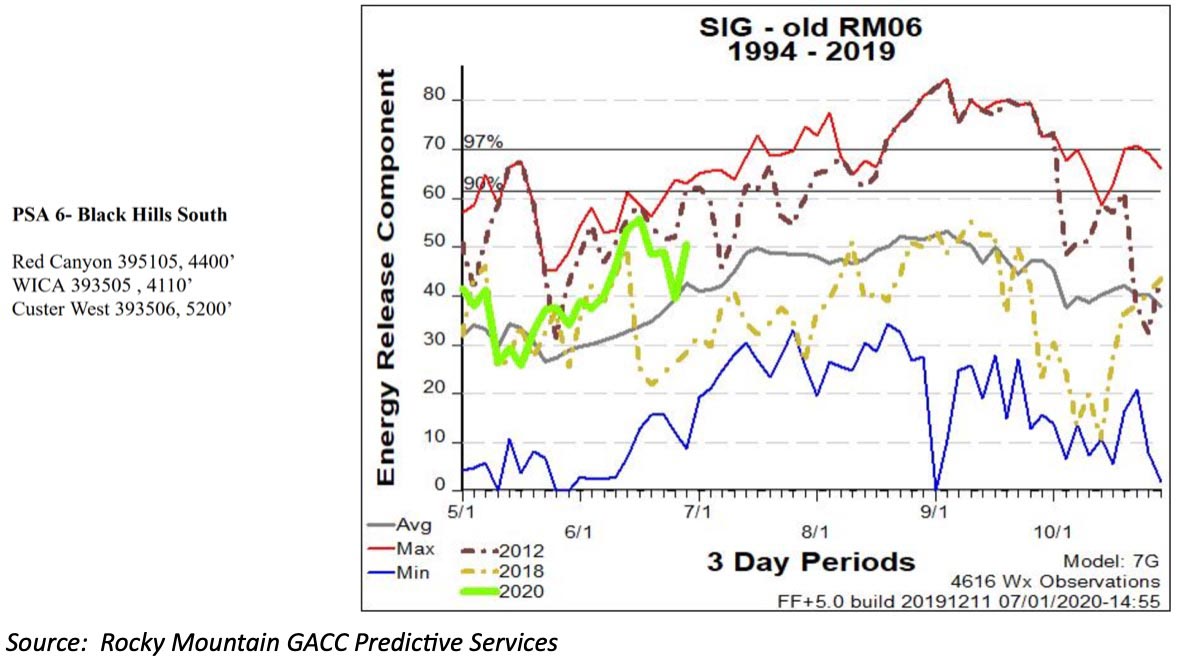
The Black Hills and specifically the area around Mt. Rushmore are experiencing an above average fire danger as shown in the following ERC charts for the northern and southern Black Hills. While, well below historic maxima, this is consistent with the Moderate Fire Danger rating for the peak of the burning period forecasted for July 3rd. Wildfire Today has reported on the Moderate Drought level for the region as assessed by the Drought Monitor.

Inputs
The only two inputs for PIG are air temperature and 1-hr. time lag fuel moisture (TLFM). Both are highly variable with the daily diurnal cycle. The Mt. Rushmore RAWS data input daily has yielded the following fuel moistures predicted for mid-afternoon tomorrow immediately before the firework display. While not inputs for the PIG they are given as a general reference.
- 10-hr TLFM: 8%
- 100-hr TLFM: 9%
- 1000-hr TLFM: 12%
Recent Precipitation: The Mt. Rushmore RAWS received nearly eight tenths of an inch between June 28th and July 1st. That rain aided in the control of a nearby fire in Custer State Park, but there has been no subsequent precipitation.

There was precipitation around the Black Hills over the 24-hour period that ended at 10 a.m. MDT July 3, but it missed Mt. Rushmore. The NWS estimate below shows, over the past 24 hours scattered sites near Mt. Rushmore may have received as much as another half to three-quarter inches, but the gap shows over the Monument.
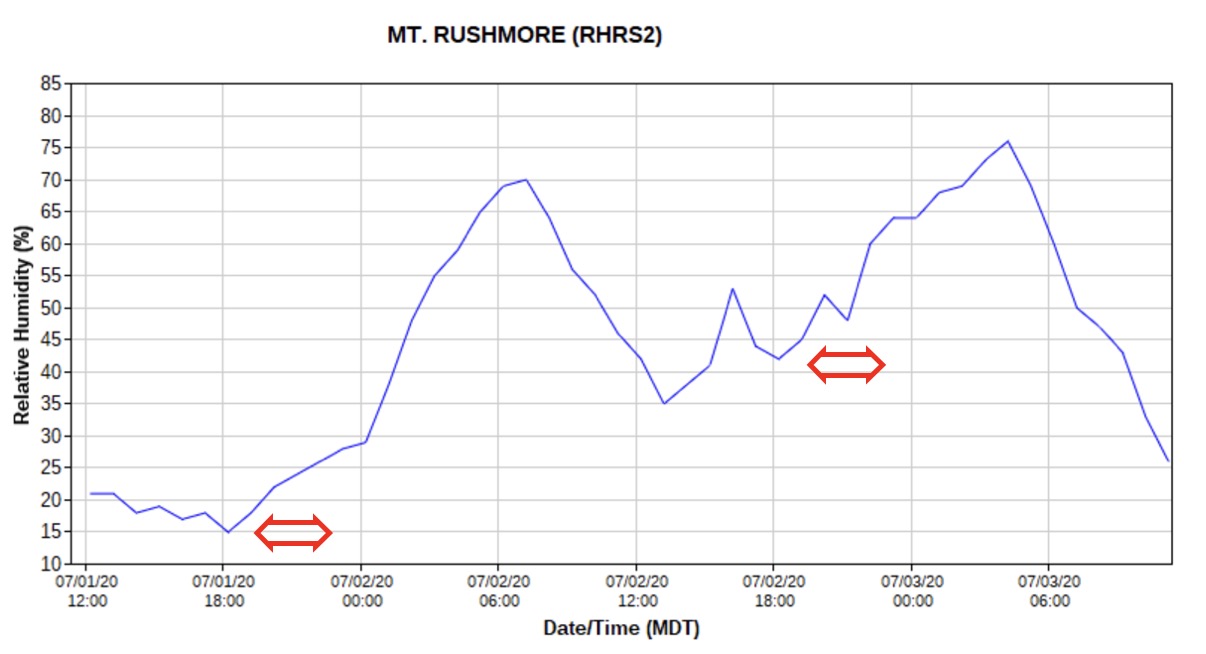
Below are the estimated temperature and relative humidity during the fireworks. Since we don’t have a site-specific weather forecast, we will use the more generalized NWS fire weather forecast and look at persistence over the past two dry evenings, understanding that the region is moving into a hotter, drier period.