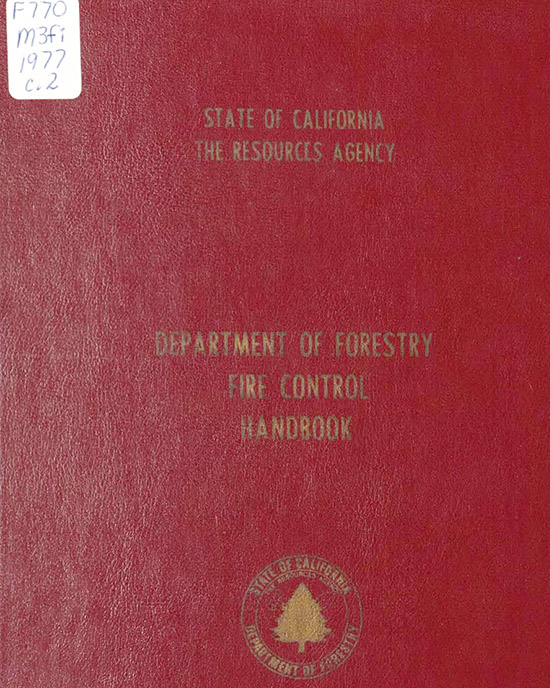
 Cover of the 1977 California Department of Forestry Fire Control Handbook.
Chief John Hawkins shared with us a copy of the California Department of Forestry’s Fire Control Handbook, 1977 edition. The agency was known as CDF before they became the California Department of Forestry and Fire Protection, CAL FIRE.
It is a .pdf copy of Handbook 5600 with a few amendments around 1979 and 1980 to address the agency’s limited trial of the Incident Command System (ICS) in their Region VI starting in 1978, and the planned California-wide implementation of the ICS in 1983. The entire document can be downloaded here (large 10.2 Mb file).
Firefighters of a certain age will most likely enjoy skimming through the pages of this 45-year old document.
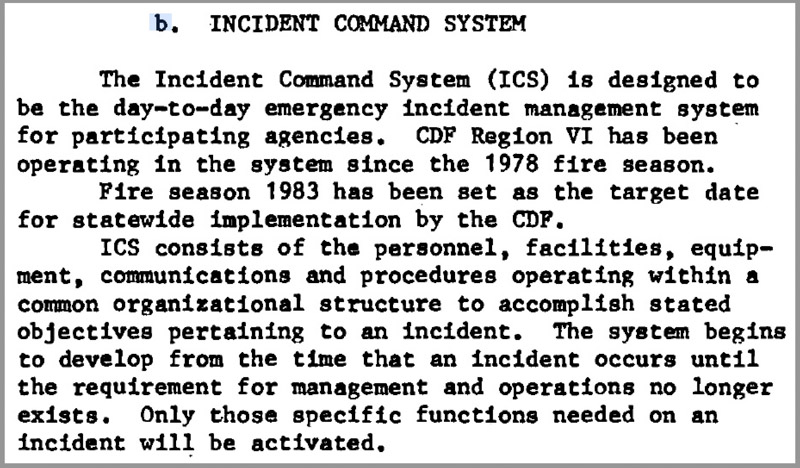 From page 51 in the CDF 1977 Fire Control Handbook, amended December, 1980.
The 324-page book contains many operational guides, as well as information about aviation, safety, pre-attack planning, “support teams”, and flood control operations. Much of it is timeless, but there have also been many changes. It is interesting to compare the 45-year old policies with current procedures.
But going back even further, let’s take a look at fire organizations before ICS began to be adopted in the 1980s:
- “Two-Sector Fire” organization from Principles of Organization for Forest Fire Suppression, US Forest Service, 1953, and,
- Organization that was used on the Battlement Creek Fire in 1976.
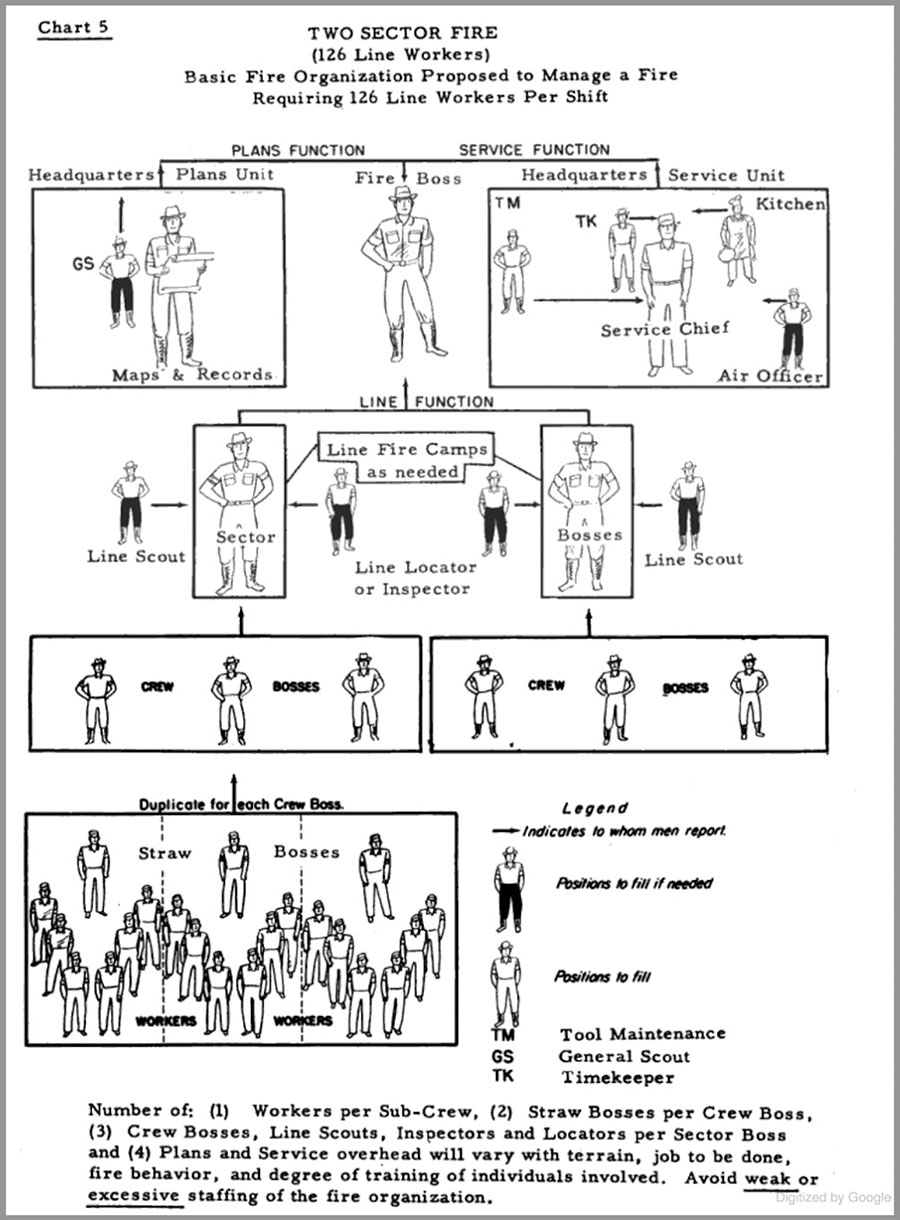 Two-Sector Fire. From Principles of Organization for Forest Fire Suppression, US Forest Service, 1953.
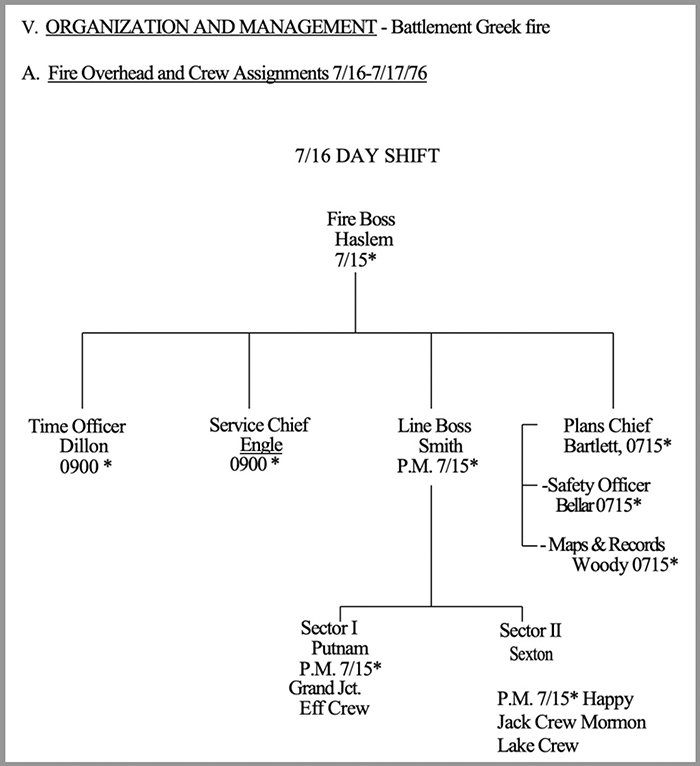 Organization on the Battlement Creek Fire, July, 1976. From the report.
My career was with the US Forest Service and National Park Service. The CDF organization from the Fire Control Handbook has at least one feature unfamiliar to me, the “Attack” function, which was called the Line Function by the USFS. It is now labeled “Operations” in the ICS. In the USFS it was led by a Line Boss in the pre-ICS days. “Service” became Logistics, and in the Planning section the Maps and Records Officer was replaced by two units, Resources Unit and Situation Unit. Sectors became Divisions, and a new position was inserted between the Planning Section Chief and Division Boss: Branch Director. There were numerous changes in Service/Logistics.
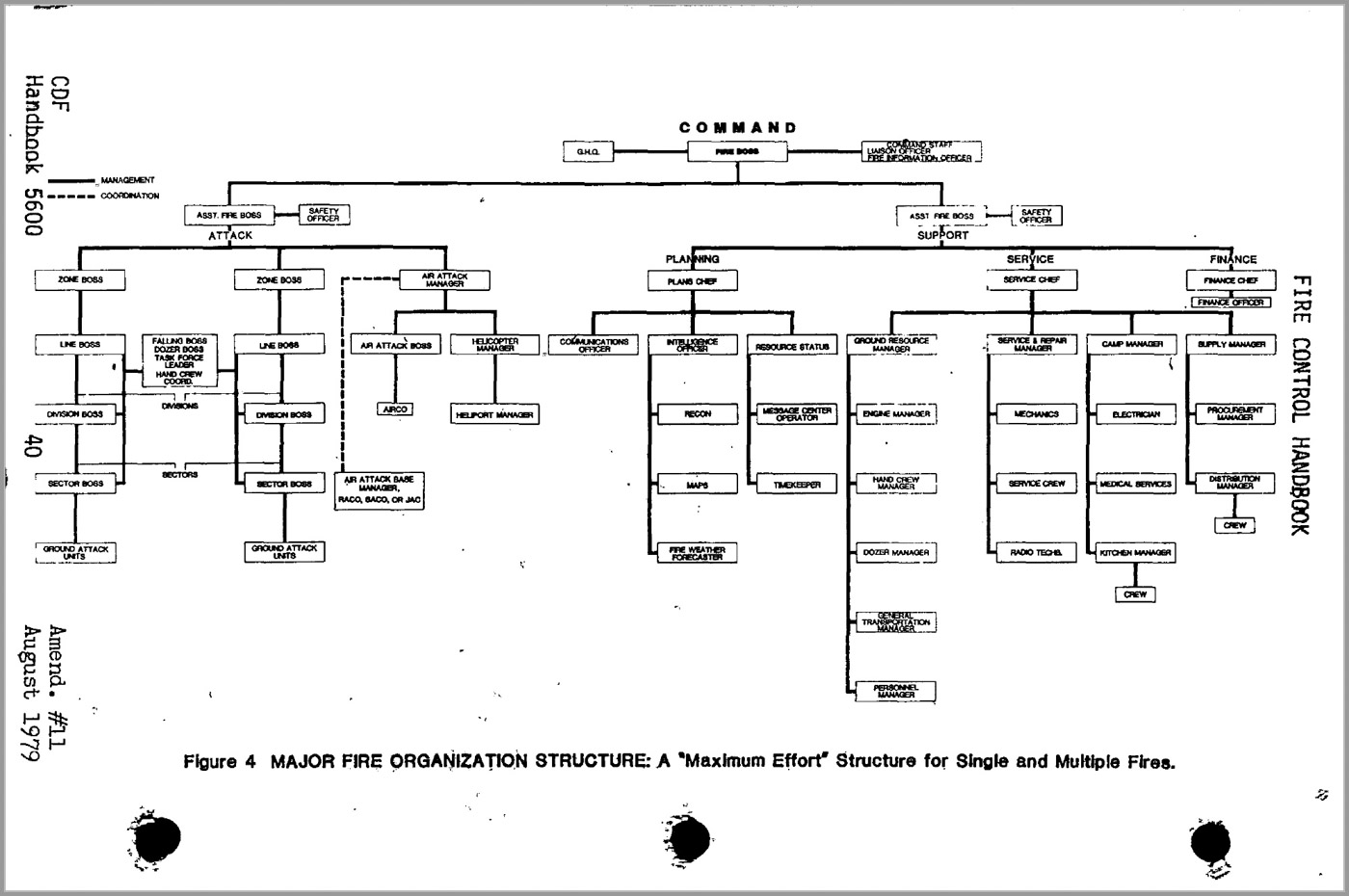 CDF Fire Organization Structure, 1979.
And then there is the current Incident Command System structure; keep in mind, you only fill the positions that are needed.
 Expanded Incident Command System (ICS) Structure
The CDF Fire Control Handbook, 1977 edition, has a section on “Support Teams”.
 CDF Support Teams, CDF Fire Control Handbook, 1977 edition.
 Early Motorola pager.
I don’t remember exactly when we started what were later known as Type 2 Incident Management Teams in the Southern California federal agencies. I think it was around 1980 or so.
As a Maps and Records Officer on a Cleveland National Forest team in the 1980s I carried a small Motorola pager to be notified when our team was dispatched. Back then, if somebody paged you, the pager would give an alert tone, sometimes followed by a difficult to hear voice message from the dispatcher. After the message it would go quiet until the next page, but you could press down on the on/off button to hear radio traffic on the frequency. We later upgraded to fancier pagers.
And before we close this out, below are the CDF standards for hair in 1977. Since many CDF/CAL FIRE positions require the use of breathing apparatus which need a good seal over the face, some of the facial hair specifications are understandable. I don’t know what the current CAL FIRE requirements are, but I have a feeling that many US Forest Service, BLM, and NPS fire personnel might run up against some “grooming requirements”.
 CDF hair standards, 1977.
 Continued, CDF hair standards, 1977.