


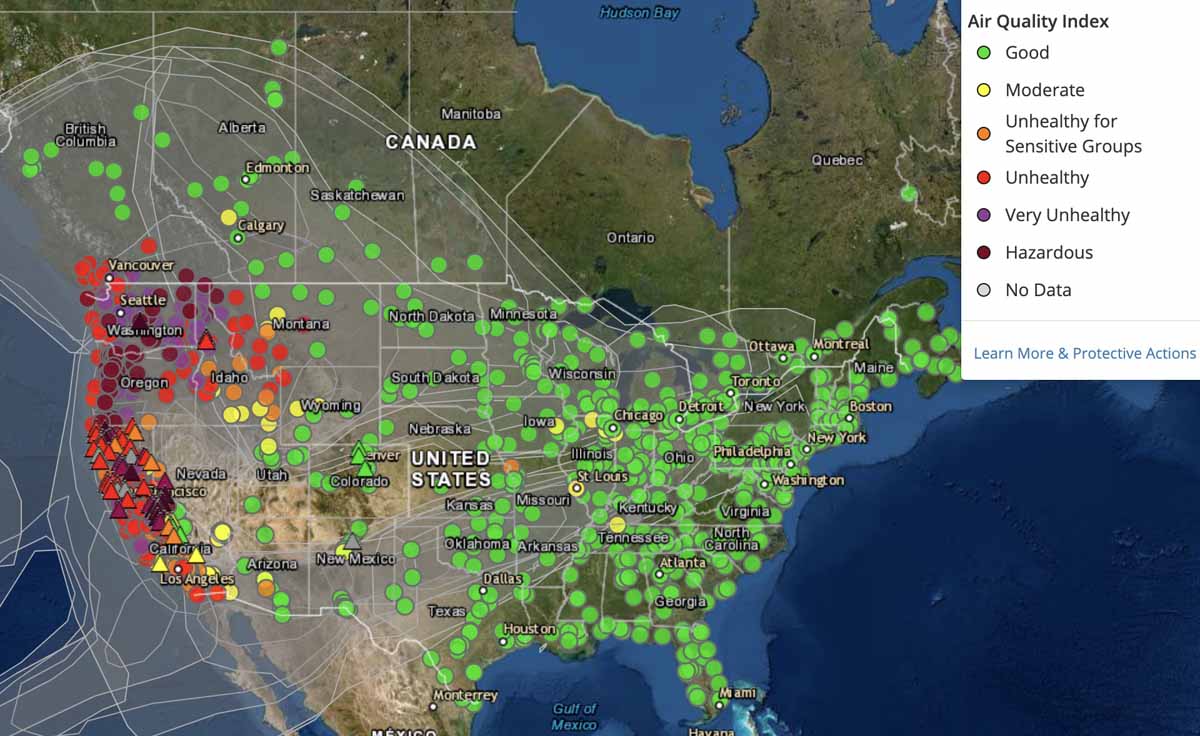
September 14, 2020 | 7:40 a.m. MDT
Wildfires in the West are producing large quantities of smoke that is severely affecting residents in those areas, but it is also spreading to other states.
Simply staying inside is not enough to protect yourself unless you are aggressively filtering the air with HEPA filters. Outdoor air finds ways to come into your home. If there was no air exchange, you would eventually die as the carbon dioxide levels rose and all of the oxygen was used.
The information below is from AirNow.gov.
What can I do to reduce my exposure to fine particle pollution when levels are extremely high?
- Stay indoors in an area with filtered air. Particle pollution can get indoors, so consider purchasing an air cleaner if you live in an area with high levels of particle pollution. (See information on selecting an air cleaner below.)
- Air cleaners that remove particles include high-efficiency mechanical filters and electronic air cleaners, such as electrostatic precipitators. Avoid using an air cleaner that works by generating ozone, which will increase the pollution in your home.
- If you do not have air cleaners in your home, try to go somewhere that does have air filtration. This could, for example, be a friend’s home, if it has air filtration.
- Keep your activity levels low.
- Avoid activities that make you breathe faster or more deeply. This is a good day for indoor activities, such as reading or watching TV.
- If you cannot buy filters for your entire home, create a clean room for sleeping.
- A good choice is a room with as few windows and doors as possible, such as a bedroom.
- If the room has windows, keep them closed.
- Run an air conditioner or central air conditioning system if you are certain your air conditioner does not draw air from outdoors and has a filter. If the air conditioner provides a fresh air option, keep the fresh-air intake closed. Make sure that the filter is clean enough to allow good air flow indoors.
- Use an air filter in that room. Avoid using an air cleaner that works by generating ozone. Those types of cleaners will increase the pollution in your home.
- Follow steps for keeping pollution in your home low (see next section).
- Take additional steps to keep pollution in your home low. Air cleaners alone may not be enough. Because particle pollution from the outdoor air can easily get inside, take steps to avoid adding even more pollution indoors when outdoor PM2.5 levels are high:
- Avoid using anything that burns, such as wood fireplaces, gas logs and even candles or incense.
- Keep the room clean – but don’t vacuum unless your vacuum has a HEPA filter. That stirs up particles already inside your home. Wet mopping can help reduce dust.
- Don’t smoke.
- Be cautious when the weather is hot. If it is too hot to stay inside with the windows closed, or if you are in an at-risk group, go somewhere else with filtered air.
- When air quality improves, open the windows and air out your home or office.
- Selecting an air cleaner:
- Air cleaners that remove particles include high-efficiency mechanical filters and electronic air cleaners, such as electrostatic precipitators. Avoid using an air cleaner that works by generating ozone, which will increase the pollution in your home.
- The California Air Resources Board has information on selecting portable and central air cleaners– including information on choosing the correct size for your room(s). Go to California Certified Air Cleaning Devices
- EPA also provides detailed technical information on air cleaners in the home. See http://www.epa.gov/indoor-air-quality-iaq/guide-air-cleaners-home-0
- Air cleaners that remove particles include high-efficiency mechanical filters and electronic air cleaners, such as electrostatic precipitators. Avoid using an air cleaner that works by generating ozone, which will increase the pollution in your home.
- Should I wear a dust mask if I have to go outside?
- Do not rely on dust masks for protection. Paper “comfort” or “dust” masks are designed to trap large particles, such as sawdust. These masks will not protect your lungs from small particles such as PM2.5. Scarves or bandanas won’t help either.
- Disposable respirators known as N-95 or P-100 respirators will help if you have to be outdoors for a period of time. It’s important that you wear the respirator correctly.


