


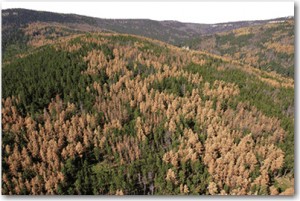
 Additional research about the effects of insect outbreaks on fires confirms that generally, insect damage reduces burn severity.
Researchers from the University of Vermont and Oregon State University studied 81 Pacific Northwest fires that burned in areas affected by infestations of two prevalent bark beetle and defoliator species, mountain pine beetle (Dendroctonus ponderosae) and western spruce budworm (Choristoneura freemani). The fires spanned the years 1987 to 2011.

Few of the 81 fires occurred in forests while the needles were still on the trees in the red highly flammable stage of the outbreak shortly after the trees were killed by mountain pine beetles. The researchers recommend more studies in this area.
Aside from the transient red stage the burn severity decreased for more than 20 years following a MPB attack. Forests affected by western spruce budworm (WSB) exhibited a sharp decrease in fire severity immediately after an attack. This decrease is likely due to the fact that the WSB defoliates the tree, removing fuel from the canopy. The MPB kills the tree from the inside, leaving the dying needles on the tree until they fall off in one to two years. It makes sense that fewer fine fuels in the canopy would reduce the fire intensity and make it less prone to transition from a ground fire to a crown fire. But in the WSB-affected forests, the fire intensity slowly increased after 20 years to a neutral condition, then continued to increase in the 5 to 10 subsequent years. The researchers elaborated on that effect:
The relatively rapid increase of the budworm-fire coefficient with time indicates that the thinning effect on fuel profiles is less persistent for the defoliator (WSB) than for the bark beetle (MPB). In addition to relatively lower per-unit-area tree mortality impacts, WSB affects host forests that are more productive than those affected by MPB in the study region , leading to more rapid accumulation of live overstory and understory vegetation. Thus, as time elapses following WSB outbreaks, fuel density and connectivity likely increase in multiple strata, including dead surface fuels and total live biomass, the latter of which is associated with higher burn severity.
The research was conducted by Garrett W. Meigs, Harold S. J. Zald, John L. Campbell, William S. Keeton, and Robert E. Kennedy. The paper is titled, Do insect outbreaks reduce the severity of subsequent forest fires?
Our analysis
There is legitimate cause to be concerned about fires during the one or two year red needle stage after an insect attack, although I think more research studying actual fires is needed in this area. And there is danger from falling snags 5 to 20 years after an attack. Snags are dangerous for firefighters and any structures, hikers, traffic on roads, and any improvements that could be damaged by the falling trees. But as numerous researchers have found, after the needles are on the ground fire behavior, intensity, and severity decrease.
We first wrote about a post-attack decrease in burn intensity in a 2010 article titled Firefighters should calm down about beetle-killed forests.
Rather than panicking and rushing out to cut every tree affected by insects, preventive measures to keep forests healthy could be more effective, such as prescribed fire and thinning.


