


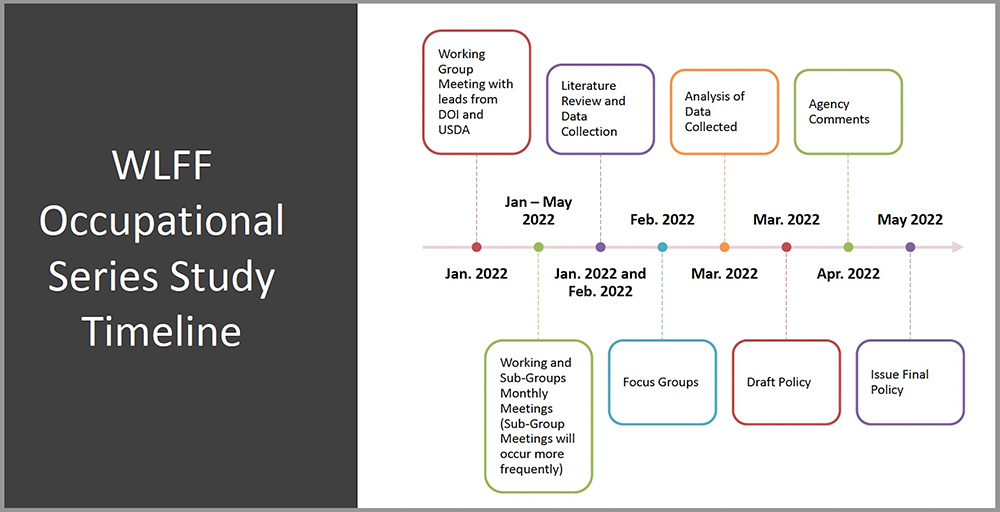
 OPM’s timeline for development of a Wildland Firefighter job series. OPM graphic.
The US Office of Personnel Management (OPM) has created an action plan for the development of a job series to more accurately reflect the work that is now being done by wildland firefighters (WLFF) employed by five federal agencies. For the last 50 or more years WLFFs working for the Departments of Agriculture (DoA) and Interior (DoI) have been pigeonholed into Forestry or Range Technician positions. Their pay is very different from firefighters who work for private industry, municipal departments, the California Department of Forestry and Fire Protection, and private contractors who fight wildland fires for the DoA and DoI.
The timeline created by the OPM is very ambitious for a task to be completed by half a dozen federal agencies. It establishes May of this year as a target for issuing the final policy.
During those five months the OPM expects to:
- Review the current situation and compare work done by firefighters inside and outside the agencies;
- Survey the federal agencies for what work they need accomplished;
- Create groups and subgroups to meet regularly for job classification;
- Hold focus groups;
- Obtain input from leadership of the agencies;
- Meet with human resources subject matter experts and the leadership of the agencies to discuss findings and recommendations;
- Draft policy, guidance, and/or tools for Wildland Firefighter (WLFF) work in the Federal government;
- Receive comments and feedback from the agencies;
- Issue the final policy in May, 2022.
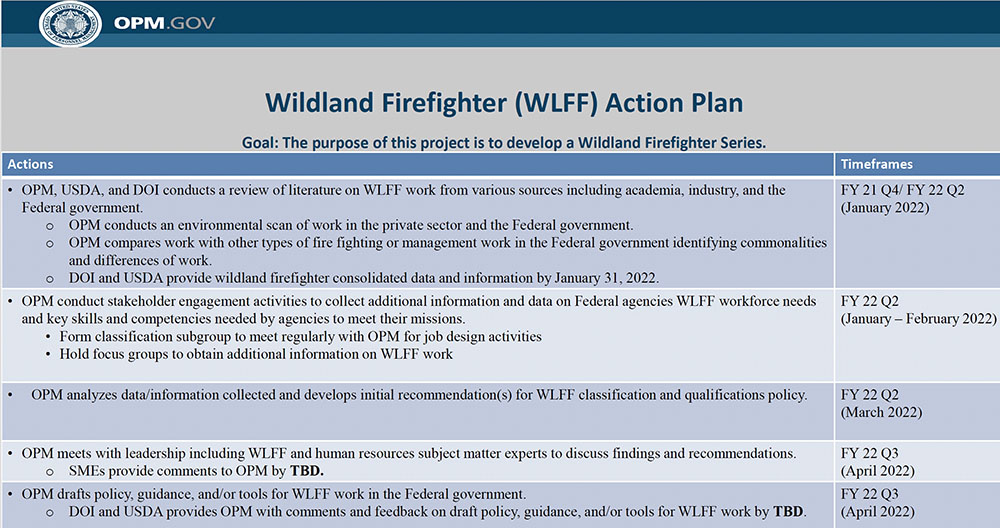 OPM’s action plan for development of a Wildland Firefighter job series. OPM graphic.
After the new WLFF job series is developed, then the five agencies have to actually adopt it and convert their firefighters into Firefighter positions. If the series requires higher pay, that could become a stumbling block. But if there are as many vacant positions now as there were last May they probably have enough unspent salary money to take care of the difference. But I would be surprised if there are many working in the new series before the start of the fiscal year that begins October 1, 2022 at the very earliest.
In a perfect world the development of the WLFF job series would have been initiated decades ago by leadership of the five federal agencies that employ a total of about 15,000 of these firefighters (if all positions were filled): Bureau of Land Management, Fish and Wildlife Service, National Park Service, Bureau of Indian Affairs, and Forest Service. Instead, they and the OPM are being forced to do the right thing by bipartisan infrastructure legislation passed by Congress in November, 2021.
Federal WLFFs have been recommending a realistic job series for decades, but within the last year their voices have been louder than ever and members of Congress have noticed. A fairly new non-profit organization, Grassroots Wildland Firefighters, has been one of those voices helping to raise awareness with the public and legislators.
Two other bills have been introduced in the last few months that address pay issues for federal WLFFs, H.R. 4274 Wildland Firefighter Fair Pay Act, and H.R. 5631 Tim Hart Wildland Firefighter Classification and Pay Parity Act. Brief descriptions of the bills are in the article we published October 26. The legislation has been introduced, referred to five committees, and one hearing was held by the House Natural Resources Subcommittee on National Parks, Forests, and Public Lands.
Thanks and a tip of the hat go out to Ben and Matt.


