


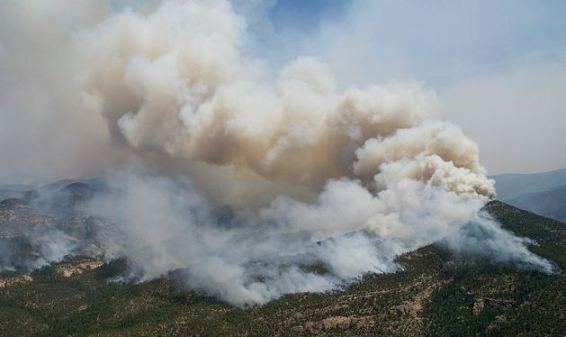
In the southwest United States 1748 was a very active year for wildland fires. According to Craig Allen, a research ecologist with the United States Geological Survey in Los Alamos, New Mexico, “Every mountain range we studied in the region was burning that year”. But in spite of there being no debate or controversy about “let burn”, suppress every fire by 10 a.m., budget cuts, or air tankers, the forests survived. Not only did they survive, they thrived.
There are two reasons why the fires of 1748 had a different effect than the fires of the last 15 years.
One is tree density. In 1748 there were about 80 trees per acre. Frequent low-intensity fires maintained this stocking level, reducing regeneration, ladder fuels, and dead wood on the forest floor. Fires spread slowly and for the most part stayed on the ground without turning into crown fires. Today’s forests have about 1,000 trees per acre and sanitizing fires are no longer a part of the equation, making it much more likely that a ground fire will leap into the canopy and become a tree-killing conflagration.
The second reason is climate change. Higher temperatures along with more frequent droughts have caused heat stress on forests making them less resistant to attacks by fire and insects.
Dr. Allen’s research indicates that these conditions have brought us to a situation with increased tree mortality and forests that are less likely to regenerate. In some areas trees are being replaced by shrub lands.
The New York Times interviewed Dr. Allen. Here is an excerpt from their article:
But beginning in 1900, when railroads enabled the spread of livestock, cattle devoured the grassy surface fuels and the fire cycle stopped. A decade later, a national policy of forest fire suppression formalized this new normal. Over the next century, forest density went from 80 trees pr acre to more than 1,000.
Then in 1996, the climate emerged from a wet cycle into a dry one — part of a natural cycle for this region. Winters became drier. And “we immediately began seeing major fires,” Dr. Allen said.
With so many trees crammed into the forest, fires climbed straight to the canopy instead of remaining on the ground.
“These forests did not evolve with this type of fire,” said Dr. Allen. “Fire was a big deal in New Mexico, but it was a different kind of fire.” The result, he said, is that the species that now live there — ponderosa pines, piñon, juniper — cannot regenerate, and new species are moving in to take their place.
“Ecosystems are already resetting themselves in ways big and small,” Dr. Allen said. The challenge for managing these ecosystems, he said, is to try to help them adapt.
Seeking to preserve existing systems is futile, he said.







