


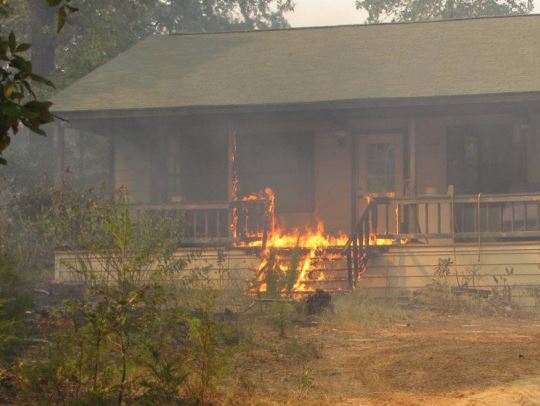
 Relatively fire-resistant homes can ignite during low-intensity wildfires if a path of combustible material, such as fences, stairs, decks, or support beams lead the fire to the home. Image from Texas Forest Service report about fires in 2011.
Recognizing that the Home Ignition Zone can be the most important factor that determines how vulnerable a residence is to an approaching wildfire, the State of California has embarked on a pilot program that will grant up to $40,000 to homeowners who retrofit their homes to make them more fire resistant.
Working with the Federal Emergency Management Agency (FEMA) the funds in the $100-million project will be available in areas that are commonly threatened by fires.
From the LA Times:
The California Department of Forestry and Fire Protection, or CAL FIRE, chose the communities of Dulzura, Potrero and Campo based largely on their concentration of low-income residents living in older, fire-prone homes. The state is also starting to roll out the pilot in Shasta County [in Northern California]. Residents with higher incomes can still qualify for the retrofits as long as they pay for a percentage of the work on a sliding scale.
Applications for the grants can be submitted at wildfiremititgation.caloes.ca.gov.
There may be additional federal funds becoming available in the future. During a January 21 speech at Del Rosa Fire Station on the San Bernardino National Forest Vice President Kamala Harris spoke about wildland fires and the resilience of communities threatened by fire.
“We are talking with home owners and reaching out to communities,” she said, “to figure out how we can support them to create a community that is less likely to be so significantly damaged if a fire should hit.”
However, she may have been referring to the $100-million from FEMA and California.
Our take
We will never be able to prevent all fires that threaten homes and private property. We have to learn to Live With Fire. The Home Ignition Zone should be an extremely high priority in preventing structures from burning in wildfires.
Grants for homeowners to retrofit homes to make them more fire resistant is the right thing to do. These could be expanded to include modifying the vegetation within 100 feet of the structures. Below is an excerpt from an article posted September 24, 2020 on Wildfire Today:
“Ignition resistant homes, and collectively communities, can be readily created by eliminating and reducing ignition vulnerabilities within the Home Ignition Zone,” said Jack Cohen, a retired U.S. Forest Service Research fire scientist. “This enables the prevention of wildland-urban fire disasters without necessarily controlling extreme wildfires. Ironically, ignition resistant homes and communities can facilitate appropriate ecological fire management using prescribed burning. The potential destruction of homes from escaped prescribed burns is arguably a principal obstacle for restoring fire as an appropriate ecological factor. Therefore, it is unlikely that ecologically significant prescribed burning at landscape scales will occur without ignition resistant homes and communities.”
Here are some suggestions that could be considered for funding along with an enhanced prescribed fire program.
- Provide grants to homeowners that are in areas with high risk from wildland fires. Pay a portion of the costs of improvements or retrofits to structures and the nearby vegetation to make the property more fire resistant. This could include the cost of removing some of the trees in order to have the crowns at least 18 feet apart if they are within 30 feet of the structures — many homeowners can’t afford the cost of complete tree removal.
- Cities and counties could establish systems and procedures for property owners to easily dispose of the vegetation and debris they remove.
- Hire crews that can physically help property owners reduce the fuels near their homes when it would be difficult for them to do it themselves.
- Provide grants to cities and counties to improve evacuation capability and planning, to create community safety zones for sheltering as a fire approaches, and to build or improve resilient emergency water supplies to be used by firefighters.
Thanks and a tip of the hat go out to Gerald.


