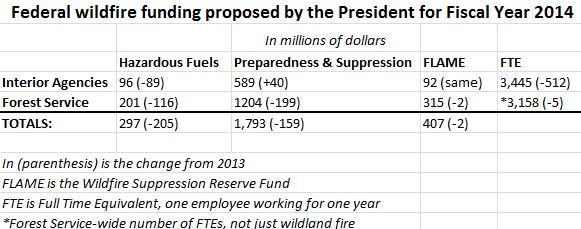
The President is recommending reduced budgets next fiscal year for the federal land management agencies that have wildland fire responsibilities. In his budget released on Wednesday President Obama desires to slash by 41 percent the funds allocated for the five agencies for reducing hazardous fuels, and the preparedness and suppression budget would be cut by 8 percent. The amount set aside for the FLAME Wildfire Suppression Reserve Fund would remain about the same.
The four Department of Interior Agencies would see a reduction of 512 FTEs (full time equivalent employees) to 3,445, down from 3,957 in FY 2012. Those four agencies are the National Park Service, Fish and Wildlife Service, Bureau of Land Management, and the Bureau of Indian Affairs.
Below, we assembled some of the numbers from documents released by the Departments of Interior and Agriculture:

It should be noted that the chances of this proposal being enacted exactly as recommended are somewhere between slim and none. Congress has not passed a federal budget in four years, and even if they did get one signed for Fiscal Year 2014 which begins in October, 2013, it would no doubt be different from what the President desires, after it makes its way through the dysfunctional House and Senate chambers.
On March 23 the Senate passed another version of a budget for Fiscal Year 2014.
Here are a couple of excerpts from information supplied by the two Departments about the President’s proposed budget. First, Interior, about Hazardous Fuels:
The 2014 President’s budget reduces funding for the Hazardous Fuels Reduction program to $95.9 million. This is a net program reduction of $88.9 million from the 2012 enacted level. The 2014 program presents an opportunity to re-evaluate and recalibrate the focus of HFR to align and support the direction in the National Cohesive Wildland Fire Management Strategy and the FederalWildland FireManagement Policy. Affirming a commitment to the intergovernmental goals of the Cohesive Strategy, HFR program activities will be planned and implemented to mitigate increasing risks posed by wildfire. A risk-based prioritization process is used to ensure activities are implemented in the areas at greatest risk from wildfire.
And Agriculture, about air tankers:
Our budget request for FY 2014, taking the Suppression and FLAME line items together, fully covers the average annual amount spent on suppression in the preceding 10 years. Airtankers are a critical part of an appropriate response to wildfire, but the fleet of large airtankers that the agency uses is old, with an average age of more than 50 years. The cost of maintaining them is growing as are the risks associated with using them. As such, the Forest Service is implementing a Large Airtanker Modernization Strategy to replace our aging fleet with next-generation airtankers. Our FY 2014 budget request includes an increase of $50 million to pay for the increased costs of modernizing the firefighting airtanker fleet. This is in addition to the $24 million requested in the FY 2013 budget for a total of $74 million proposed over the last two years to further enhance the agency’s capacity to fight wildland fire. We believe that large airtankers are an important part of an appropriate mix of aviation assets, and are critical for a continued high rate of initial attack success given fuel accumulation, drought, climate change, and growth in housing developments. This approach ensures agency capability to protect life, property, and natural resources, while assuring an appropriate, risk-informed, and effective response to wildfires that is consistent with land and natural resource management objectives.