


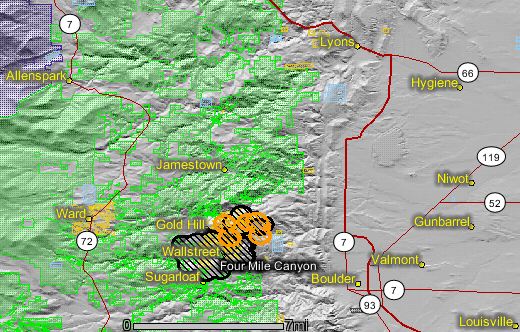
A draft report has been released about the the Fourmile Canyon fire. The fire started on September 6 and burned 6,200 acres and 168 homes a few miles west of Boulder, Colorado. The fire was devastating to local fire districts within the burned perimeter in several ways, including the facts that a firefighter’s burn pile escaped and started the fire, the homes of 12 firefighters burned, and one fire station and an engine inside it burned. Wildfire Today covered the fire extensively.
One of the interesting findings was that some fuel treatments done before the fire came through actually increased the intensity of the fire, compared with untreated areas. This was primarily due to the more open stands allowing wind to push the surface fires, and the treatment prescriptions’ emphasis on thinning to a target basal area (density of trees) rather than designing a prescription that accounted for fire behavior during dry and windy conditions. In addition, a significant amount of surface fuels remained, including slash piles in some areas that had not been burned after the treatments.
Another finding was that 83% of the homes that burned were ignited by surface fire, rather than a crown fire, which is typical.
The report includes some statistics on the use of aircraft on the fire. I broke out a calculator and did some analysis, arriving at these numbers:
- $343,082, total cost of the retardant dropped by air tankers (just the retardant).
- $1.97, cost per gallon of retardant (just the retardant).
- 174,149, gallons of retardant dropped by air tankers.
- 86, loads of retardant dropped by air tankers.
- 47.09, total flight hours by air tankers.
- 3,698, gallons of retardant dropped per flight hour by air tankers.
- $3.55, total cost per gallon for the delivery of retardant by air tankers.
- $619,483, Total cost of the air tankers, including retardant and flight costs.
- 0.55 hour, the average time for each air tanker drop. (This is extremely low and is due to the fact that the air tankers were reloading at Rocky Mountain Metropolitan Airport near Boulder, Jeffco air tanker base, about 15 air miles from the fire. This helped keep the cost per gallon of delivered retardant lower than on your typical fire, which is normally much more than 15 miles away from the reload base.)
As a comparison, on September 9 there were three large Type 1 helicopters dropping water:
- $99,284, Total cost for the three Type 1 helicopters on September 9.
- 71,950, gallons of water dropped by the three helicopters.
- 12.9, hours flown by the three helicopters.
- 5,577, gallons of water dropped per flight hour by three Type 1 helicopters on September 9.
- $1.38, cost per gallon of water delivered.
- (?) the number of loads of water delivered was not specified.
A decision about using helicopters vs. air tankers should be based on more than just the above numbers. Retardant, sometimes known as “long-term retardant”, slows the spread of a fire more effectively and for a longer period of time than plain water. And helicopters cruise at a much slower speed than an air tanker, so depending on their location at the time of initial dispatch, it can take much longer to arrive at the fire.
Scroll down to see a map showing the location of every drop by a large air tanker on the fire.
Moving on to the rest of the report, here are some excerpts:
========================================
Fuel Treatments
- Thinning trees to a specified density (residual basal area) or spacing was the prescription often negotiated with land owners. In addition, the treatments were often focused on improving the health of the forest (removing diseased and malformed trees, i.e., dwarf mistletoe) rather than modifying fire behavior.
- Pervasive spotting observed during the Fourmile Canyon Fire easily breached the narrow fuel treatment units and rendered them of limited value to containment efforts.
- The abundance of grasses, forbs, shrubs, and often branches and twigs that could have been removed through judicious surface treatments (e.g., prescribed fire) occurring within the areas where the fuels had been treated contributed to the high fire intensities and fire spread rate observed.
- Post-fire satellite imagery clearly shows the absence of changes in stand condition inside treated areas compared to neighboring untreated stands. In some cases, treated stands appeared to burn more intensely than adjacent untreated stands, perhaps because of additional surface fuels present as a result of the thinning. One clear example of this comes from near Gold Hill where the piles of slash were scattered in the understory of a thinned stand but had not been burned.
Home Destruction
- A total of 474 homes were located within and adjacent (~ < 100 feet) to the final wildfire perimeter.
- 168 or 35.4% of the homes within the burned area were destroyed by the Fourmile Canyon Fire. This is consistent with the percentage of homes destroyed in other wildland-urban interface (WUI) fire disasters.
- Within the Fourmile Canyon Fire:
- 29 homes were ignited by crown fire
- 139 were ignited by surface fire
- 157 homes were destroyed within the first 12 hours
- The initial rapid fire growth and intense burning overwhelmed fire suppression and structure fire protection capabilities.
- 83% of home destruction was associated with surface fire and consistent with other WUI fire disasters. This indicates survival or loss of homes exposed to wildfire flames and firebrands (lofted burning embers) is not determined by the overall fire behavior or distance of firebrand lofting but rather, the condition of the Home Ignition Zone (HIZ) – the design, materials and maintenance of the home in relation to its immediate surroundings within 100 feet.
- For a HIZ to be successful in preventing a home from burning is predicated on the home having ignition resistant materials and with the homeowner removing flammable debris from on and around the house and maintaining this condition. If flammable vegetation is not continuous (landscaping, driveway, etc.) to the home it is difficult for firebrand ignited spot fires to contact the home. Also if trees within about 100 ft are not continuous the potential for active crown fire is minimal and even if individual trees do torch, they present minimal radiant heating to the house.
Social
Interestingly, 127 of the landowners evacuated during the Fourmile Canyon Fire were surveyed in 2007 regarding their perceptions of their wildfire risk and mitigations efforts. A critical finding was that most landowners surveyed prior to the fire did not believe that characteristics of their home and immediate surroundings were significant factors influencing the likelihood of a wildfire damaging their property within the next five years. These perceptions are refuted in the scientific literature and the home ignition assessment within this report.
=====================================
Below is a map showing the locations of the retardant drops by the large air tankers on the Fourmile fire.







