


In a message to Directors and Managers in the Department of the Interior, Secretary Ryan Zinke ordered “more aggressive practices” to “prevent and combat the spread of catastrophic wildfires through robust fuels reduction and pre-suppression techniques”. The directive, dated September 12, 2017, attracted attention today when Mr. Zinke referred to it in a press release about the President’s proposed budget for Fiscal Year 2019.
“In September, I directed all land managers to adopt aggressive practices to prevent the spread of
catastrophic wildfires,” said Mr. Zinke in the February 12 release. “The President’s budget request for the Wildland Fire Management program provides the resources needed for fuels management and efforts that will help protect firefighters, the public and local communities.”
The September 12 directive mentions implementing FireWise principles around government facilities:
The Department has lost historic structures in wildfires like Glacier National Park’s historic Sperry Chalet lodge. In an effort to help prevent future losses, the Secretary is also directing increased protection of Interior assets that are in wildfire prone areas, following the Firewise guidance, writing: “If we ask local communities to ‘be safer from the start’ and meet Firewise standards, we should be the leaders of and the model for ‘Firewise-friendly’ standards in our planning, development, and maintenance of visitor-service and administrative facilities.”
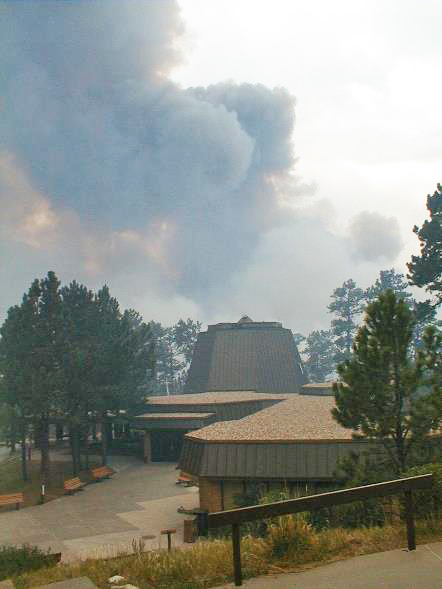
It is a wise move to encourage better fuel management and FireWise techniques around public structures in fire-prone areas. I have seen too many U.S. Forest Service and National Park Service facilities with nearby hazardous fuels that make them extremely vulnerable to a wildfire. An example is the photo above showing dense tree canopy very close to the visitor center at Jewel Cave National Memorial as the Jasper Fire approached in 2000. A few years after that a professional tree service was brought in to thin out the large pines within 100 feet of the headquarters building at Mount Rushmore as a large wildfire burned nearby. Firefighters took the same action at Devils Tower National Memorial when a fire was bearing down on the visitors center. Waiting until a fire is an imminent threat is not the best policy.
When the 83,000-acre Jasper Fire burned into Jewel Cave National Monument in 2000 the shake shingle roof on an isolated historic structure surrounded by ponderosa pines had just been replaced with a new roof. A reasonable person would have chosen materials that look like shakes, but are fire resistant. The new wooden shake shingles had to foamed by engine crews before they withdrew on three occasions when the fire lofted burning embers at the site and made runs at the structure.
While Mr. Zinke makes some good points about more aggressive fuel management on public lands, he attempts to reinforce his directive by introducing a political element. I don’t read every directive issued by the Secretary of the Interior, but politicizing wildland fire management is not productive.
In the third paragraph Mr. Zinke is quoted taking an unnecessary swipe at the land managers that preceded him, saying:
This Administration will take a serious turn from the past and will proactively work to prevent forest fires through aggressive and scientific fuels reduction management to save lives, homes, and wildlife habitat.
It is an unusual but welcome tactic for the current administration to invoke science in a discussion.
The directive goes on to include quotes attributed to five senators and representatives, all Republicans, and all supposedly saying that Mr. Zinke is right. No Democrats were quoted.
One of the most egregious examples is from Rob Bishop, (R-Utah):
I’m heartened to finally have an Administration that’s focused on actively managing and addressing the on-the-ground conditions that are contributing to our historic wildfire crisis.
Mr. Bishop goes on to advocate more logging.
Politicizing wildland fire management and going out of your way to create barriers that make it more difficult to get anything done, is not the best course of action to preserve and protect our natural resources and public facilities. It brings to mind one of Mr. Zinke’s predecessors, James Watt, who served as Secretary of the Interior from 1981 to 1983.


