


(Originally published at 2:46 p.m. MT December 4, 2013; updated at 8:30 p.m., December 4, 2013)
Today the Arizona Division of Occupational Safety and Health (ADOSH) proposed fines totaling $559,000 to be imposed on the Arizona State Forestry Division as a result of the fatalities on the Yarnell Hill Fire near Yarnell, Arizona. Their findings were presented to the Industrial Commission of Arizona during a 1:00 p.m. public meeting in Phoenix. The documents can be found HERE.
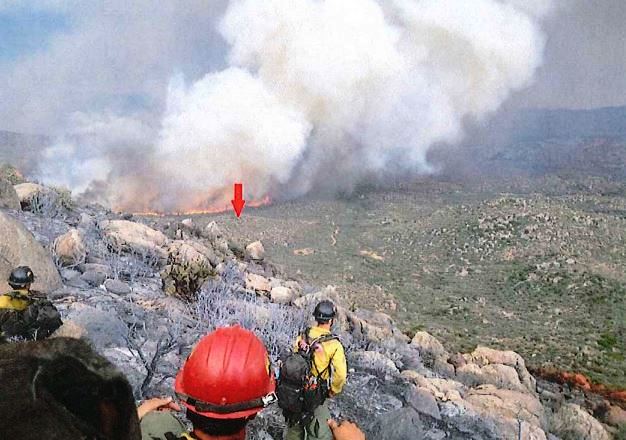
On June 30, 19 members of the Granite Mountain Hotshots were entrapped by rapidly spread flames from a brush fire and were killed. One member of the crew who was in a different location serving as a lookout was not injured.
Two citations were proposed, one “willful serious” with a tine of $545,000, and another that was “serious” with a fine of $14,000.
[UPDATE at 6:46 p.m. MT December 4, 2013; The commission approved the fines. The Arizona State Forestry Division has 15 days to appeal the decision.]
The willful serious citation included the following (paraphrased):
- Failure to furnish a place of employment which was free from recognized hazards that were causing or likely to cause death or serious physical harm.
- Implementation of suppression strategies that prioritized protection of non-defensible structures and pastureland over firefighter safety.
- The employer knew the suppression was ineffective, and that the wind would push the fire toward non-defensible structures, but firefighters were not promptly removed from exposure to smoke inhalation, burns, and death.
- Thirty-one members of a structure protection group charged with protecting non-defensible structures were exposed to possible smoke inhalation, burns, and death.
- A lookout was exposed to the same dangers.
- Approximately 30 firefighters working on an indirect fireline in Division Z were exposed to the same dangers.
- The Granite Mountain Hotshots continued with suppression activities until 1642 hours on June 30 when they were entrapped by a rapidly progressing wind driven wildland fire.
The serious citation, totaling $14,000:
- The employer failed to implement appropriate fire suppression plans in a timely fashion during a life-threatening transition between initial attack and extended attack.
- When the fire escaped initial attack none of the following analysis procedures were implemented: Incident Complexity Analysis, Escaped Fire Situational Analysis, Wildland Fire Situation Analysis, Wildland Fire Decision Support System, or Operational Needs Assessment.
- On June 29 an Incident Action Plan was not completed for the next operational period prior to transitioning to a more complex management team.
- The positions of Safety Officer and Planning Section Chief were not filled on June 30.
- On June 30 the Division Z Supervisor (adjacent to the Granite Mountain Hotshots’ Division) departed from his assigned position which left Division Z without supervision during ongoing fire suppression operations.
Today, in addition to the citation information, the following documents were released by the Industrial Commission of Arizona:
- Incident narrative and timeline.
- Maps, photos, and diagrams.
- The “Entrapment and Burnover Investigation” report prepared by Wildland Fire Associates.
We will add to this article later with more details about the investigation report, but below are the conclusions reached by Wildland Fire Associates, the consultants hired by the Arizona Division of Occupational Safety and Health:
- Fire behavior was extreme and exacerbated by the outflow boundary associated with the thunderstorm. The Yarnell Hill Fire continually exceeded the expectations of fire and incident managers, as well as the firefighters.
- Arizona State Forestry Division failed to implement their own extended attack guidelines and procedures including an extended attack safety checklist and wildland fire decision support system with a complexity analysis.
- The incident management decision process failed to recognize that the available resources and chosen administrative strategy of full suppression and associated operational tactics could not succeed. This also remained the case when the strategy changed from full suppression to a combination of point protection and full suppression.
- Risk management weighs the risk associated with success against the probability and severity of failure. ASFD failed to adequately update their risk assessment when the fire escaped initial attack leading to the failure of their strategies and tactics that resulted in a life-threatening event.
****
UPDATE at 8:30 p.m. MT, December 4, 2013
We just finished reading the “Inspection Narrative” compiled by AZ OSHA, and the “Granite Mountain IHC Entrapment and Burnover Investigation” report written by Wildland Fire Associates (WFA).
The Inspection Narrative
We noticed a couple of interesting tidbits in the Inspection Narrative that we don’t remember being pointed out in the previous Serious Accident Investigation Team report which was released on September 28.
One was found on page 18. At approximately 1545 hours, one of the the Type 2 Operations Section Chiefs called the Granite Mountain Hotshots and asked if they could spare resources to assist in Yarnell. Either Marsh or GMIHC Captain Steed responded that they were committed to the black and he should contact the Blue Ridge Hotshots.
While the GMIHC said they were not available for the change in assignment, the request from the Ops Chief informed them that they were needed in Yarnell. This may have influenced their decision to move toward the ranch, perhaps with the ultimate goal of assisting in the town. We could not find a mention of this in the WFA report.
One other item in the Narrative (on page 17) we noticed was a disagreement and/or confusion about the break between Divisions A and Z. The Division Z Supervisor didn’t arrive on the fire line until 1 p.m. on June 30. I in addition to the Division break fiasco, he was not clear at all about what tactics in the area could be successful. He left the fire line to head to the Incident Command Post and did not return. Parts of this were also mentioned in the WFA report. The problem with filling the Division Z position was mentioned in the citation.
Below are some quotes from the WFA report:
P. 15: At 1558, ATGS abruptly leaves the fire and goes to Deer Valley. He turned air tactical operations over to ASM2 who was busy dealing with lead plane duties at the time. ASM2 got a very brief update from ATGS that did not include division breaks locations and the location of the on-the-ground firefighters. ASM2 had been ordered as a lead plane because ATGS functions were covered.
P. 30: Based upon our interview with ICT2, we have concluded that when ICT2 arrived at the Incident Command Post (ICP) he observed an obviously fatigued ICT4. Realizing that the fire situation was very dynamic and intensifying, ICT2 took over the fire despite the fact that certain key members of the team had not yet arrived. ICT2 provided the 0930 briefing to resources that had arrived at the ICP. Some resources were not at the 0930 briefing because they had already been assigned and [were] working on the fireline. Based upon incident documents and interviews, ICT2 was working in a diligent and professional manner, although the situation was deteriorating.
P. 31: The ultimate result was that ICT4 and ICT2 failed to convey a coherent strategic plan for suppressing the fire that was uniformly understood by ground and air resources from initial attack through the entrapment and burnover. An IAP with formalized strategies and tactics known to all resources assigned to the Yarnell Hill Fire, starting with initial attack, would have decreased the amount of confusion and miscommunication that occurred.
P. 31: The ASFD failed to give clear management direction to the incoming IMT2 because they had not completed the Escaped Fire Situation Analysis (EFSA) required by their own policy for fires escaping initial attack22. A Complexity Analysis was not completed until June 30, after the IMT2 had taken over the fire. ASFD published their Wildland Fire Situation Analysis (WFSA) decision on July 4.
P. 31: We also examined the Type 1 Certification for the Granite Mountain Interagency Hotshot Crew (GMIHC), along with the training records for each firefighter. We have determined that GMIHC met the Type 1 Crew
P. 32: By mid-afternoon on June 29, the fire jumped over the two-track trail. ICT4 started ordering additional resources. The initial attack forces had clearly failed to “stop the fire and put it out in a manner consistent with firefighter and public safety and values to be protected.”23 ASFD did not declare that the fire had escaped initial attack. Had they made that declaration, the decisions from that moment forward would have been proactive, rather than reactive. Based upon the Wildland Fire Incident Management Guide (PMS 210), the ICT4 would have completed a complexity analysis, implemented risk management protocols from Incident Response Pocket Guide (IRPG), determined and documented incident objectives, and reviewed the Extended Attack Safety Checklist. Based upon interviews and incident documents, we have found no evidence that this occurred.
P. 33: An alternative to the implemented tactics could have been to establish the anchor point as they did, burn out along the two-track trail that existed at the top of the ridge, and then burn out along the jeep trail that they used to hiked in, ending at the old grader. This tactic would entail indirect attack with burnout, and would have provided a secure line from the ridgetop to the valley floor. This tactic would have supported the strategy of point protection in Peeples Valley and the town of Yarnell. This concept is displayed in Figure 15.
P. 36: The short Type 2 Incident Management Team did not arrive as a cohesive and functioning unit and spent the day, June 30, trying to bring order to a very chaotic situation.
P. 36: Communications on the Yarnell Hill Fire were inadequate from the time IMT2 arrived because the COML arrived late. COML was not available to clone radios at the morning briefing. Tone guards were also a problem. Lack of communication is a significant safety problem.
P. 36: An additional problem with the way the team arrived is that without a PSC, maps are not readily available to resources going to the fireline. GMIHC was not provided with a map or aerial photo by ICT4 when they arrived on the fire. A map would have helped the crew estimate how far the Boulder Springs ranch site was away from the lunch spot and evaluate alternative escape routes including the two-track road to Boulder Springs Ranch.
P. 38: Planning OSC stated that “since we had not developed a plan…as we got…things going we would just assign them out.”
P. 38: Once the SEAT drops had extinguished the test fire [for their intended burnout operation] that GMIHC was igniting, the crew tried to build direct handline, which subsequently failed. We found no evidence that DIVS A notified Planning OSC that the tactic of going direct had failed. Such a notification should trigger a reassessment of both strategy and tactics.
P. 42: Based upon interviews, fatigue appears to be a factor in the decisions that were made by ICT4 during the Yarnell Hill Fire. Timesheet records indicate that he had worked 28 days straight as of June 28.
P. 42: Fatigue may have been a factor for GMIHC as well. Their work records indicate that they had worked 28 out of 30 days during the month of June. The crew had worked 13 of a 14-day tour. Although technically not a violation of the work-rest guidelines, cumulative fatigue resulting from working 28 out of 30 days may have been a factor in their decision making process.







