I wonder if one day wildland firefighters will be igniting prescribed fires, backfires, and burnouts with lasers. One thing to consider, of course, is the difference between accidently hitting a person on the ground with a plastic sphere vs. a laser.
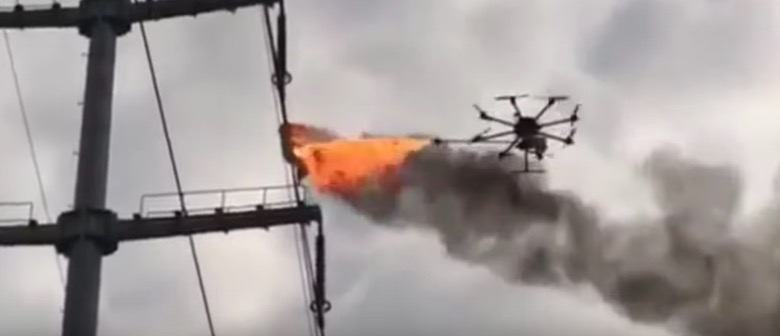
A drone uses fire to remove debris from a power line in China. Screen grab from the video below.
Drones are slowly, very slowly, becoming firefighting (and fire-starting) tools. A company in China is using one to burn debris on power lines.
In this video a flame-throwing drone uses fire to remove what appears to be plastic on a high-voltage line.
Earlier we have written about an experimental drone that drops plastic spheres which ignite a prescribed fire after hitting the ground. And the Lockheed Martin and K-Max Corporations have modified a Type 1 helicopter that can be remotely-piloted to drop water on a fire and haul cargo in an external load.
The use of an unmanned aerial system, or drone, to ignite a portion of the prescribed fire at Homestead National Monument west of Beatrice, Nebraska appeared to be successful, according to the participants we talked with at the completion of the project. After the perimeter was ignited by hand using drip torches, the drone launched to the interior and dropped plastic spheres which burst into flame about a minute after landing on the ground. The spheres are similar to the ones dropped by helicopters for aerial ignition on large wildfires and prescribed fires. This project was 26 acres of grass that had received heavy rain which ended about 30 hours earlier. The ground was wet but the thatch was mostly dry and greenup had started. The temperature was in the high 60s and the relative humidity was around 40 percent. The wind was light, a few miles an hour.
The drone only holds 13 spheres, compared to the hundreds or more that fit into the hopper of a full size machine carried by a piloted helicopter. The drone made around half a dozen or so sorties, returning to the launch spot each time to reload. It followed a predetermined pattern each time, flying to its assignment, dropping the spheres in a line, then returning.
After the first sortie it returned with its full load of spheres. A radio communication problem prevented the deployment of the devices. After this was worked out it went fairly smoothly. At several points, however, the hand igniters had to wait for the drone to launch and light its assigned locations before the firefighters could continue working their way around the perimeter.
Most likely these bugs can be worked out.
A drone is launched to ignite a portion of a prescribed fire at Homestead National Monument. Staff from the University of Nebraska at Lincoln introduce unmanned aerial systems, or drones, that were used to ignite a portion of a prescribed fire at Homestead National Monument.
Below is a video report about the project. It includes images from the burn plus interviews with five key members of the team that helped make it happen.
The flame thrower mounted on the drone above looks scary as hell — even more so than the one being developed at the University of Nebraska that uses plastic spheres to ignite fires.
The aircraft below can carry a dry chemical fire extinguisher or a liquid.
Obviously neither of these appears to be practical in their current state, however I wonder what we might see in five to ten years.
One of the many obstacles to overcome is the rotor wash which would have a significant effect while either igniting a fire or trying to suppress it. This is not a problem for the University of Nebraska version since the plastic spheres only burst into flame about half a minute after being dispensed, after the helicopter has left the area.
Typically when aerial ignition is used to light a prescribed fire or a burnout operation on a wildfire, it is done with a large plastic sphere dispenser mounted in a conventional helicopter, as in the photo below.
Dennis Kirkley of Kaibab Helitack loads the plastic sphere dispenser (ping pong ball machine) with plastic spheres. Grand Canyon Helitack’s A-Star was used to do aerial ignition on the Sitgreaves Complex in northern Arizona August 8, 2014. Photo by Tom Story.
The University of Nebraska is developing an unmanned aerial vehicle that can use plastic spheres to ignite fires. What could possibly go wrong?
Below is an article from the university written by Leslie Reed.
****
Sebastian Elbaum (from left), Dirac Twidwell and Carrick Detweiler have developed a new patent for setting range fires with small drones. The drone injects a liquid into plastic spheres to start a delayed fiery process that allows the balls to fall to the ground before igniting. Elbaum and Detweiler are holding flaming tennis balls similar to those carried by the drones. University of Nebraska photo by Craig Chandler.
A new drone under development at the University of Nebraska-Lincoln could change the way wildfires are fought – and encourage the use of prescribed burns for conservation purposes.
The Unmanned Aerial System for Fire Fighting, or UAS-FF, is under development by a multidisciplinary team of UNL experts in drone technology, fire ecology, conservation and public policy.
The Great Plains, California and other locations around the world are seeing an increasing number of bigger and more intense wildfires in recent years, said Dirac Twidwell, a team member and a range ecology expert and faculty member in the Department of Agronomy and Horticulture.
Twidwell said it’s a trend that results from land management practices, including a decline in human use of fire for ecosystem management, as well as exotic species invasions, drought and climate change.
The aerial robot would have the ability to ignite and monitor fires in remote areas. Novel technology would allow it to operate in harsh environments with limited supervision, enhancing the capabilities of fire management personnel.
“The idea is to provide a safe mechanism for people to perform fire management tasks with less risk and higher efficiency,” said Sebastian Elbaum, a computer science and engineering professor and drone researcher.
The team has successfully performed indoor tests on a prototype. Carrick Detweiler, a faculty member in the computer science and engineering department, said the researchers have been working with the Federal Aviation Administration and hope to have authorization from the FAA and fire departments for a field test of the fire-starting drone as early as March.
“Unmanned aerial devices have the potential to carry out key resource management strategies and could help us deal with something as big as the international increase in severe wildfires,” Twidwell said.
Prescribed burns, where grasslands are burned off according to a predetermined plan, are widely recognized as an effective conservation tool that eliminates invasive species, restores native plants and reduces the risk of wildfire. However, they are underutilized because of perceived safety concerns.
A recent study from Twidwell’s lab shows prescribed fires are actually less less risky to landowners than other commonly used management techniques, and using drones would further reduce the risks posed by lighting prescribed burns by hand and using all-terrain vehicles and suppression vehicles in rough and remote areas.
Many federal agencies use helicopters to ignite such areas, but it’s too costly to use helicopters on private lands.
Elbaum and Detweiler built upon their prior research as co-founders of the Nebraska Intelligent Mobile Unmanned Systems, or NIMBUS, Laboratory to design aerial robots small enough to fit in a firefighter’s backpack, yet smart enough to safely interact with the environment
The drones carry a cargo of ping pong-like balls filled with [a chemical]. Before being dropped through a chute, each ball is manipulated and injected with [another chemical], creating a flame after several seconds. A similar method now is used to start fires for conservation purposes with helicopters and hand-held launchers, Detweiler said.
“We wanted to use proven technology that the prescribed-burn community is already familiar with,” he said.
The drones would have the ability to drop the balls in a precise pattern over the landscape – on the perimeters and interior of a rectangular plot, for example. Detweiler said the robots could be programmed so they don’t fly into areas that are too hot or windy for safe use.
The team is seeking grant funding to develop the next generation prototype with more sophisticated sensing and actuation capabilities, including the ability to operate as a swarm.
Other team members are Craig Allen, research professor and director of Nebraska Cooperative Fish and Wildlife Research, and Lisa Pytlik Zillig, research associate professor at UNL’s Public Policy Center. James Higgins, a mechanical engineering graduate student, designed the prototype’s mechanics, while Christian Laney, a computer science and engineering undergraduate student, was responsible for the control electronics.
The drones could be an especially effective tool in battling Eastern Red Cedar, an invasive tree species that some experts view as one of the region’s most serious ecological threats. It causes extinctions of many grassland plants and birds, collapses forage production important to the beef industry and is contributing to dangerous wildfires.
Detweiler and Elbaum said the drones also might be used in place of manned aircraft and hotshot teams of firefighters dropped by parachute in some wildfire-fighting situations.
“What we’re doing is supporting the expert and the user in the field,” Elbaum said. “The drone and the operator work together to make the job safer, more efficient and cheaper.” “