Families of Iron 44 helicopter crash victims reportedly settle suits

The Oregonian newspaper reports that seven of the families of the firefighters that were killed and three that were injured in the crash of the helicopter on the Iron 44 fire in 2008 have reached a tentative settlement in various lawsuits.

On August 5, 2008, a Sikorsky S-61 helicopter crashed as it was taking off from a helispot on the fire in the Shasta-Trinity National Forest in northern California. Nine were killed, including a pilot, a check pilot, and seven contract firefighters with Grayback Forestry.

An attorney representing some of the families said a tentative agreement has been reached with Carson Helicopters, Columbia Helicopters, and the U.S. Forest Service, but the dollar amount is still being finalized. No agreement has yet been reached with Sikorsky, the manufacturer of the helicopter, or General Electric, which built the engines.

The Oregonian reports that the families of Roark Schwanenberg, the pilot who died, and Jim Ramage, a Forest Service check pilot, as well as surviving pilot William Coultas, did not reach settlements with any of the five defendants.

A contributing factor in the crash may have been the weight of the helicopter as it attempted to take off from the helispot with the ten firefighters, tools, two pilots, and one check pilot. In their report, the National Transportation Safety Board estimated that the actual empty weight of the helicopter was 13,845 pounds, while Carson Helicopters stated in their contract proposal that the weight was 12,013 pounds. For the purpose of load calculations on the day of the crash, the pilot assumed the weight to be 12,408 pounds, which was 1,437 pounds less than the actual weight estimated by the NTSB. In addition, the manifest for that fatal flight calculated that the payload was 2,355 pounds, while the NTSB report estimated that the actual payload was 3,005, a difference of 650 pounds. So the actual total weight of the loaded helicopter as it attempted to take off from the helispot may have been 2,087 pounds heavier than anyone at the fire realized, according to data in the report.

After the crash, the U.S. Forest Service weighed the 10 Carson helicopters that were under contract. They found that seven of them were heavier than Carson had stated in their contract proposals, by an average of 490 pounds. The USFS later canceled their contract with Carson.

In 2009 Carson obtained a contract to supply seven Sikorsky S-61 helicopters to haul supplies for the U. S. military in Afghanistan. The company is partnering with a subsidiary of Blackwater Worldwide, which recently changed their name to “Xe”.

Killed on the Iron 44 incident were pilot Roark Schwanenberg, check pilot Jim Ramage, Shawn Blazer, Scott Charlson, Matthew Hammer, Edrik Gomez, Bryan Rich, David Steele, and Steven “Caleb” Renno. Injured were William Coultas, Richard Schroeder Jr., Jonathan Frohreich, and Michael Brown.

The Wildland Firefighter Foundation has a tribute page online [HERE] and CALFIRE has one [HERE].

Station fire fatality report released

Camp 16 from belowThe Los Angeles County Fire Department has released the Factual Report about the August 29, 2009 burnover of Camp 16 on the Station fire near Los Angeles. During that burnover, two firefighters were killed, Fire Captain Ted Hall, Superintendent 16, and Fire Fighter Specialist Arnie Quinones, Foreman Crew 16-3. Hall and Quinones were implementing a planned burnout below Camp 16 when their vehicle left the road. It was found 800 feet below the road with the two deceased firefighters inside.

Camp 16 from above

Camp 16 accident scene

The images are from the report; click on them to see larger versions.  Below are the causal and contributing factors from the report.

==============================================
Causal and Contributing Factors

Causal Factors

Causal Factors are any behavior, omission, or deficiency that if corrected, eliminated, or avoided, probably would have prevented the incident.

1. The decision to protect Camp 16 and shelter in place and allow the firing operation was made at the Battalion Chief’s management level without contact with the Station IMT.

2. The lack of contact with the Station Incident prevented Camp 16 leadership from knowing about predicted fire behavior and available resources.

3. The firing operation on the Mt Gleason road was not successful due to the extreme fire behavior which exceeded the prediction of the plan.

Contributing Factors

Contributing Factors are any behavior, omission, or deficiency that sets the stage for an accident, or increases the severity of injuries.

1. The organizational culture allows firefighters to accept a notably higher risk to protect structures on wildland fires. A sense of ownership may have also influenced the decision to defend the facility.

2. The south winds aloft and prevailing up-canyon winds aligned with the topography of the North Fork of the Mill Creek drainage resulting in rapid fire progression toward Camp 16 and the firing team on the mid-slope road.

3. The fire burned in rugged terrain and the burnover occurred in the upper end of a steep drainage with fuel loads at seasonal low fuel moisture levels.

4. Resources assigned to Camp 16 were utilizing two different frequencies for tactical discussions and reports. Effective communication controls were not in effect prior to the incident.

5. There was no lookout dedicated to the firing operation.

6. The Station Fire IMT was either unaware of the threat to Camp 16 or understaffed to provide any assistance.

7. The ninety-year period of no fires in the vicinity of Camp 16 provided no historic baseline for reference.

Pilot dies in air tanker crash in Canada

The Telegraph-Journal and other news outlets are reporting that a pilot died in the crash of an air tanker in New Brunswick, Canada. Here is an excerpt from the article.

Ron Clowes, a pilot from Grand Falls with Forest Protection Ltd., was conducting a practice flight in a water bomber when the plane crashed shortly after taking off from the airport, just before 2 p.m.

Air Tanker Crash
The engine of a downed Forest Protection Limited aircraft sits several metres away from the crash site near the Miramichi Airport on Friday. Pilot Ron Clowes, 62, died in the crash. Photo: KRIS MCDAVID/TIMES & TRANSCRIPT

He was the only person in the plane, and no other injuries were reported.

The plane reportedly clipped the tops of some trees before crashing close to a building at Envirem Technologies, a peat moss facility near the airport.

The Miramichi police, fire department, and airport emergency crews quickly descended on the scene, which was littered with debris from the downed aircraft.

David Davies, managing director for Forest Protection Ltd., said in an interview Friday evening he had no information on what might have caused the plane to go down.

He said Clowe was an experienced pilot who had worked with the company for a decade putting out forest fires, and had 13,000-plus hours in the air.

“He was a very well-liked, well-respected person,” Davies said.

“The ground crew, the maintenance crew, everyone liked him.”

He said Clowes was flying a TBM Avenger aircraft, an American torpedo bomber first used in the Second World War, which the company had converted for forest fire service.

The company once held the largest civilian fleet of Avengers in the world, but has gradually sold them over the years, and now owns only three, Davies said.

Cpl. Todd Chadwick of the Miramichi police said in an interview late Friday that it will take time to determine the cause of the crash.

He said the Transportation Safety Board of Canada is scheduled to arrive this morning to begin their investigation, and that police will continue to secure the site until all the evidence has been gathered.

“It will be a lengthy investigation,” he said. “And of course, once (the evidence) is collected, they will need to analyze it before they can determine what happened.”

Forest Protection Ltd. is a joint government-industry company that conducts aerial fire protection, insect control and herbicide programs, with offices in both Fredericton and Miramichi.

Davies said everyone at the company is still reeling from the crash, and that Clowes’ family had been contacted.

“I spoke to a family member, a sister, and I think everybody now is in a state of shock,” he said.

“Our concern is for the family at this time. This has all been a very big shock for all of us.”

Davies said Clowes had battled countless fires during his years with the company and was a brave a pilot.

Our sincere condolences to the family and coworkers.

Kansas firefighter killed on brush fire

KAKE television station and FirefighterCloseCalls.com are reporting that a Peru, Kansas firefighter was killed on a vegetation fire on Sunday, April 11. Harold D. Reed Sr, 74 years of age, was overcome by smoke while working on a fire west of Peru and died in the line of duty. Firefighter Reed was transported to Sedan City Hospital where efforts to revive him were unsuccessful. He had been a longtime member of the fire district and was a current board member.

Funeral services will be handled by the David Barnes Funeral Home in Sedan.

Our condolences to firefighter Reed’s coworkers and family.

Report released on USFS rappelling fatality

Thomas Marovich died on July 21, 2009 when he fell while performing routine helicopter rappelling proficiency training while assigned to the Backbone fire near Willow Creek, California. On October 2, 2009 the Occupational Safety and Health Administration (OSHA) issued “serious” and “willful” violation notices to the U. S. Forest Service for the incident.

The USFS has just released their Preliminary Aircraft Accident Investigation Report which was completed on October 19, 2009, and a Safety Action Plan dated February 1, 2010. The report is 63 pages long, but I will mention a few of the key points. [UPDATE 9-13-2011; the Lessons Learned Center removed the two reports from their site at the direction of the U. S. Forest Service, who said they were not intended to be released to the public. They replaced the two reports with the National Transportation Safety Board narrative.]

A proficiency rappel is required every 14 days to maintain technical competency. Marovich was in his first season rappelling and was about to make his 11th rappel.

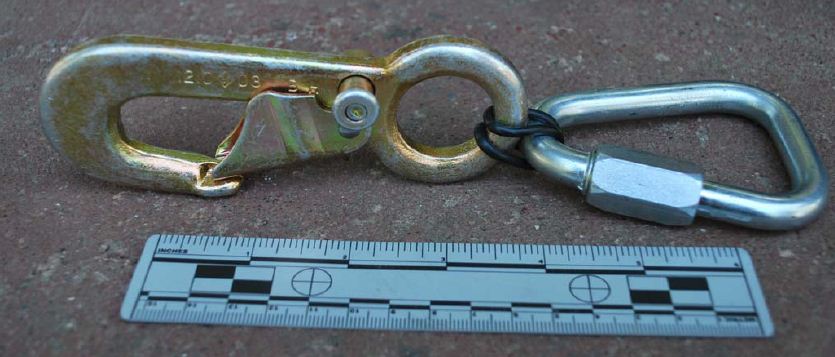
Before the rappelling training, Marovich noticed that the Kong clip on his Tri-link was broken. The Kong Clip is used to center the “J” hook at the forward corner of the Tri-link. It is a nice piece of equipment to have, but is not essential. Kong clips are prone to breaking and are not popular. He sought assistance from a spotter trainee who replaced the Kong clip with an “O” ring, which was an authorized substitution. If I interpreted the report correctly, the “O” ring was installed incorrectly.

Here are some photos from the report showing for illustration purposes examples of a correct and then an incorrect installation of an “O” ring on a Tri-link.

O Ring, correctly installed
“J” hook, Tri-link, and an “O” Ring, correctly installed. USFS photo.
O ring, incorrect
“J” hook, Tri-link, and an “O” Ring, incorrectly installed. USFS photo.
Rappelling rigs
Three different equipment rigging set ups. The top set up is rigged correctly using a Kong clip. The middle set up is rigged correctly using an O-ring. The bottom set up is rigged improperly using an O-ring. USFS photo.

Before the rappelling attempt, four people looked at or inspected Marovich’s rappelling gear: the spotter trainee who installed the “O” ring, Marovich, and in the helicopter a spotter, and another helitack crewperson who did a “buddy check”.

Rappellers just before accident
This photo was taken seconds before Marovich fell, unarrested. He is on the left side.

Marovich fell, unarrested, shortly after stepping out onto the helicopter skid. He was pronounced deceased about 30 minutes later.

The Human Factors section of the report, beginning on page 33, is particularly interesting. Written by Jim Saveland and Ivan Pupulidy, it discusses, along with other issues, the concept of not seeing elements in our visual field, or “blindness”.

Below are some quotes from that section:

Continue reading

Australian firefighter killed in vehicle rollover

UPDATE at 11:16, January 11:

The firefighter has been identified as Hugh Monroe. Here is information from CFA Connect dated January 11:

====================

Tolmie & District Rural Fire Brigade member Hugh Monroe died yesterday after the tanker he was driving was involved in an accident on the way to an incident in Victoria’s North East. The accident happened about 14 kilometres from Tatong.

Mr Monroe, 62, had been a volunteer for nearly 11 years and was a much loved member of both his brigade and community. A dedicated firefighter and brigade 3rd Lieutenant, he was involved in the 2006 campaign through Victoria’s high country and the Black Saturday fires last year.

=====================

(The original article:)

A firefighter was killed and four others were injured when their fire truck rolled over while they were responding to a grass fire at Lake Mokoan near Benalla in northeast Victoria, Australia. (map)

Here is information from the Brisbane Times:

=============

A 62-year-old volunteer firefighter was protecting his community in northeastern Victoria when he died in a tanker rollover that injured four of his brigade mates.

The man was travelling to put out a blaze ahead of extreme fire weather when he was killed at Tatong in northeast Victoria on Sunday.

Three men and a woman were also injured in the rollover, two suffering serious injuries.

Country Fire Authority (CFA) chief fire officer Russell Rees said the man, from nearby Tolmie, was one of five firefighters travelling to a fire at Lake Mokoan, near Benalla, when tragedy struck.

“One of our members tragically died and our condolences go to the family and the broader CFA family,” Mr Rees said.

“This is a sad event, it reinforces once again the dedication and commitment of our people across the emergency services, but particularly the volunteers who get up out of bed while you and I are slumbering away on a Sunday morning and go and do work for their community.”

The single vehicle accident occurred on the Spring Creek Road at Tatong, north of Mansfield, about 6.30am (AEDT).

The 62-year-old firefighter, believed to be the driver, was trapped inside the tanker and died at the scene.

Two men were flown to Melbourne hospitals in a serious condition and a man and a woman were transported by road ambulance to the Goulburn Valley Hospital in Shepparton.

Acting Premier Rob Hulls said his thoughts went out to the family of the deceased and those injured.

“I think it really reinforces that CFA volunteers put their life on the line and this is certainly very clear by what occurred today,” he said.

“A volunteer going to Lake Mokoan fire to further blacken out particular areas has tragically lost his life, really trying to protect (the) lives of others.”

It’s believed two of the injured firefighters went to a nearby house to raise the alarm and a doctor and an off-duty policeman were the first on the scene.

A man, aged about 42, was flown to the Royal Melbourne Hospital with spinal and chest injuries.

Another man, aged 52, was flown to The Alfred hospital with neck, back and head injuries.

A woman suffering chest and abdominal injuries and a man with head lacerations were taken to Shepparton.

Wildland firefighter LODDs, 2009

2009 proved again that wildland firefighting is still a very hazardous occupation. Here is a list of the wildland fire related line of duty deaths of which we are aware. We make no claim that it is a complete or official tally, but we did the best we could. If you are aware of any that we missed, let us know.

Jan. 4: A father and son, driving separate fire department vehicles, collided in dense smoke while responding to a vegetation fire. John C. Meyers of the Wesley FD in Oklohoma, died.
https://wildfiretoday.com/2009/01/06/follow-up-on-oklahoma-fatality/

Feb. 17: A firefighter with the Australian Capital Territories Fire Brigade in Australia was killed when a tree fell onto a fire apparatus.  https://wildfiretoday.com/2009/02/17/australian-firefighter-killed-by-falling-tree/

Feb. 20: John Adams with the Silver City VFD in Oklahoma collapsed and died while working on a vegetation fire near Mannford, OK.
https://wildfiretoday.com/2009/02/21/oklahoma-firefighter-dies-while-fighting-fire/

Mar. 8: Pilot Roger Hershner died when his helicopter crashed in Kansas while ferrying the ship to the location of a fire contract in Virginia.
https://wildfiretoday.com/2009/03/09/helicopter-pilot-killed-in-kansas-crash/

Mar.15: Lt. Roger Vorwark collapsed and died from an apparent heart attack while working on a vegetation fire in Odessa, Missouri.
https://wildfiretoday.com/2009/03/16/missouri-lodd/

Mar. 21: Gregory Carroll Cooke went into cardiac arrest and died while working on a vegetation fire near Whitakers, North Carolina.
https://wildfiretoday.com/2009/03/24/wildfire-news-march-24/

Apr. 8: Pilot Heath Van Handel, a DNR employee, died when his spotter plane crashed while working over a fire near Cary, Wisconsin.
https://wildfiretoday.com/2009/04/08/wisconsin-fire-spotter-plane-crashes-killing-pilot/

Apr. 8: New Zealand firefighter killed by falling branch
https://wildfiretoday.com/2009/04/08/new-zealand-firefighter-killed-by-falling-branch/

Apr. 25: P2V Air tanker crash kills 3 near Toole, Utah: Tom Risk, Pilot, of Littleton CA, Mike Flynn, co-pilot, of Alamogordo, NM and Brian Buss ,Crew chief of Alberton Montana.
https://wildfiretoday.com/2009/04/27/24-hour-briefing-on-air-tanker-crash/

May 15: Chief Trent Hill of the Keswick Valley FD, New Brunswick, Canada, died from an apparent heart attack while working on a vegetation fire.
https://wildfiretoday.com/2009/05/17/wildfire-news-may-17/

Jun. 18: Two people were killed when a firefighting helicopter crashed into a lake in southwestern Turkey.
https://wildfiretoday.com/2009/06/19/two-bodies-of-helicopter-crash-victims-found-in-turkey/

Jun. 26: BLM firefighter Brett Stearns was killed by a falling tree while working on a hazard-tree removal project 15 miles northeast of Craig, Colorado.
https://wildfiretoday.com/2009/06/28/colorado-blm-firefighter-killed-in-falling-accident/

Jul 21-23: Five firefighters died while working on vegetation fires in the north of Spain.
https://wildfiretoday.com/2009/07/22/four-firefighters-killed-in-spain/
https://wildfiretoday.com/2009/07/23/another-firefighter-dies-in-spain/

Jul. 21: Thomas Marovich died in a heli-rappelling training accident on the Backbone fire near Willowcreek, California.
https://wildfiretoday.com/2009/07/21/fatal-accident-during-training-at-backbone-fire/

Jul. 29: A bulldozer operator was killed on a fire in Spain.
https://wildfiretoday.com/2009/07/29/dozer-operator-killed-on-spanish-fire/

Aug. 14: Pilot Robert Christopher Woodhead was killed when his helicopter crashed into the Fraser River in British Columbia, Canada.
https://wildfiretoday.com/2009/08/15/b-c-firefighting-helicopter-crashes-into-river-pilot-missing/

Aug. 20: Pilot Dave Jamsa died when his single engine air tanker crashed while working on the Hoyt fire 25 miles northeast of Reno, Nevada.
https://wildfiretoday.com/2009/08/21/air-tanker-crash-in-nevada-kills-pilot/

Aug. 27: The pilot of an air tanker was killed while working on a fire on the Ionian Sea island of Kefalonia near Greece.
https://wildfiretoday.com/2009/08/27/air-tanker-crashes-in-greece-killing-pilot/

Aug. 31: Two Los Angeles County firefighters, Capt. Tedmund D. Hall, and Firefighter Specialist Arnaldo Quinones, were killed when their vehicle ran off the road and was burned over on the Station fire.
https://wildfiretoday.com/2009/09/01/preliminary-information-about-the-fallen-lacfd-firefighters/

Dec. 9; New South Wales firefighter, Aaron Harber, killed in helicopter crash
https://wildfiretoday.com/2009/12/10/friends-honor-nsw-park-ranger/

Our sincere condolences to the families and co-workers of all of these firefighters.

And, as usual, “Let’s Be Careful Out There“.

NTSB releases factual report on crash of Tanker 09

Tanker 09 last drop
Air tanker 09 making their last drop, September 1, 2008 before it crashed at Reno later that day.

UPDATE July 4, 2012: HERE is a link to the NTSB’s final report. Below is an excerpt from the summary:

NTSB summary crash p2v 9-1-2008


===================

The factual report that the National Transportation Safety Board (NTSB) released on December 28 about the crash of Tanker 09 on September 1, 2008 does not have any surprises. Witnesses had reported that the left turbojet engine on the P2V was on fire during takeoff from Reno. The report confirms there was a compressor disc failure in that engine.

Here are some excerpts from the report:

The airplane is powered by two radial, 18 cylinder, aircooled, Curtiss Wright R3350-32WA engines, rated at 2,800 horsepower, driving Hamilton Standard hydromatic propellers, and two auxiliary Westinghouse J34-WE-36 turbojet engines, each rated at 1,500 pounds of thrust. The turbojet engines were installed to improve takeoff characteristics at increased gross weights and to furnish additional power when required.

[…]

The airplane’s left outboard engine (position #1) was a Westinghouse J34-WE-36 turbojet engine, serial number 211235. Total time on the engine was 703.4 hours, 384.4 hours since overhaul, and 64 hours since its last inspection.

[…]

The engine originally had been in service with the United States Navy, and at the time of its initial civilian installation on a Black Hills Aviation P2V on May 16, 1986, it had accrued 458.7 hours since new, and 128.4 hours since overhaul.

[…]

After in-depth inspection and analysis, it was determined that the 11th stage compressor disc had failed near the transition radius between the disc web and the bolting ring. This engine was manufactured by Westinghouse, identified as model J34-WE-36, serial number 211235.

[…]

The airplane’s left outboard engine, serial number 211235, was located about 580 feet from the IIP on a measured magnetic heading of 239 degrees. A visual examination at the wreckage site revealed that the engine’s compressor section had separated prior to impact.

Three aerial firefighters were killed in the crash: Pilots Gene Wahlstrom and Greg Gonsioroski, and mechanic Zachary Vander Griend. Mr. Wahlstrom was the chief pilot for Neptune Aviation, and it was Mr. Vander Griend’s first flight in a P2V.

The NTSB has not released a factual report on the other crash of a Neptune Aviation P2V, Tanker 42, which occurred on April 25, 2009 near Toole, Utah killing three crew members. Their final report can be found HERE.

More details emerge about the loss of 2 firefighters and Camp 16

A television station in Los Angeles, KTLA, has put together more details about the Station fire and the events that led to the deaths of two Los Angeles County Fire Department firefighters and the burn over of Camp 16 on August 30, a facility housing inmate firefighters. KTLA obtained, through federal and state disclosure laws, U. S. Forest Service and county dispatch logs, the “daily summaries” (ICS-209, Incident Status Summary?), e-mails, and volumes of other records. The Station fire started on August 26 near Los Angeles, burned 160,000 acres, and killed two county firefighters, Capt. Tedmund Hall and Spc. Arnaldo Quinones.

Camp 16, Station Fire
Camp 16

A key focus of KTLA’s inquiry was what led to the burn over of Camp 16, the destruction all of the facilities there, and the deaths of the two firefighters who were killed while trying to find an escape route for the others at the camp.

The burn over of Camp 16 occurred on day 4 of the fire, a period of time in the life of a fire by which most of the essential pieces of the fire suppression puzzle are in place and the typical chaos has been converted to an appearance of order.

Since the camp was never evacuated, it appears that the incident management team running the Station fire either forgot about Camp 16, assumed it was not occupied, hoped it was fire-safe, or thought they would take care of themselves, since the personnel at the camp were all firefighters. You have to wonder, also, what the thought process was on days 1, 2, 3, and 4 in the Los Angeles County Fire Department which managed the fire personnel at the facility, and if there was anything that could have been done before the fire to reduce the chances of the facility being totally destroyed when the inevitable fire visited the area.

Below is an excerpt from the article by KTLA.

========================

…County Fire Chief Deputy John Tripp, the No. 2 executive in the department, said he did not believe that the camp had been an afterthought to the commanders. He also said that his agency had “some communications” with the crews during the firefight. A county review of the response to the Station blaze termed those communications “sporadic.”

Asked if it had been too risky for firefighters to stay at the camp, Tripp said, “That I can’t talk about yet.” He deferred to an inquiry into the deaths by the county and the state Department of Forestry and Fire Protection, whose findings are due to be released in the coming days.

Don Feser, former fire chief of the Angeles National Forest, said it was senseless to have kept crews at the camp, especially because they were waiting for the blaze to reach them rather than actively confronting it.

“It wasn’t like there was any engagement going on,” he said. “It was an oversight, I’m guessing, in the county command system. . . . They either forgot about them, or the people who were calling shots for the county were oblivious about what could happen to them.”

Feser, who retired in 2007 after seven years as chief, said it was a mistake not to include the camp in the wider Station fire fight: “The incident command teams should have been double-checking to make sure that they didn’t have anybody out there, that everybody’s been evacuated.”

A preliminary county report and interviews show the crews had abandoned any hope of taking a stand against the fast-moving fire on that fateful Sunday morning, Aug. 30, and instead scrambled for cover in a dining hall and their vehicles.

“It got to the point where there was no oxygen to breathe,” said the firefighter who was at the camp.

At 4:15 p.m., “fire conditions around the camp began to deteriorate very rapidly,” the report states. At 5:15, it says, “an accounting of all personnel began, and it was determined that two personnel were missing.” At 5:41, this chilling entry appears in Forest Service dispatch logs: “Camp 16 has been burned over.”

As the flames roared up through the camp, exploding through the treetops, the crew members sought refuge in the dining hall, then were marshaled outside as the fire surrounded the building; they huddled in trucks and engines, and some unfolded hand-held shelters, according to witnesses and records. “We thought we were going to die,” said the firefighter who was on Mt. Gleason.

Friends honor NSW park ranger

Aaron Harber
Aaron Harber, holding a muttonbird in the Nimboi-Binderay National Park. The Australian

The park ranger who was killed in a helicopter crash on Wednesday in New South Wales has been identified as Aaron Harber. The helicopter crashed in heavy fog as it was on its way to pick up other members of a rural firefighting team near Dorrigo in Australia. The pilot was seriously injured in the crash and is in critical condition with head and chest injuries.

From The Australian:
================

Yesterday Harber’s friends paid tribute to a family man who worked tirelessly for the community.

“He was a big-hearted, down to earth, really nice guy who was generous with his time. The whole town is in a state of shock,” family friend Ross Pollard said.

With the National Parks and Wildlife Service since 1997, Harber moved up to Dorrigo 13 years ago with his family from Sutherland Shire in southern Sydney where he grew up.

His wife Jane Louise Geyle Harber said in a statement released yesterday afternoon, “It is with great sadness that we mourn the tragic loss of Aaron, proud husband, father and family member in a tragic helicopter crash yesterday at Dorrigo.

“While we are devastated by our loss, we take pride in the knowledge that Aaron has left a lasting legacy as a fine family man and as an active member of the Dorrigo community.

“His sacrifice will not be forgotten and he will be forever missed.”

“His family will be cared for,” Barnes said.

“We’re working with the family and we’re helping out in every way possible. We will be supporting them through this.”

“The family will be entitled to a lump sum payment from the National Parks and is also entitled to weekly payments to dependent children,” a National Parks spokesperson said.

Nearly 100 bushfires are still raging in NSW with 29 fires rated “uncontainable”.

Fires in Bundarra, Barraba and near Gwydir remain out of control, burning in and around rural properties.

“We have got a lot of fire activity from north of Tamworth to Armidale and that’s mostly a result of some dry lightning that has went through the area over the last few days,” RFS spokesman Ben Shepard said.

A statement released by NSW Health confirmed that 61 year old Bernie Schulte is in a critical but stable condition and 20 year old Cameron is in stable condition after suffering burns while defending their property in the town of Vittoria, 25km west of Bathurst.