In a meeting in the White House today with FEMA and other federal officials, the subject changed to wildfires, and the President expressed his opinion about the pay of federal firefighters.
From the Washington Post:
“There’s an old expression: God made man. Then he made a few firefighters. They have a higher incidence of severe injuries than police officers do. They are incredibly, incredibly brave at what they do. … And I just realized — I didn’t realize this, I admit — that federal firefighters get paid $13 an hour. That’s going to end in my administration,” he said. “That’s a ridiculously low salary to pay federal firefighters.”
White House Press Secretary Jen Psaki told reporters earlier that Biden wanted to meet with federal emergency management officials to discuss preparedness and response efforts given the onset of peak wildfire and storm season.
Federal firefighters get paid a “ridiculously low” $13 an hour — that’s going to end in this admin, @potus tells us during meeting with FEMA. pic.twitter.com/p03FiYSnIg
Forest Service Chief Vicki Christiansen testified before the Senate Committee on Energy and Natural Resources June 17, 2021. (Still image from the Committee video.)
In what will be one of her last appearances in a Congressional hearing before she retires at the end of August, U.S. Forest Service Chief Vicki Christiansen called repeatedly for a “paradigm shift” for treating hazardous fuels.
Today she testified before the Senate Committee on Energy and Natural Resources to defend the President’s budget request for the U.S. Forest Service for Fiscal Year 2022 which begins October 1.
In addition to increasing the amount of timber harvested on Forest Service lands, the topic of reducing the number of devastating wildfires came up many times in the hour and a half hearing. A video is available on the Committee’s website.
Senator John Barrasso (WY) mentioned (at 27:49 in the video) that in an April hearing the chief said a paradigm shift was needed to reduce the hazard fuels in forests. He asked, “Do we need to dramatically increase the number of [wildfire mitigation] acres treated annually?” Chief Christiansen said,”Yes… We can’t just do the same old thing we’ve always done, just treat whatever acres we can get to… We have a crisis. We have a crisis that needs to be addressed differently.”
The Chief said the agency treats about three million acres each year, but they need to treat two to four times that amount.
Senator Ron Wyden (OR) got the Chief to confirm that the agency’s latest estimate is that it would take $20 billion over a 10-year period to “get in front of the hazardous fuel challenge” (at 39:25).
A fuel complex defined by kind, arrangement, volume, condition, and location that presents a threat of ignition and resistance to control.
Senator Wyden addressed the possibility of a fire season this year that could be worse than average (at 36:40). He asked, “What is the plan for keeping people safe when there are fires in multiple communities in the West?”
Chief Christiansen said, in part, that in recent years there has been competition for firefighting resources when the number of fires have resulted in requests for firefighters and equipment that were unable to be filled, and later said, “Our system is at a breaking point.”
Senator Wyden asked the Chief to submit a “written statement on what the plans are if we are short on resources in the West.”
Senator Catherine Cortez Masto (NV) asked if the President’s proposed budget includes sufficient funding for battling wildfires, post-fire recovery, prevention, reducing hazard fuels, and addressing invasive species.
“Senator, it’s a step in the right direction. A significant step in the right direction… It helps in modernizing our wildland fire workforce. It does not get us every step that we need to be.
“I’m very concerned about our workforce,” she continued. “They are tired, and fatigued. Their mental well-being and stress that we are concerned about. Many of these folks are temporary employees and they try to make a year’s living in six to nine months. There are still more things to address, but this budget is a very good first step.
Senator Masto asked about the recruitment and retention challenges that the agency is facing (1:05:30).
“It’s a calling to do this work,” the Chief said. “But anybody should be able to have a living wage to do this work. We do have concerns about a competitive wage… We are committed to work with the Department of the Interior and others to do a comprehensive look at our workforce needs.”
“Please share that,” said Senator Masto. “It’s the same thing I’m hearing in my state from our fire chiefs. It’s a challenge. And this is something we have to address.”
Senator Angus King (Maine) said timber sales on public lands fell from 13 billion board feet in 1988 to 3.2 billion last year, a factor of five, he said. (1:13:07) “What in the hell happened,” he asked. Later he said, “Coincidentally from 1991 to 2020 the number of acres burned has gone up by a factor of five. Is there a connection?”
“Yes sir, there is,” the Chief quickly replied. The Senator moved on to another topic and did not allow her to fully explain why she thought there is a connection.
“It’s like having gasoline out there,” said Brian Steinhardt, forest fire zone manager for Prescott and Coconino national forests in Arizona, in a recent AP story about the increasingly fire-prone West.
Now something else is happening — and at the worst possible time.
Federal firefighters are leaving the workforce and taking their training and experience with them. The inability of federal agencies to offer competitive pay and benefits is creating hundreds of wildland firefighting vacancies.
Vacancies, of course, limit how much federal firefighters can do. If Western communities want to be protected, they need to ensure that their firefighters receive better pay and benefits.
Jonathon Golden
In my 11 years of work as a wildland firefighter, I’ve managed aircraft, trained people and run fires myself, but I also did outreach and recruitment for the Forest Service and Bureau of Land Management. I know how hard it is for hiring managers to make 2,000 hours of grueling work, crammed into six exhausting months, sound appealing when the pay is $13.45/hour. The pay doesn’t come close to matching the true demands or everyday dangers of the job.
Federal wildland firefighters, by necessity, are transient workers. During the fire season — now nearly year-round — they must be available to travel anywhere in the United States at any time. And to advance in their career, they have to move to other federal duty stations to gain more qualifications.
Finding affordable housing has always been a problem for career firefighters on a federal salary. To make matters worse, federal agencies revoked the “Transfer of Station” stipend for career employees, which helped offset the cost of moving. Just recently, a national forest supervisor also revoked a “boot stipend.” It might sound minor, but it isn’t: When you’re in the firefighting business, boots tough enough to save your life can easily cost you $500.
Some states aren’t relying on the government to act quickly. “We aren’t just waiting for the next crisis to hit,”said California Gov. Gavin Newsom, in establishing an $80.74 million Emergency Fund that delivers an additional 1,256 seasonal firefighters to boost CALFIRE’s ranks. This Emergency Fund is in addition to the governor’s $1 billion budget request for California’s Wildfire and Forest Resilience Action Plan.
In Washington, state legislators unanimously passed a $125 million package that will enable the state’s Natural Resources Department to hire 100 more firefighters. The legislation furthers the state’s efforts to restore forest health and creates a $25 million fund to ensure community preparedness around the state.
Utah’s House Bill 65, recently signed into law, appropriates money to help Utah’s communities offset the cost of wildfire suppression. Most importantly, it commissions a study to evaluate the current pay plan for firefighters within Utah’s Natural Resources Department.
The bill’s sponsor, Rep. Casey Snider, was amazed to learn that frontline wildland firefighters make more money at McDonald’s: “These positions are critical,” he said. “They are the first ones on fires.” This year, Utah has already had five times the number of wildfires it normally experiences in a year.
And firefighters are organizing and speaking up. The Grassroots Wildland Firefighters is working to halt the exodus of firefighters from federal agencies by advocating for pay parity with state and local fire protection agencies. The group also supports initiatives to assist the physical and mental health of firefighters and their families. The statistics they highlight are shocking: Wildland firefighters have a suicide rate 30 times higher than the average. They also experience high incidences of cardiovascular disease and lung cancer.
There is talk on the federal level of creating a permanent, year-round firefighting workforce. I think this is a necessary step, but it won’t fix the workforce capacity issue unless increased pay and benefits are used to encourage the recruitment and retention of federal firefighters.
We all know that today’s wildfires are longer, more damaging and more frequent than ever before. We also know that men and women are putting their lives on the line for less than they’d earn at a McDonald’s.
Our firefighters do all this to protect our lives, our forests and our communities. We owe them at least a living wage and a chance for a healthy life. I hope more states and legislators will start paying attention. This is a debt that needs to be paid.
Jonathon Golden is a writer for Writers on the Range, a nonprofit dedicated to spurring lively conversation about the West. He lives in Park City and has 12 seasons as a wildland firefighter. He resigned in 2019 to prioritize his family and find a sustainable career. In 2020 Jonathon started Golden Group, LLC, a consulting company that focuses on domestic and international conservation initiatives as well as national security.
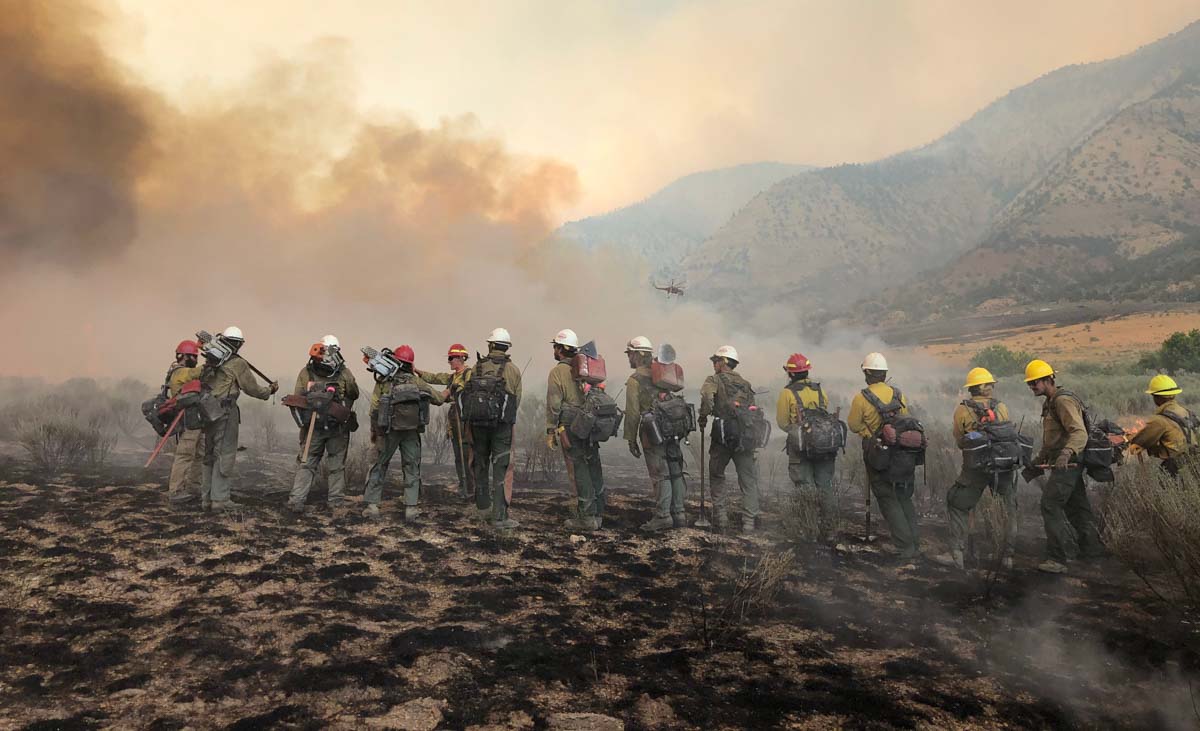
Firefighters being briefed on the Pine Gulch Fire in Colorado, August 21, 2020. InciWeb.
A senior-level wildfire management person in the U.S. Forest Service (FS) told Wildfire Today that there are hundreds of vacant permanent firefighting positions in California. The agency’s difficulties in recruiting and hiring seasonal and permanent firefighting personnel has resulted in multiple hotshot crews not qualifying to respond to a fire with 18 personnel, the minimum required by interagency standards.
More than a dozen FS fire engines in the state are completely unstaffed, or instead of seven days a week coverage they have cut back to only five. (Check with your local fire department and ask which days of the week they staff their fire engines.) Thirty modules of FS hand crews, dozers, or water tenders in California have been shut down due to a shortage of employees, according to our source.
(Read more: Forest Service issues statement saying in part, “Federal wages for firefighters have not kept pace with wages offered by state, local and private entities in some areas of the United States.”)
The personnel issues are caused by two primary factors, difficulty in hiring, and experienced firefighters leaving the organization for better pay and working conditions.
Seasonal federal firefighters in California are generally hired in January and start working in mid-May or mid-June. The centralized hiring process now being used has been heavily criticized as inefficient.
A look at the system for advertising vacant permanent firefighting positions in the federal agencies, USA JOBS, shows a large number of unfilled FS positions. Here is a sample from this week:
Some of the FS fire jobs at the website are open for a few months or a year, and others are basically continually open with no end dates. Hiring of permanent fire personnel can go on throughout the year as additional positions become vacant.
The entry level wildfire job with the federal agencies is usually a GS-3 working under the title “Forestry Technician,” which receives $13.32 per hour, almost $2 less than the minimum wage sought by some politicians recently. In California a state agency that competes with the federal government for hiring firefighters pays about double that rate. A recent survey found that the first and second most cited reason for leaving federal firefighting organizations is to move to a job with the California Department of Forestry and Fire Suppression or local municipal fire departments.
Difficulties staffing Incident Management Teams
Skilled fire personnel leaving the federal land management agencies have made it difficult to find employees qualified and willing to serve on Incident Management Teams (IMT) that are mobilized to suppress large wildfires and manage other incidents.
From a report released May 13, 2021 by the Incident Workforce Development Group:
Today, critical challenges in rostering and managing IMTs is leading to a decrease in the number of teams available for an increasing number of complex incidents.
In the past five years there have been multiple occasions where all available IMTs have been assigned to large fires. Local units have had to face the consequences of managing a complex incident without the services of an IMT.
Firefighters in the Department of the Interior
A spokesperson for the Department of the Interior told Wildfire Today that they do not anticipate having a large number of vacant firefighting positions. (Wildfire Today was unable to confirm this claim):
The Department of the Interior is on track to have available a total of approximately 5,000 firefighters, a similar number to what was available last season.
The initial bureau hiring targets are:
Bureau of Indian Affairs – 600
Bureau of Land Management – 3,450
U.S. Fish and Wildlife Service – 530
National Park Service – 930
How many firefighters does the FS have?
The Forest Service, which is in the Department of Agriculture, has been saying for years that they have 10,000 fire personnel. Wildfire Today filed a Freedom of Information Act Request with the the agency on December 10, 2019 to obtain the actual number of firefighters. We are still waiting to receive factual information.
Widespread news coverage
Three major news organizations have published articles this week about the recruitment and retention of federal wildland firefighters. Below are excerpts:
Despite the increased threat, the Forest Service does not expect to meet its goal of hiring 5,200 federal firefighters in California this year.”It will be below that number,” said Bob Baird, director of fire and aviation management for the Forest Service Pacific Southwest Region. “With hiring challenges and attrition, it could be a lower percentage than that, but we won’t know until we finish our hiring process.”
“California is ground zero for attrition,” said Riva Duncan, a former Forest Service officer who is the executive secretary of Grassroots Wildland Firefighters, which advocates for federal fire personnel. “We’re losing people at an accelerated rate because there are so many other opportunities.”
The [FS] projected a shortfall of 313 firefighters in Region 5 this year, at least 8% fewer firefighters than it aimed to employ. The shortfall is frustrating for many in California’s state government, which relies on the federal service to help put out wildfires, but has little control over staffing levels.
Thom Porter, the chief of California’s state fire agency, CAL FIRE, said he’s had regular conversations with California-based Forest Service officials about staffing this year. He said he’s most worried that when the agency’s teams are moved to fight fires in other states, the Forest Service won’t have enough people, or enough experienced people, to backfill those roles in California.
“If they’re unable to hire, if they’re unable to keep staff on when we’re having our most critical periods, it is a public safety risk,” Porter said of the Forest Service. “Because we so much rely on each other that—there isn’t a single agency in California that has all of the resources it needs for a major incident of any type. It’s all hands on deck.”
Jon Groveman, a spokesman for the Forest Service in California, said the agency attempts to staff 46 hotshot crews in the state annually, but it hasn‘t been able to fill all of those positions for several years, leaving it with between 35 and 40 crews. The agency expects “a similar number of crews to be staffed this fire year,” he wrote in an email, adding that “some crews for various reasons (mainly due to staffing challenges) will not be able to attain Hotshot standards.”
Hotshot crews that have lost that designation include the Horseshoe Meadow Hotshots in the Sequoia National Forest and the Modoc Hotshots in the Modoc National Forest, both of which the agency considers “unstaffed.”
A Forest Service job posting earlier this spring for a full-time, experienced firefighter in the Bridger-Teton National Forest in Jackson, Wyoming, warned applicants that real estate costs were high. It suggested a few affordable options, including Habitat for Humanity, the nonprofit home builder that helps low-income people get into new homes.