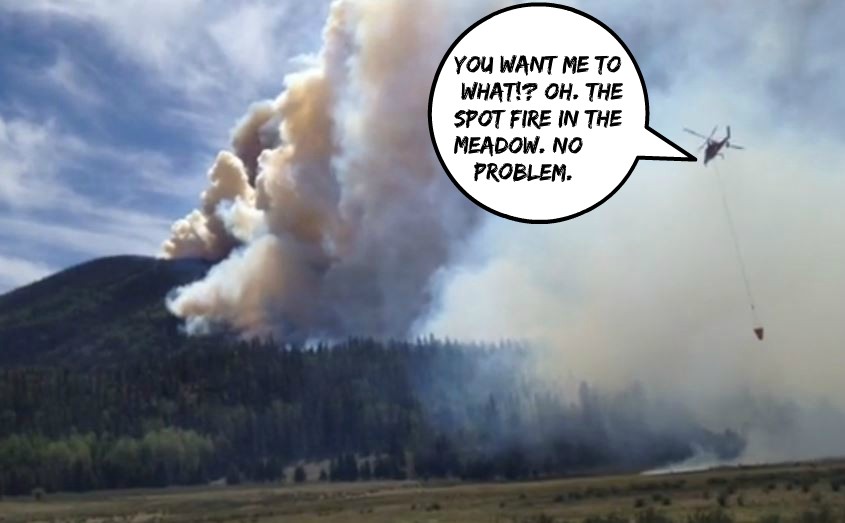
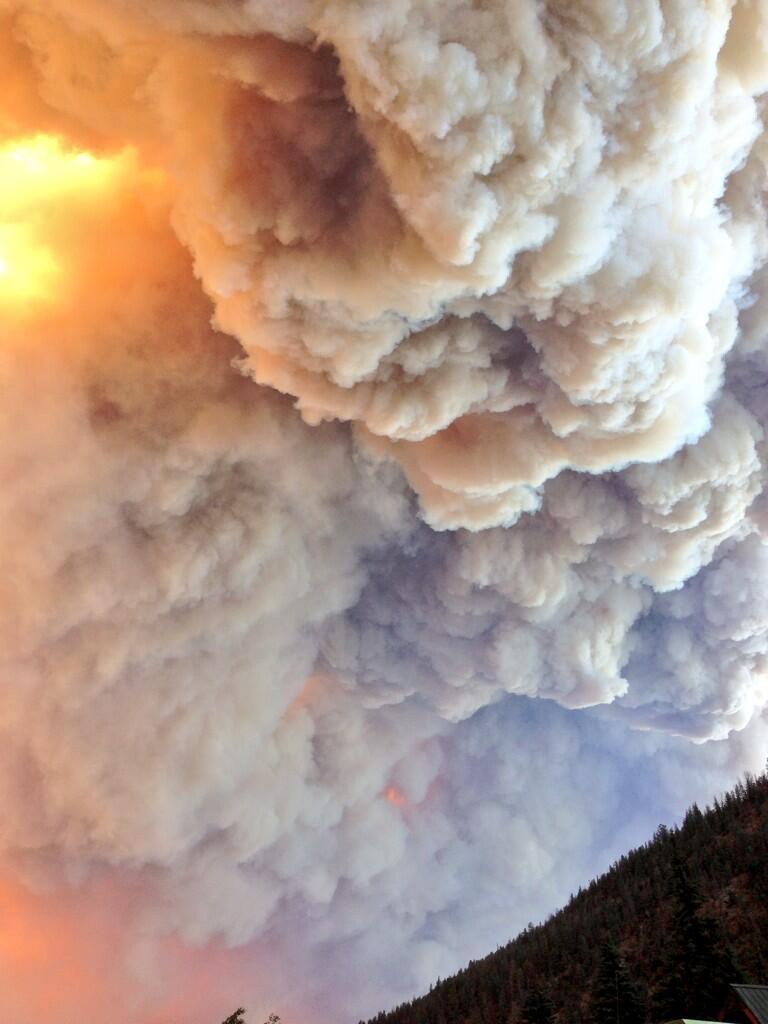
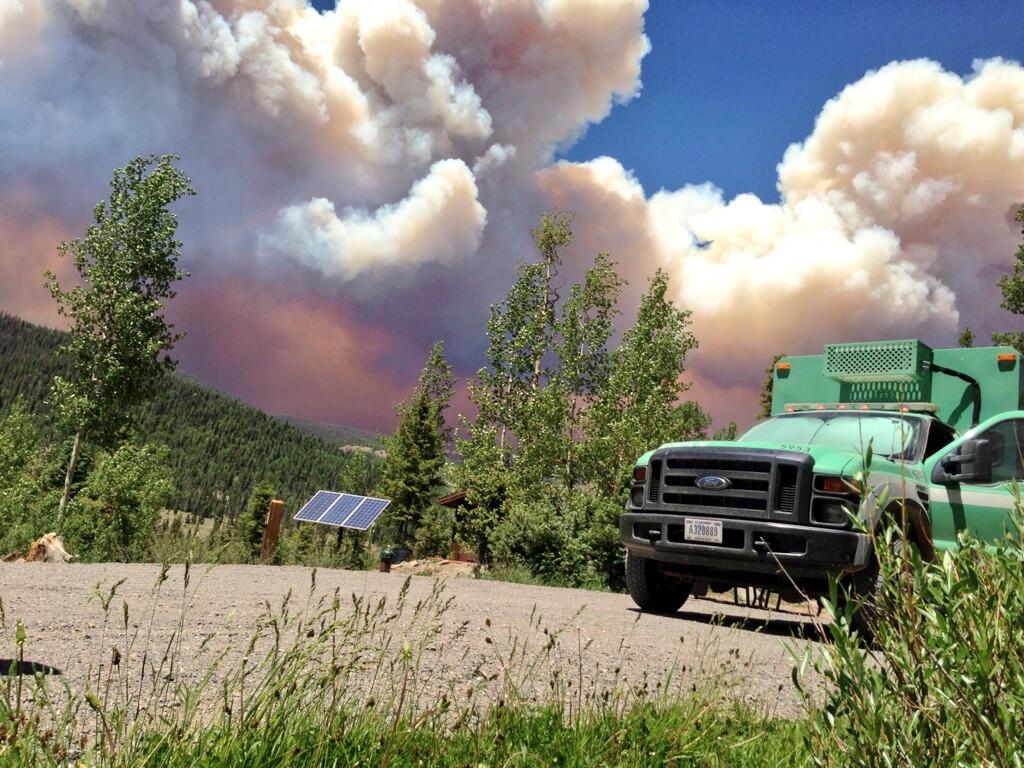
The Pine Crest wildfire near Columbus, Montana burned two homes this weekend and forced dozens of residents to evacuate, the Billings-Gazette reported on Sunday.
The fire started around 1 p.m. on Saturday five miles west of Columbus, which is west of Billings. As of Monday morning it had burned 3,000 acres and was 10 percent contained on Sunday night. Three helicopters fought the fire along with 98 firefighters, according to the Billings-Gazette. InciWeb reports show that one firefighter was injured.
A subdivision was expected to remain on evacuation until Monday morning, when the Columbus Fire Department planned to host a public meeting. The fire’s cause is still under investigation, according to InciWeb.
Another Montana fire near Red Lodge briefly shut down a local ski area on Saturday. The West Fork fire was 20 percent contained at 400 acres as of Saturday night. In a post on its Facebook page, Red Lodge Fire Rescue said the fire ignited when a days-old controlled burn rekindled.
“The periods of warm chinook flow during this time melted snow accumulations over all but the highest elevations east of the Continental Divide in Montana, and dried fine fuels enough to allow sporadic grass and brush fire activity,” the report said. “This is not an unusual occurrence as these warm dry periods in winter occur most years to some degree.”
Matt Johnson shot this time lapse photography of scenes in the southern Colorado mountains, plus smoke columns from the Windy Pass, West Fork, and Papoose fires. All of the footage is beautiful, but in case you’re wondering, the fire scenes begin at 1:55.
Mr. Johnson’s description:
Colorado is currently experiencing some of the largest wildfires in the state’s history. In July, I visited the Bruce Spruce Ranch a little ways outside of Pagosa Springs and watched as the Windy Pass, West Fork, and Papoose wildfires burned thousands of acres of forest. I have never seen such a powerful event up close like this before, it was truly humbling.
Please visit http://whoismatt.com/pagosatimelapse and download this film in high definition. The video itself is 3 Gigabytes in size and looks amazing.
This video was obviously shot by a firefighter on the West Fork Complex and has some excellent images of the fire. Be sure and notice the horizontal roll vortex at 1:35.
The description of the video as it appears on Vimeo:
“One for the record books! June 13-24 2013
Started as ICT3 20 acres in the Wiminuche wilderness San Juan National Forest.Fire ran to 5,000 acres called NIMO Team. west Fork Jumped the continental divide, closed HWY 160,evacuated the town of South Fork,Got the call to get over to the Papoose fire,Evacuated town, found missing Boy Scout troop, and thanks to some solid folks we saved every house.”
We took the liberty of getting a screen grab from the video and decided that it needed a caption:
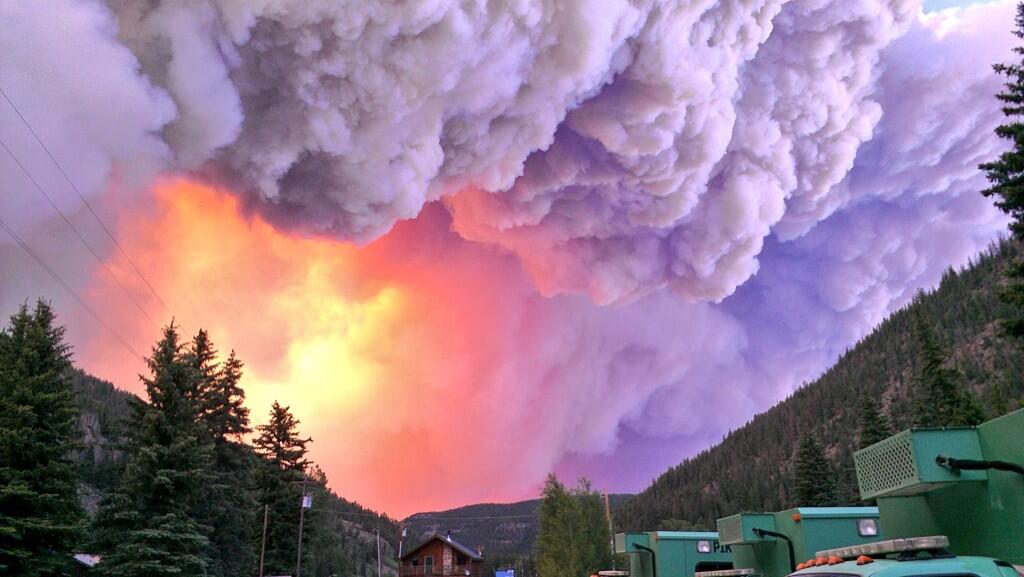
West Fork Fire, June 20, 2013 Photo by Pike Hot Shots
If you’re not keeping up with the status of the West Fork Fire in south-central Colorado which has forced the entire town of South Fork to evacuate, you have missed seeing these very impressive photos taken by the Colorado-based Pike Hotshots. If you’d like to comment on the photos or the fire, please do so at the main West Fork Fire article which is updated as conditions change.
West Fork Fire, June 20, 2013. Photo by Pike Hot Shots. West Fork Fire, June 20, 2013. Photo by Pike Hot Shots.
Distribution of smoke from wildfires at 10 a.m. MDT, June 20, 2013
As you can see in the map above which represents the distribution of smoke from wildfires, residents in Kansas are being exposed to what to them is probably surprisingly high levels of smoke. I believe the Silver Fire in southwest New Mexico can be blamed for a large share of the smoke, in addition to four large fires in Mexico that are 15 to 60 miles south of the border. The West Fork Complex in southern Colorado which is a “confine/control” fire is also becoming a major smoke contributor, and could continue to maintain that status for weeks or months.
For the last several days the weather has been in favor of the firefighters. Saturday brought rain over most of the Complex, with accumulations of 0.02 to 0.20 inches, however in some areas it did not penetrate tree canopies in areas with heavy timber. Smoke prevented most aerial firefighting Saturday but helicopters and air tankers will be in the air Sunday if they are needed and weather permits. Thunderstorms are in the forecast for the next few days. Winds on Sunday will be out of the Northwest at 5-15 mph, with a 60% chance of rain actually hitting the ground.
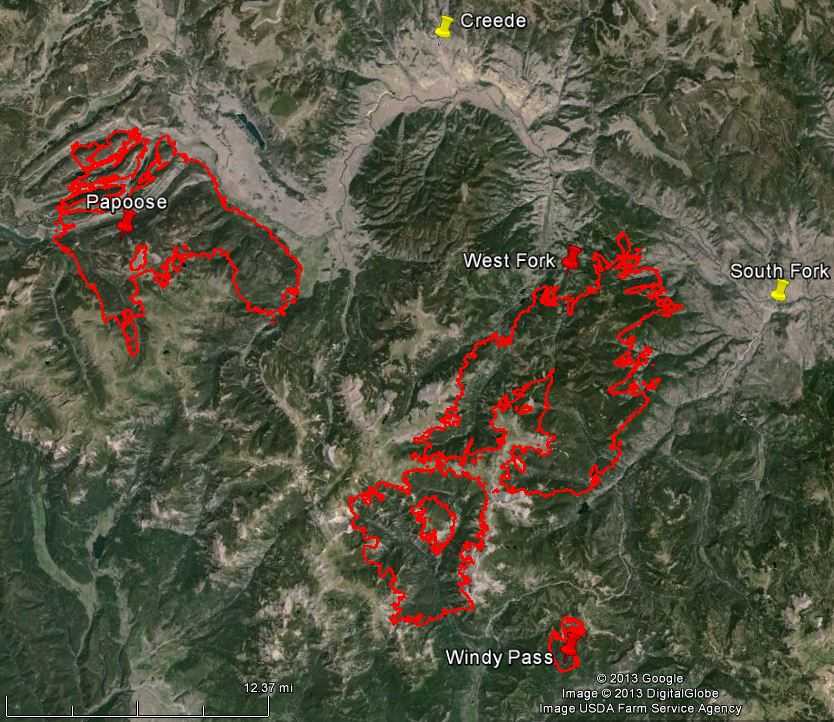
The Incident Management Team reports the fire is two percent contained and the three fires in the complex have burned 95,775 acres: Windy Pass 1,415, Papoose 34,836, and West Fork 59,524 acres.
Resources on the fire include 8 Type 1 hand crews, 20 Type 2 hand crews, 109 engines, 5 dozers, and 11 water tenders, for a total of 1,502 personnel.
****
(UPDATE at 9:20 a.m. MDT, June 28, 2013)
Map of West Fork Complex, 12:01 June 28, 2013 (click to enlarge) East side of Papoose Fire, looking NE, 12:01 June 28, 2013 (click to enlarge)
The Papoose Fire, pushed by 30 to 40 mph northwest winds out of a thunderstorm, ran for about four miles on the east side Thursday, southwest of Antelope Park. Adding approximately 6,000 acres, it became established in Trout Creek and threatened to spread up the east side of the drainage. The fire spread through beetle-killed Englemann Spruce spotting one mile to one and a half miles ahead, according to the Incident Management Team spokesperson, who reported that firefighters burned around some structures to remove the fuel before the fire hit those areas — here were no reports that any burned.
The West Fork Fire was much quieter than the Papoose Fire, but it was somewhat active near Elk Mountain and on the southeast side.
The incident Management Team reports the three fires in the Complex have burned a total of 90,056 acres.
The weather forecast for the Antelope Park area south of Creede calls for 78 degrees, relative humidity in the mid-20s, about a 30 percent chance of thunderstorms, and winds out of the southwest at 8 to 15 mph.
****
(UPDATE at 10:50 a.m. MDT, June 27, 2013)
More information has become available about the West Fork Complex:
The Papoose Fire was active Wednesday night and moved into Crooked Creek and towards Rio Grande Dam. It moved past structures near Workman Creek along Highway 149 but there was no report of damage to structures. Firefighters worked through the night to reinforce firelines, protect structures, and conduct firing operations along Squaw Creek to remove fuels in front of the fire.
The West Fork Fire has been active on the northeast flank near Elk Mountain. Structure protection, including sprinklers, is in place along Highways 149 and 160.
Portable fire retardant plants have been set up near the Papoose Fire and on the east side of the West Fork Fire. These will be used for refilling buckets and tanks on helicopters. Dropping fire retardant will be more effective than using plain water.
Current acreage for the whole Complex: Total 83,004; Windy Pass 1,403; Papoose 26,483; West Fork 55,118.
Shortly after 9 a.m. today two military MAFFS C-130 air tankers were dispatched to the West Fork Fire from their base at Colorado Springs where another portable fire retardant base has been established.
The Incident Management Team is now putting various types of information in at least four different places: Google Drive (which I can’t get to work), Facebook, Photo Bucket, and Inciweb. Apparently this IMTeam has said goodbye to the concept of putting all information about a fire in one place, possibly due in part to the dysfunctional InciWeb.
****
(UPDATE at 7:20 a.m. MDT, June 27, 2013)
Map of heat detected by a satellite on the West Fork Complex at 11:21 p.m., June 26, 2013 (click to enlarge)
The satellite that passed over the West Fork Complex twice in the last 24 hours has not found as many heat sources as in previous days. But the instruments can only detect areas of heat that are at least 30 meters by 30 meters.
Dozers have finished constructing a fireline between the fire and the town of South Fork and fire crews are continuing to work around the structures on Highway 149. Not much other new information is available, other than the Incident Management Team reported that they held some internal meetings and briefings. The fire’s InciWeb page has not been updated since Wednesday morning.
****
(UPDATE at 10:40 p.m. MDT, June 25, 2013)
The West Fork Fire has been burning for 20 days, and on day 20 a usable map of the fire was posted on InciWeb by an Incident Management Team running the fire. And instead of placing photos of the fire on InciWeb, they are putting them on something called “Photo Bucket” under West Fork Complex, according to a message sent out by the team. In addition the IMTeam is posting some information on Facebook, “dedicated to thank yous to the firefighters working on the fire line” according to a Tweet the Information Officer published. Of course, InciWeb is virtually unusable, so they can hardly be blamed for partially abandoning it and only updating InciWeb rarely. Apparently this IMTeam has said goodbye to the concept of putting all information about a fire in one place.
As the weather moderates, the IMTeam expects the fire to become more fuel (or vegetation)-driven, rather than wind-driven as has been for the last one to two weeks. On Tuesday an increase in humidity caused the fire to spread more slowly and allowed firefighters to make more progress than they have been used to, especially on the west side.
The Papoose Fire still remains south of highway 149 and Creede has not been evacuated, in spite of reports to the contrary. One of the DC-10 air tankers dropped retardant on the west side of the fire today, at a rate of 11,600 gallons per sortie.
****
(UPDATE at 8:25 a.m. MDT, June 25 2013)
Map of West Fork, Windy Pass, and Papoose Fires, 10 p.m. MDT, June 24, 2013 (click to enlarge)
There was not much change in the perimeters of the Papoose, West Fork, and Windy Gap fires over the last 24 hours. Each of them grew a bit, but there was no major change in acreage. The West Fork Fire is still about four miles from the intersection of Highways 160 and 149.
The Incident Management Team this morning said: “Current acreage per infrared flight last night: West Fork 54,222; Papoose 23,605; Windy Pass 1,355 TOTAL for complex, 79,182” Continue reading