


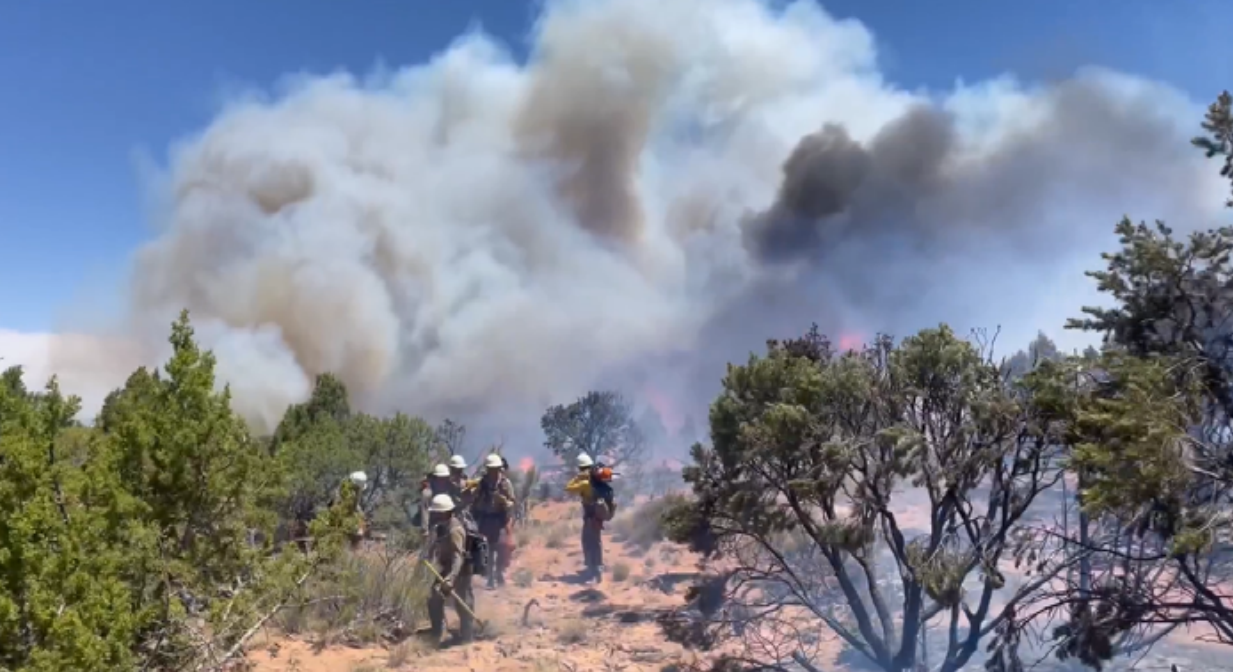
The United States Department of the Interior on Monday officially announced the launch of the “U.S. Wildland Fire Service,” an effort by the department to unify the wildfire-fighting resources of numerous agencies.
Secretary of the Interior Doug Burgum first announced the department’s intent to establish the new service in September as a continuation of President Donald Trump’s executive order in June, which directed all agencies represented by the National Interagency Fire Center to enhance their wildland firefighting capabilities. The new Service will consolidate all department sub-agencies’ wildland firefighting forces, including those in the National Park Service, Bureau of Land Management, Bureau of Indian Affairs, and U.S. Fish and Wildlife Service.
The Service already faces financial and legislative hurdles. A group of both Democratic and Republican lawmakers effectively blocked the service from being funded in a new appropriations bill package. The bills included $0 for the U.S. Wildland Fire Service, despite the Department requesting around $6.5 billion for the agency’s wildland fire operations. The lawmakers also specifically said they don’t agree with the administration’s consolidation efforts in a recent press release.
“The bill does not endorse the consolidation of federal wildland firefighting into one agency as proposed in President Trump’s budget request,” a press release from the United States Senate Committee on Appropriations’ Democratic members said. “Instead, it specifically provides funding to continue wildland firefighting using the longstanding practice of funding both the U.S. Forest Service and the Department of the Interior to allow Congress to consider legislative proposals for such a major change.”
Monday’s announcement did not mention the funding discrepancy.
The new Service’s name is also a bit of a misnomer, as the vast majority of the nation’s wildland firefighting resources won’t be included in the Service. More than two-thirds of those resources are managed by the United States Forest Service, which will be excluded from the new U.S. Wildland Fire Service. Lawmakers have officially signaled their desire for the Forest Service to eventually become part of the Wildland Fire Service, but such a consolidation would need an act of Congress.




12 Comments
I am wondering what exactly a “transition period” is going to look like and what is the point in doing this in a way that can be overturned by the next administration?
The reason for doing this is to fulfill Trump‘s executive order. And because it is Trump‘s executive order, there’s a very good chance it will be overturned by a Democratic president, along with most if not all of his executive orders. Additionally I suspect the Forest Service is resisting hard to avoid being brought into this service; it may require an act of Congress to do so, but what better time than now when Republicans control both the Senate and the House? And with regard to the transition period, there will be quite likely many unit land managers who are unhappy with the loss of control over their own fire staffs, especially if they feel the new organization leaves them more vulnerable to wildfires. The lack of funds in fiscal years 26 and 27 specifically for the new service is especially revealing in terms of the longevity of this concept, or the lack of it.
The Wildland Fire Service is not a panacea for all our wildfire problems.
This whole effort is now a ridiculous waste of time and effort. Many of us knew by the previous letter of intent that the US Forest Service firefighting workforce was being excluded. The USFS political engine was never going to let this happen. This whole effort was just the same BS, different year.
Why does anyone think that consolidating the Interior Agencies only was going to be anymore efficient? They are already managed and utilized as consolidated resources by the National Interagency Fire Center now. This was the time to consolidate ALL firefighting agencies now.
As a result of this debacle, nothing will ever change! Financing and treatment of employees will remain different. Policies will remain the same but different between the two Agencies and there will always be some reason by Line Officers, Executive Managers and politicians not to consolidate all.
What a wasted effort!!!!!
L. Briggs
After 35 years in Wildland Fire Management I would hope there was extensive “Prepardness” and Pre-attack planning for the upcoming Fire season that needs to be done “NOW” as it relates to Initial Attack Planning and actual Resources availability.
Although on its face it might look more efficient to consolidate all wildland firefighters in one new agency it is a bad idea for several reasons. One of the main jobs of wildland firefighters is fire management, not just suppression. Having firefighters who are tied to a specific piece of public land allows them to get familiar with the landscapes, fuel types, weather patterns and fire history of their public land unit. While it’s true that we have effective fire modules that travel widely to help out on prescribed and wild fires, it’s usually the local wildland firefighters professionals who have the knowledge to write the prescriptions and help line out the visiting modules when they arrive. Secondly, with FS budgets allocating the vast majority of funding to fire, there are insufficient funds to do recreation, silviculture, range, wildlife projects on most National Forests. With locally directed wildland firefighters crews we are able to accomplish much of this important work when fire season is slow. This still allows plenty of time for wildland fire training, details, and fire assignments. If all wildland firefighters crews are united in one big agency it will decimate the USFS ability to accomplish important forest management work including prescribed fire.
I think you are quite right, and a major issue with consolidation of Interior agency fire staff into a DOI level organization will be how unit managers access DOI fire staff for both fire and non-fire work, as you line out. The National Biological Service was mentioned in an earlier post as an example of this type of consolidation, in that case of agency scientists during the Clinton administration. Unit managers and staff were often unhappy with this new arrangement, for, among other things, the loss of access to research personnel with local knowledge of conditions and issues. I wonder if the first year will be mostly cosmetic, with fire season approaching and little in the way of a published plan about the mechanics of the “transition,” including administrative issues already mentioned such as interagency funding and cooperative agreements.
The trouble with fire management personnel doing recreation work when they aren’t as busy is that the most intense portion of the fire season is also the peak season for recreation. //S// Retired USFS Recreation Manager
I completely agree Steve. We as wildland firefighters do it all; build fence mend fence. Build trails, cut trees to thin or prepare for prescribed fire. Do some research for fish and other biologists. Wildland Firefighters are MacGyver’s of the trade, we can weld, build and maintain the facilities that the USFS owns.
What if there are no fires or a slow season, do fire folks just sit around and do nothing??
This makes me wonder about the Admim/ support staff. I work for a smaller federal agency where Fire is supported by non- Fire administrative staff. Payroll, travel and budget are done by people who do not work directly for fire and are paid through other programs. I know that the few administrative staff paid through the Fire program will get consolidated at some point but I wonder what will happen to fill the gap left by non- fire admins who support fire?
It is time to move the U.S. Forest Service (USFS) into the Department of the Interior. Let this new wildland fire agency get a couple of years in and then transfer the USFS into Interior. The reason for this is that all natural resource/land management agencies should be in one department. The Department of Agriculture where the USFS is presently located has not done a good job overseeing the agency. One department, dedicated to land management, should be in charge of policies of all the land management agencies. There would be better interagency cooperation if all of them were in one cabinet department.
Fred, I am pretty sure (99%) the Forest Service will stay a standalone agency. Why did the Forest Service (2026) put in for an analysis before consolidation? The complexity of the Forest Service and contracts employ more than 3/4 of all fire suppression resources available in the United States of America. I don’t think combining agencies DOI and USFS will streamline things. For example, the BIA Bureau of Indian Affairs are a sovereign nation- is defined as a political entity that possesses the ultimate authority to govern itself without external interference. This concept is fundamental in international relations and law, establishing the framework for how states interact and maintain order on BIA Land, therefore they will always manage their own land, Not the United States Wildland Service. The department of the interior does not have the capacity to govern all of the fire resources in the United States. Nor do they have the framework or retention rate to sustain operations. Just wait until the next administration to put things back to the way they were normal BLM and normal USFS, before trying to consolidate and cut corners.