


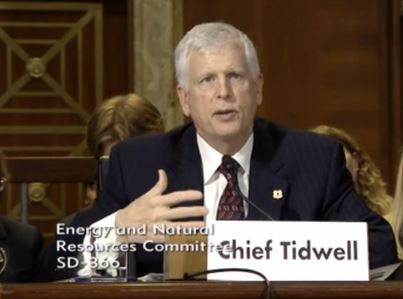
Testifying Tuesday at a hearing of the Senate Energy and Natural Resources Committee, Tom Tidwell, Chief of the U.S. Forest Service, assured the Senators that there would be an adequate number of firefighting resources available this year.
In spite of budget reductions that will cut 500 firefighters and up to 75 engines from his agency, Chief Tidwell said:
We will have the resources we need.
He said the Forest Service will rely on call-when-needed contracts for air tankers to fight wildfires, but said when they are activated they will cost “one-and-a-half to two-times” more than exclusive use contracts for air tankers that are on duty six days a week.
According to a March 22 report in the Durango Herald, U.S. Agriculture Secretary Tom Vilsack, in a letter written to Senator Mark Udall of Colorado, said contracts will be awarded “soon” for seven next-generation air tankers. Secretary Vilsack was responding to a letter Senator Udall sent to the Secretary in January requesting an update on the modernization of the federal air tanker fleet.
The U.S. Forest Service first issued a solicitation for next-generation air tankers 503 days ago but no contracts have been signed. They were almost awarded last summer but were held up by protests filed by two unsuccessful bidders. The solicitation was reissued in October of 2012 but no results have been announced.
During the second half of the western fire season last year, there were between 9 and 11 large air tankers on exclusive use contracts, down from 44 in 2002. If the USFS awards contracts for 7 next-generation air tankers, adding to the 9 Korean War vintage legacy air tankers, the agency may supplement the total with up to 8 old CV-580 air tankers if they are available from Canada and the state of Alaska. In addition, 8 military C-130s may be accessed if they are available and needed.







