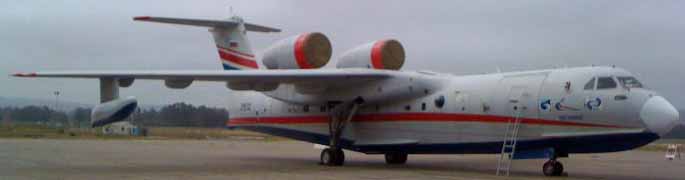
Randall F. Stephens is reporting on his Fireplanes blog that the representatives from U.S. Forest Service are in Russia conducting tests of the Russian-built BE-200 amphibious air tanker. The web site has some posts from David Baskett of International Emergency Service who has been campaigning for years to import the air tanker, and in 2010 arranged for one of the BE-200s to visit the United States. When we interviewed Mr. Baskett in February he told us that in about three months the BE-200 was going to be tested to determine if it meets the criteria established by the Interagency Air Tanker Board (IATB). His plan is to purchase 10 of the aircraft and lease them to air tanker operators in the United States.
Apparently the manufacturer of the aircraft, Beriev, is covering the costs for two USFS employees to travel to Taganro, Russia the home base of the Beriev company, to conduct the first phase of the evaluation, lasting for 10 days. The final phase will be conducted in late summer.
Here is an excerpt from the Fireplanes blog, which in this case was written by Mr. Baskett:
First-Phase test criteria required putting the 90,000 pound airplane on special ramps for static flow tests and three days of flight testing to include demonstrations of the very effective Russian fire fighting “salvo” tactic onto an instrumented grid with 100 data points.
The 30 – day Phase II test program is scheduled for late this summer and will include the use of the U.S. Forest Service standard retardant flown over and then dropped on about 3,000 data collection points.
Preliminary Phase 1 test results indicate that the BE 200 passed the Interagency Airtanker Board (IAB) criteria for scoopers, heavily used in Europe and Canada, which are likely to see more service in fighting US fires.
The estimated cost of a BE-200 is $30-42 million, it has a capacity of 3,000 gallons, can scoop water or be filled with retardant at an airport, cruises at 348 mph, and is powered by two jet engines.
The most difficult obstacle confronting Mr. Baskett and Beriev may not be the air tanker tests, but obtaining certification from the U.S. Federal Aviation Administration, which could take years.
This provides us another excuse to post this impressive 7-second video of a BE-200 dropping on a fire in Russia: