


New regulations will require employers in Washington State to protect outdoor workers from wildfire smoke. KING5 News reported that the new regulations will take effect next month, making Washington the third state to establish year-round smoke protections for people who work outdoors. California and Oregon were the first two states to enact regulations.
“Wildfire smoke events have continued to happen in Washington state over the last five-plus years, seeming to be very consistent throughout the state each summer,” said Ryan Allen, senior program manager for the Division of Occupational Safety and Health (DOSH) at the Washington State Department of Labor and Industries.
Wildfire smoke can cause short and long-term health problems. “Our primary pollutant of impact is the PM2.5,” Allen said. “It can get into the small recesses of your lungs and start causing damage within the lung itself.”
Starting in January the department will be enforcing year-round workplace protections for those who work outdoors in Washington. The primary petitioner in this case was the United Farm Workers Union; the initiative was advocated primarily by the community of agricultural workers. Emergency rules were enacted in several states during smoky conditions, but now the rule in Washington will be in effect all year round.
Efforts that employers must make during smoky conditions range based on air quality, and they include providing respiratory protection, requiring N95 masks, and requiring immediate medical attention and relocating the person to clean air when experiencing symptoms of smoke exposure.
Source NM reported that a study published in the American Journal of Public Health found that 87 percent of Americans experienced more days of heavy smoke in 2021 than they had in 2011. The change was marked east of the Mississippi River in states including New Jersey, New York, Ohio, and Pennsylvania — and Western states including Arizona, California, Colorado, and Washington. Eastern and Midwestern states this year were subjected to far more smoke than usual from the record-breaking fires in Canada.
Wildfire smoke contains an unpredictable mix of vaporized chemicals and microscopic particles that can enter the bloodstream when inhaled. The dangers have increased from the days of “forest fires” burning mostly trees and other vegetation; wildland/urban interface fires now often include smoke from burning plastics, construction materials, vehicles, outdoor equipment, and other hazardous fuels.
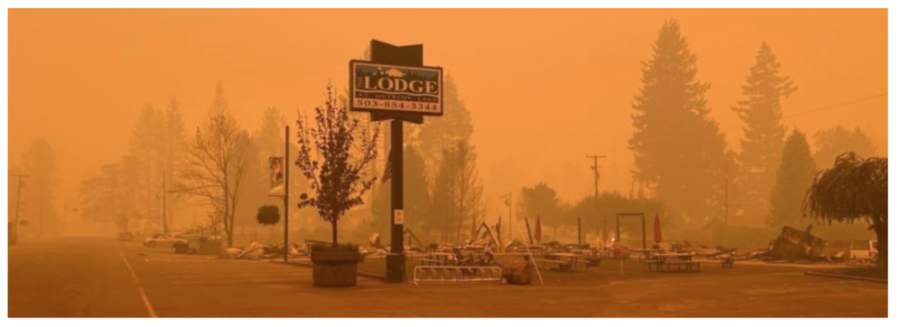 Dense smoke from the 2020 Beachie Creek Fire in Oregon. Inciweb photo.
Even at low levels, pollution from wildfire smoke can irritate the eyes and respiratory tracts of particularly sensitive people including children, older adults, and those with preexisting respiratory or cardiovascular conditions. At higher levels, pollutants in smoke can cause heart attacks and damage lung function.





